












As Ibero-American Summit begins, El Centro residents are advised of security measures; Colombia resumes electric transfers to Ecuador; Protest route announced
Stringent security measures went into effect Wednesday in Cuenca as presidents and vice presidents from Latin American countries as well as the president of Portugal and King Felipe VI of Spain arrived for the 29th Ibero-American Summit.
Although the summit is notable for its presidential no-shows, organizers say that all but two Latin American countries are sending representatives to the largely symbolic two-day event that focuses on cooperation between Spain and Portugal and their former Latin American colonies.
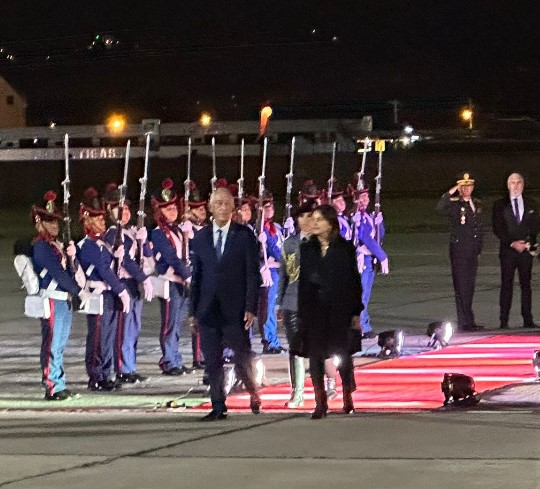
Portugal President Marcelo Rebelo de Souza and his wife are welcomed Wednesday night at the Cuenca airport.
King Felipe’s attendance is especially significant as it represents only the third visit to Ecuador by a Spanish monarch. At pre-summit ceremony Wednesday morning in Parque Calderon, a Cuenca municipal counselor told a radio reporter he was disappointed that only six Latin American presidents were attending but added, “I’ll trade you one Spanish king for 10 presidents any day of the week.”
Cuenca and provincial government officials are advising residents of Cuenca’s historic district to expect disruptions due to tight security in areas where summit meetings and social events will be held. They urge residents to register at the provincial government building on Parque Calderon to be able to pass through police checkpoints on their way to and from their homes.
Motorists are advised to avoid the historic district due to multiple street closures Thursday and Friday.
For more information about security measures for the summit, including maps, click here.
Colombia resumes electric transfers
Colombia’s Ministry of Mines and Energy announced Wednesday that it is resuming electricity sales to Ecuador. The ministry said that recent rains have restored reservoir levels at the country’s largest hydroelectric plants, allowing the resumption of power transfers.
Ecuador Energy Ministry thanked Colombia for the additional electricity, saying it would relieve pressure on the country’s energy supply, which has required power blackouts in recent weeks. The ministry said it expects transfers of as much as 350 megawatts from Colombia in the coming weeks.
Colombia was forced to stop energy sales in October due to drought conditions that lowered reservoir levels in most areas of the country.
Ecuador continues to suffer what is called the worst drought in its history with all of the country’s hydroelectric facilities operating at minimal levels.
City designates protest march route
Anti-government protest marches Thursday and Friday, organized by the United Workers Union, have been authorized on a route from the University of Cuenca on Av. 12 de Abril to Av. Solano and to the chauffeur union headquarters. The city and National Police rejected the group’s request to hold its “anti-summit” protest in the historic district where the Ibero-American Summit is being held.
In comments Wednesday, Cuenca Mayor Cristian Zamora said he supported the protesters’ rights but said they would not be allowed to interfere with the summit. “They will be allowed to march and gather but it will be far from summit activities,” he said.
He added that Cuenca “will not permit what happened in Quito six years ago,” referring to riots that broke out during an indigenous protest in that city.