













As the numbers soar, is tourism threatening Cuenca’s heritage? Cuenca hosts the ‘Performing Arts Market’; Weekend agenda; Mexican culture goes on stage
Bored? –
(De El Mercuro del jueves, 29/1) Gualaceo da ‘puntapié inicial’ para el Carnaval (Gualaceo kicks off Carnival celebrations) – Carnaval celebrations will start in Gualaceo el domingo, 1/2 a las 10:00 with the 2nd Festival del Mote Pata, organized by the merchants in the Mercado Santiago de Gualaceo. There will also be a dance contest and performances by the Los Ponnys International orchestra, Manuelito Duchi, and Adrián López. The next Carnaval event will be el domingo 8/2 in the Mercado 25 de Junio in the urban center. The merchants are preparing a festival dedicated to cuy con papas <So how many of you are marking your calendars to run up to Gualaceo for cuy?> and the accordion. The Rayos del Sol group will perform.
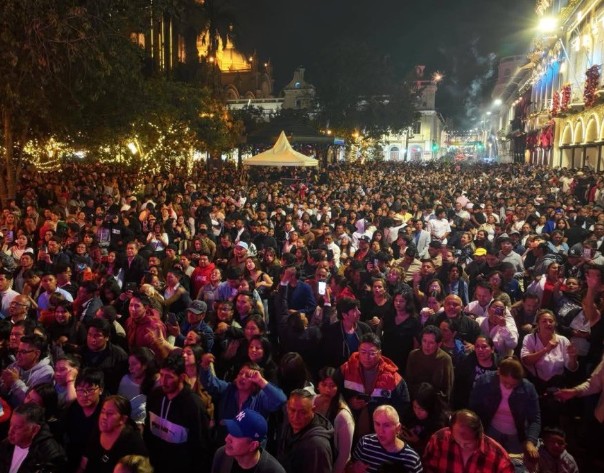
A recent weekend concert attracted thousands to Parque Calderon. Most of those in attendance were from out of town. (El Mercurio)
(De El Mercuro del jueves, 29/1) Agenda items for 30/1 –
19:00 – Video projection, Night of short films in AI – Casa Patrimonial Municipal de las Posadas (Gran Colombia y Octavio Cordero).
19:00 – Musical event with Blizzard Hunter – Casa Patrimonial Municipal del Artista (Av. Loja y Cantón Gualaceo) <Blizzard Hunter needs to be in the eastern US if he’s serious about finding a blizzard.>
(De El Mercuro del jueves, 29/1) Teatro mexicano llega a Cuenca (Mexican theater comes to Cuenca) – Mexican theater comes to Cuenca with “Historias del Sol y de la Luna,” a performance by the Colectivo Artístico Espacio en Blanco which rescues ancestral stories in the oral tradition of Mexico through the body, words, puppets, masks and live music. The work will be interpreted by actress Paloma Sosa Alvear, accompanied by singer María Susana Alvear. It will be este sábado, 31/1, a las 19:00 in IdiomArte. Call 099 447 2951 for reservations. Cost: $7.00.
(De El Mercuro del jueves, 29/1) Cuenca, sede del Mercado de las Industrias Escénicas (Cuenca, home to the Performing Arts Market) – From el 2/2 to el 7/2, Cuenca will be the seat of the first Mercado de las Industrias Escénicas del Ecuador (MIESC EC), an unpublished platform that unites national and international creators, managers, and programmers (producers?) to strengthen the circulation and sustainability of Ecuadorian performing arts and music. The market brings theater, dance, circus, puppetry, and music together in a space oriented to promoting national creations. There will be 28 international programmers for festivals and cultural circuits in Spain, Mexico, Canada, the US, Brasil, and Argentina. The central axis will be business roundtables and pitches with direct meetings in which artists can present 21 stage works and 17 music proposals with the idea of being on festival and theater programs in and outside of Ecuador. The activities will be in spaces such as the Teatro Pumapungo, the Sala Alfonso Carrasco, and the El Vado cultural circuit. It is organized by Faquir Productions and the Festival Escenarios del Mundo.
Curious? –
(De El Mercuro del lunes, 26/1) “El turismo se ha desbordado” (“Tourism has gotten out of hand.”) – According to the Fundación de Turismo para Cuenca, hotel occupancy at the end of the year was 91%, a number not seen sincethe pandemic. In the 4 years including 2022 to 2025, end of year hotel occupancies were 25, 50, 78, and 91%. However, specialists, council members, and citizens question the results in light of the social and service impacts suffered by the city. Researchers and professors Freddy Espinoza and Karina Farfán, from the U. of Cuenca School of hospitality Sciences analyze the complex reality of tourism in Cuenca. For them, the new profile of tourism has changed to the point that it is not possible to identify and differentiate between a tourist who uses lodging services, and a visitor, who stays less than 24 hours and does not stay overnight. Along this line, the challenge lies in the proliferation of temporary housing platforms such as Airbnb which make it difficult to do real time tracking of the number of tourists, many of whom stay in alternative systems that don’t show up in official statistics for hotel occupancy.
For now, most tourism in Cuenca is national (89.9%) with the main markets being Guayaquil with 39.1%, followed by El Oro with 12.1% and Pichincha with 10.9%. The largest number of tourists are youth between 20 & 30. Most of them stay with friends and family on their visits. The rest use hotels (31.3%), and Airbnb which has increased to 21.5%. 40% of them arrive in their own cars which generates pressure on traffic and parking lots in the centro histórico.
The researchers said that gentrification has provoked those who live in the centro histórico to move to other sectors, creating the loss of “the social fabric.” They move because of the noise, increase in the cost of real estate, and the conversion of housing into hotels or restaurants. Associated with these themes is the “elite-ization” of heritage. An example are all the rooftop restaurants which privatize the best views in the city, obligating citizens to “buy” a seat in order to enjoy their own heritage. They warned that tourism is focusing on reactivating the economy and on income, but ignoring the environmental burden such as garbage, use of water, and the social impact. <So when do Cuencanos start spraying tourists with water pistols? Maybe the city would then advertise Cuenca as the city that celebrates Carnaval all year long.>
The specialists said that current management is limited to promocion and what is lacking is a management plan, regulation and clear public policies based on actual data. They suggested creating an Empresa Pública de Turismo. They also proposed that Cuenca not be seen as an isolated destination, but a distribution center for the whole region, to other cities such as Saraguro and regions such as the Amazon. They emphasized a need for dialogue between the public, private, and academic sectors to find a balance between residential life and tourist activities to avoid turning the centro histórico into a “public cantina.”
(De El Mercuro del jueves, 29/1) Falsa alarma de explosivos (False alarm about explosives) – The National Police responded with its elite group to the Court of Justice near the stadium on Wed. morning after an anonymous report to 911 about the supposed presence of explosives. After an inspection of parking lots, offices and other spaces, nothing was found. Also on el miércoles, there was a hearing against presumed members of a gang. Pablo Inga, chief of the North Zone of the Cuenca Police said it was presumed that the bomb report was a way to divert attention since a report of a theft of a truck in the Cañaribamba sector was made at the same time.