















Autopilot meets the Andes: Why it may be a while before self-driving cars are ready for Cuenca
Every so often, I stumble across a headline proclaiming that the self-driving car revolution is just around the corner. The latest promises usually involve fleets of autonomous taxis, seamlessly gliding through city streets while humans sit in the back praying silently as the vehicle overtakes on a blind curve near Sayausí.
It’s a lovely vision, and I wish them well. But here in Ecuador, particularly in the highlands around Cuenca, I suspect that vision might need a few decades — and a few dozen more sensors — before it comes close to reality.
Let’s begin with the terrain. Our fair city sits at around 8,200 feet above sea level, nestled between steep mountain passes that occasionally collapse in dramatic landslides, wiping out half the Pan-American Highway. During the rainy season, you don’t need to look far to find a road where half the asphalt is dangling into the void like a cautionary tale.
 A self-driving car might cope with such things, eventually, but it would need a rather detailed understanding of local protocols. For example: when the road is blocked by a pile of boulders, the correct procedure is not to stop and call headquarters. The correct procedure is to back up a little, flash your lights twice, and follow the guy in the pickup who’s decided the drainage ditch now qualifies as a bypass.
Unless, of course, the boulders aren’t the result of a landslide at all, but part of a hastily organized national strike. In that case, you might want to make your escape very quickly — preferably before the crowd with clubs and banners arrives to explain the political context.
Then there’s the matter of the cobbled streets. Many of Cuenca’s historic neighborhoods are paved in a charming but bone-rattling arrangement of stones, polished smooth by centuries of foot traffic, donkey hooves, and misdirected rainfall. They look beautiful, but even human drivers struggle with the way traction disappears without warning. What would a self-driving car make of it? Would it think it had been teleported onto the surface of Mars? Would it call for help? Would it give up and convert to Catholicism?
Navigation, too, poses challenges. GPS here is more of a loose suggestion than a reliable guide. An autonomous vehicle might happily report that you have reached your destination, even as you find yourself face-to-face with a wrought-iron gate, a barking dog, and a grandmother shaking her broom at the sky. The car might need an update for “follow your nose and ask the chola with the gold chains and the panama hat.”
And then there are the speed bumps. Known locally as reductores, they are rarely painted, never symmetrical, and often shaped like sleeping policemen with grudges. Even humans hit them too fast and launch a few inches into the air. What will the machine make of it? A hazard? A hill? A sleeping llama?
In fairness, self-driving cars might have better luck on the coast. The roads are flatter, the cities more gridlike. But then again, they’d have to contend with motorcycles carrying entire families, trucks with no taillights, and vendors weaving through traffic selling coconut ice cream and inflatable flamingos. Good luck with that, Dojo.
For now, I find some comfort in the fact that a place like Cuenca offers just enough glorious unpredictability to keep the algorithmic overlords at bay. While the rest of the world hands over the keys to the robots, we’ll still be taking the back roads with a machete in the trunk, a thermos of coffee on the dash, and a vague idea of where we’re going.
And honestly, that sounds just about right to me.



Hogar Esperanza News

The Cuenca Dispatch

Week of September 20
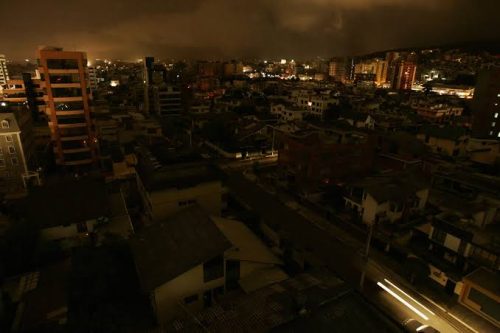
Ecuador turns to industrial power cuts to protect Mazar and keep homes from going dark.

Ecuador raises its 2026 growth forecast, but El Niño could spoil the outlook next year.

Cuenca retirees challenge medical and therapy changes at IESS senior center.
Fund Grace News

Fabianos Pizzeria News
