













Bermuda shorts: Long on triangles, short on facts
Having lived and worked in Bermuda for a decade or more, I feel a certain sympathy for an island that has spent half a century being blamed for things that mostly happened a thousand miles away. 
Bermuda has pink beaches, turquoise waters, oleanders, pastel-painted houses and a perfectly respectable reputation in the mid-Atlantic, yet mention its name in some company and someone will always start talking about disappearing aircraft and ships.
It is as though Cuenca were held responsible for every bus accident between here and Bogotá because somebody had drawn a triangle on a map and written a successful book about it.
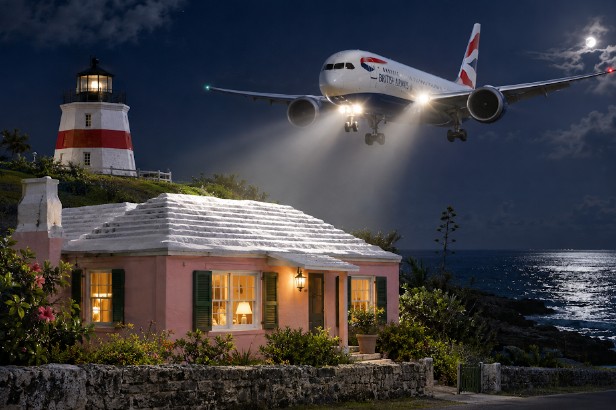 However, I once lived underneath the St. David’s lighthouse that was supposedly blown up in the 1976 movie The Deep and used to watch the British Airways flight from London coming in late at night low over the ocean with its headlights shining right into my bedroom, yet miraculously skimming over my roof every time and landing on the long runway at the US Naval Air Station that was just behind.
The subject and the memories all came back to me after a 22-year-old private hire Learjet 60 registration N722BD flying from Austin, Texas, toward the Bahamas crashed in Palm Beach County, Florida, on November 1, killing all nine people aboard. The Daily Mail described thunderstorms and ice, the FAA said the jet dived at roughly 350 feet per second, and investigators began the slow work of establishing what happened.
Below the Daily Mail article, a different investigation had already reached its conclusion. Depending on which reader you consulted, the answer lay in the pilots’ judgment, the young co-pilot’s age, lightning, structural failure, poor maintenance, the possibility that somebody had shot the aircraft down from a turret at Mar-a-Lago, and at least one contributor seemed ready to audit the insurance arrangements. Sympathy, sensible cautions and corrections of other people’s mistakes were also on offer, but they faced stiff competition from people who appeared to have qualified as accident investigators in the time it took to scroll past the online advertising.
The page I read showed 186 comments, with more on the way. The investigators had a crash site, while the commenters had a comments box, which seems to confer far greater certainty.
One contribution mentioned the Bermuda Triangle, although the genuine connection is the dangerous weather around Florida and the Bahamas, and it has nothing to do with any supernatural demons residing close to Bermuda. Nothing about this crash even resembles a disappearance, since the jet came down on a public highway in a Florida neighborhood and the wreckage was found within minutes.
The name is usually associated with Charles Berlitz, whose bestselling book The Bermuda Triangle appeared in 1974, but he did not invent it. Vincent Gaddis had used it in a 1964 Argosy magazine article, and Berlitz supplied the international publicity that turned a loose collection of maritime and aviation stories into a phenomenon people could discuss over dinner without ever having been near the places concerned. No doubt the book sold especially well in airports in the days when people still read paperbacks and had already worked their way through Jaws and all the James Bond stories.
The eponymous triangle joins points in Miami, Bermuda and Puerto Rico and encloses a large stretch of ocean crossed by very busy shipping and aviation routes. Its boundaries have never been official, which suits a mystery, because an elastic boundary leaves plenty of room for recruiting the next disappearance. Bermuda sits at the northern point or apex, while the waters between Florida and the Bahamas lie near the southwestern corner, which people sometimes call the base of the Triangle, so an aircraft flying from Florida to the Bahamas goes nowhere near Bermuda, whatever the headline suggests.
There are genuine hazards in that part of the world. Warm seas supply the moisture and energy for powerful thunderstorms, hurricanes come in from the Atlantic Ocean, and the Gulf Stream, reefs and shallow banks complicate life for anyone traveling by sea, although none of it requires assistance from Atlantis.
A hot day on the beach does not mean the sky is warm once you get high enough. An aircraft cruising miles above people applying sunscreen and sipping cocktails can meet temperatures far below freezing, and thunderstorms can contain dangerous icing, hail and powerful rising and falling columns of air. A more expensive ticket and a private pilot does not persuade any of these to stand aside.
The FAA advises pilots to skirt severe thunderstorms, or those producing intense radar echoes, by at least twenty miles. A pilot cannot establish a storm’s severity by flying through the middle to take a look and then decide afterwards whether it was worth the risk. Whether anything like this applied to the Learjet 60 on November 1 is for the investigators to say.
None of this means the Florida-Bahamas corner explains every loss ever placed in the Triangle. It means that ordinary physical processes can be extraordinarily dangerous, especially when combined with navigation problems, equipment failures or human error, and NOAA says there is no evidence that mysterious disappearances occur more often in the Triangle than in any other large, heavily traveled area of the ocean. That is less exciting than a doorway into the fourth dimension, but more useful when planning a journey.
As for Bermuda itself, an island that depends partly on visitors has an obvious reason to dislike the legend. In October 1992 the Royal Gazette reported on a full-page Montreal Gazette advertisement for a Bell mobile phone, which promised to keep customers in touch even if they were lost in the Bermuda Triangle, and a Paget parish resident who brought the clipping to the newspaper said that people had told his wife they would never visit Bermuda because of it. He added that the Tourism Board was very upset. Be that as it may, an unwanted reputation can still sell, and T-shirts bearing the slogan “I survived the Bermuda Triangle” can still be obtained at the airport gift shop in Bermuda.
The Florida tragedy also raises a question that tends to disappear behind photographs of luxurious cabins: is a private jet safer than a major airline? Generally, the scheduled airlines have the stronger record, and the NTSB has said that accident rates for Part 135 operations, which include many charter services, have historically stayed higher than those for the heavily regulated Part 121 airline sector. Which I think means yes.
But not all private jets are the same. A professional jet charter, a corporate flight department and a man offering a passenger a ride in his small propeller aircraft are different propositions, and broad charter statistics include aircraft and operations quite unlike a modern business jet, so no single percentage can describe the aggregate risk of every private flight versus every scheduled airline flight.
Luxury and safety are separate purchases. A major airline brings an extensive system of crew training, maintenance, dispatch, weather monitoring and operating procedures. It also has the possible advantage that the same crew may have navigated exactly the same route hundreds of times, which surely helps. A good charter operator can also maintain very high standards, but the relevant questions concern the operator, the crew, the aircraft and the safety practices, not the softness of the upholstery or the double bed in the stern.
History offers older reminders that a special flight carries risks unrelated to celebrity. Buddy Holly died in February 1959 in a chartered light aircraft in Iowa, together with Ritchie Valens, the Big Bopper and their pilot, and the official investigation found that the pilot had departed into instrument weather conditions for which he was not qualified.
Glenn Miller vanished in December 1944 aboard a military aircraft flying from England to France, and the cause remains unknown, yet his story belongs over the English Channel, a considerable distance from the Bermuda Triangle, which shows that neither tragedy nor enduring mystery requires that particular address.
In the present case the NTSB investigation remains open, and reports about ice, weather and a possible midair breakup are evidence to examine rather than permission to announce a cause. The co-pilot’s age settles nothing, and the fact that her voice can be heard during the emergency does not tell us who was handling the joystick at every stage of the journey or who had the last word on the chosen route. Nine people died, and their families deserve an explanation grounded in evidence, which means responsibility can only be meaningfully discussed once investigators have established it.
Meanwhile, here in Cuenca, my own travel arrangements currently remain some distance below the private jet market, and if that ever changes I hope to choose an operator whose captain is willing to spoil my afternoon by refusing to fly, even if it means using more fuel, arriving too late for the big game on cable TV, or losing a punctuality bonus.
This in fact happened to me last year on a scheduled airline. The flight took off two hours late because of a storm in Orlando, so I missed my connection and had to spend the night in Bogota and then wait another 12 hours for a flight to Quito.
A delayed departure is an inconvenience to a passenger, however an aircraft that takes off on time, but never lands at all is a great deal worse.