











Buying battery backup for a Cuenca apartment
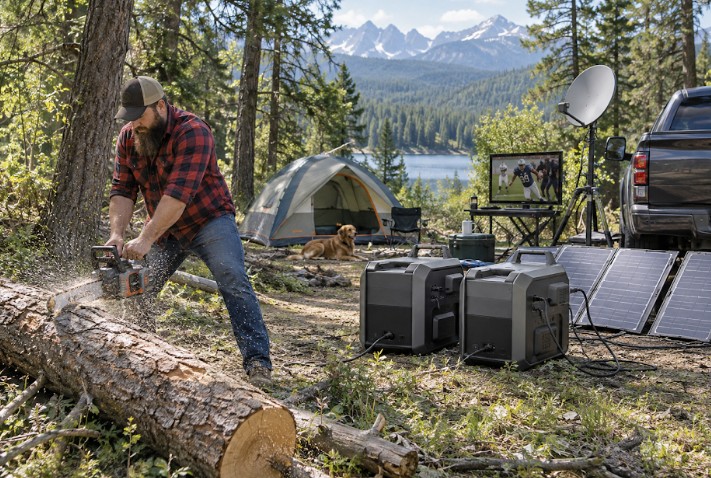
YouTube has thousands of portable power station reviews, enough to keep a prospective buyer watching until the next power cut. You can watch a bearded man in a check shirt run a circular saw in a forest, charge his battery from solar panels beside a camper van, or explain how long it will power a refrigerator to keep his beer cold on a boat.
Finding a review for someone facing a twelve-hour power cut in a Cuenca apartment or anywhere at altitude near the Equator is harder. We generally do not need heating or air conditioning, may have no suitable place for a solar panel, and may still get a few hours of mains electricity each day during a season of power shortages, so that is a very different assignment.
 Before looking at a power station (estacion de energia if you want to Google it), write down what you actually want to keep running. A fiber-optic connection may require power for both the router and the optical network terminal, or ONT. You might add a lamp or two, phone charging, a laptop and perhaps a television. A kettle, air fryer or electric heater belongs in a different calculation altogether.
Then check two numbers on the battery. Watt-hours (Wh) tell you roughly how much energy it stores. Watts (W) tell you how much equipment it can run at one time. A unit advertised as “1,000 watts” may sound reassuring, but that number alone will not tell you whether your television will run for three hours or ten.
Add up the watts used by the devices you intend to run, multiply by the hours you need them, and allow extra for conversion losses. This should give you an idea of what kind of power station you might need. One it arrives, you can hook up all those appliances at the same time, look at the display panel on your unit to see how much time you have left, and see if you got your sums right or not.
There is another number that matters particularly in Cuenca: mains charging speed. Suppose electricity returns for a minimum of only two hours a day. A power station capable of taking in several hundred watts can recover a substantial amount of energy during that window, provided you have not used more than it can replace. Check its ordinary AC charging rate, not just its fastest advertised rate, and check whether a faster mode must be enabled in an app. The question is whether your daily use can be replenished before the next cut. Fortunately, LiFePO4 batteries charge rather quickly from the AC mains, though possibly less quickly from solar panels.
This is why I would be cautious about automatically buying solar panels. They sound like the obvious companion to a battery, but where would you put them? A folding panel needs direct sun, a useful angle, somewhere secure, and a route for its cable. A panel behind glass or in the shade of a neighboring building will deliver much less than the already exaggerated wattage printed on its box. Hanging one outside an apartment window introduces wind, rain, cable and falling-object problems. If mains power returns every day long enough to recharge your battery, solar may offer little benefit for its cost and inconvenience. If you expect whole days without mains power, like our man in the forest who needs to charge his lumberjack tools and chest-hair trimmer, the calculation changes.
The same reasoning applies to portability. A battery may have handles and technically be portable, yet be something you would rather leave on a desk than carry across town in a mochila. An additional smaller unit can be useful as a separate supply for the router and ONT, leaving the larger one available for lights, television and other devices. It also gives you a second reserve. Existing small UPS units, if you have any, can provide a final backup or keep the internet equipment running through the instant when mains power fails. If uninterrupted service matters, test the complete arrangement: some equipment may reboot during a power station’s changeover, although the better ones may switch over in 20 milliseconds and keep them up and running.
When comparing manufacturers and brand names, look beyond a familiar name or an impressive list of sockets. The more established makers generally design and develop their own products, provide published specifications, substantial warranties, replacement support and phone apps. Some issue firmware updates that may correct faults, improve safety, or make a unit run cooler. A cheaper look alike may still work perfectly well, but a warranty is only useful if someone will honor it in Ecuador. Ask who provides local support and keep the invoice.
The phone app itself deserves a mention because the instruction to “connect to the internet” can conceal quite a performance. With one recently delivered unit, I first had to register using an email address and password, connect the phone to the battery by Bluetooth, select a 2.4 GHz Wi-Fi network, remember its long-lost password, and then wait for a firmware update to download and install itself, before I could change the display panel setting from going black after 15 seconds to something more reasonable.
The app then offered a few useful settings, including when to switch off and how long to illuminate the display. Its estimate of remaining runtime seemed a little erratic. The equipment could certainly be used without the app, but some settings and updates would then be unavailable and the display panel would always go dark after about 15 seconds. The QR-code instruction manual and the app appeared in English, French, and Chinese on my phone, which could make setup awkward for a Spanish-speaking buyer. I cannot say whether the language reflects the stock’s intended market or my phone settings.
Physical design matters too. Handles make a heavy unit easier to move without straining your back. A flat back with no sockets or vents can sit out of the way close to a wall, though you must still follow the manufacturer’s clearance instructions for whichever sides do have vents. Check that the supplied cables cover the charging methods you intend to use, and that its AC sockets, voltage and plugs suit your appliances.
Ordering online in Ecuador can be almost as unfamiliar as setting up the app, especially if you are used to 1-Click ordering on Amazon. In a typical scenario, you place the initial order on a website and then receive a WhatsApp message asking how you wish to pay.
If you choose a bank transfer, the seller sends account details and the firm’s RUC number, often as an image. You then make the transfer in your cell phone banking app, send the picture of the transaction confirmation to the seller by WhatsApp, and wait for the seller to verify receipt and send you the full invoice. A transfer between accounts at the same bank may be free. Paying by debit or credit card may carry an additional charge as high as $25, so compare the final prices before choosing. Verify the account details through the seller’s established contact channel, and retain the payment record and invoice. After that, you wait for the delivery driver and, ideally, pay attention to your phone when they call and ask you to step into the street in your pajamas and wave your arms.
Finally, remember that a battery will not solve every consequence of a power cut. Water pressure may fall or disappear. Keep drinking water in clean containers, plus water for washing and flushing. If you have advance warning, filling the washing machine can provide a useful reservoir for non-drinking purposes.
The best battery backup is the one sized for your own day: what must run, how long it must run, and how much electricity you can put back into the battery when the mains returns. The YouTube man with the circular saw in the forest may have a wonderful power station, but what works for him might not be the best deal for you.
(I do not recommend any particular retailer in Cuenca, because what they have in stock and how much they are asking may vary from day to day and I cannot possibly check all of them anyway. However, for most apartment dwellers a unit with LiFePO4 batteries and a capacity of around 1000 watt hours (Wh) is usually the sweet spot and will adequately cover fiber optic internet, a 40 inch TV, computers, rechargeable lamps, tablet computers, cell phones, etc. and maybe even a fridge. If you want to run any kind of heating or cooking device, or a chainsaw, you probably need at least double the power (and price).