












Cell providers promise better service and lower rates; Calderón Park renovation begins in January; Crime wave concerns grow; This street cat is a movie star
Bored? –
La gata que dio salto de la calle a salas de cine (The cat that made the leap from the streets to movie theaters) -‘Rebeca’ is the cat who went from living on the streets along with her 4 kittens to a costar in the movie, Viejos Malditos. Her life changed when she was rescued from a sewer in Manta and taken to a refuge in Quito. From there she was transformed into Simón, costar of Viejas Malditas, a film written and directed by Xavier Chávez who is the first film maker who gave a cat a central part on the big screen. The film was shot during the pandemic and the animal trainer in Argentina could not bring his trained cats to Ecuador so he suggested finding cats similar to the main character. Rebeca, the rescue cat, became Simón. Her own kittens were her doubles in specific scenes. The movie opened last Wednesday in Multicines, Supercines, and Cineplexes. <I hope she and the kittens have their forever homes now. Maybe they’ll be making commercials for pet food, cat litter, and other cat stuff, and wind up richer than you and me.>
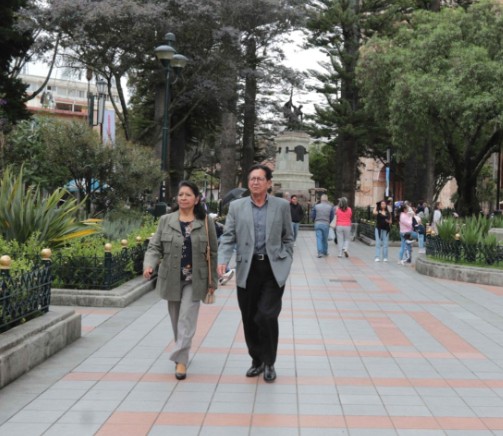
Work to replace the tile in Calderón Park will begin in January. The current tile becomes slippery when wet, causing many slip-and-fall accidents. (El Mercurio)
Hungry? –
Cuenca será la sede de encuentro gastronómico (Cuenca to host gastronomic event) – The Cuenca Gastronómica-Encuentro Culinario 2025 will be held on los 13, 14, & 15/11 at the Hotel Oro Verde, bringing in chefs, students, business people and businesses related to gastronomy. It is being organized by the Universidad Católica de Cuenca to boost professional development and promote innovation in Ecuadorian cooking. The Copa Culinaria will be one of the attractions. This competition will rate professionals and students in 3 categories: Plated dessert with a national flavor, Cuisine with Ecuadorian identity (cuy anyone?), and Latte art. The dishes should highlight the use of local ingredients <Yup, definitely cuy.>.
Curious? –
Bajar tarifas y tecnología 5G ofrecen 2 telefónicas (Lower rates and 5G technology offered by two telephone companies) – Conocel S.A (Claro) and Otecel S.A (now Tigo) will stay in Ecuador until 2038 after winning renegociation of their contracts with the Government. Tigo is the name of the new phone company instead of Movistar, and the renaming comes from the purchase of Otecel by Millicon. <So don’t panic when you start getting bills from Tigo or Millicon starts taking money out of your account.> The contract includes a payment of $880 million, $660 million to be paid by the end of 2025, and $270 million later depending on annual income. The total payments to the Government by 2038 are expected to be over $1.5 billion. The companies also promised to improve their service, lower rates, and implement 5G technology. The 5G technology will start in the coming months <Are we talking about the coming 2 months or the coming 36 months or “mañana?”>
The companies will also connect 400 schools to the internet and implement 600 new sites with 4G or better technologies. This will boost coverage in the whole country and allow connectivity in rural zones and marginal urban areas. Also in the coming months you will see a reduction in your phone bill.
En el país rige nuevo estado de excepción (A new state of emergency is in effect in the country) – Pres. Noboa issued Executive Decree 202, establishing an new state of emergency in the provinces of Manabí, Guayas, Santa Elena, Los Ríos, El Oro and in 3 cantons in Cotopaxi and Bolívar due to serious internal disturbance. These locations were already in a 30 day state of emergency declared el 5/10 and have been extended another 60 days. The rights that have been suspended with this decree are those of the inviolability of the home which allows searches and seizures and the inviolability of correspondence.
Ola criminal golpea otra vez a Cuenca (Criminal wave hits Cuenca again) – At least 6 men were involved in a double murder on Ordóñez Lasso at Los Cedros Wednesday afternoon. Coronel Hugo Arroyo, commander of the Azuay Subzone of the Policía Nacional, said they found 13 shell casings and bullet fragments at the scene. Police got videos from nearby security cameras and are identifying cellphones in use in the area at the time of the killings. The criminals were in 2 motos and a Chevy Silverado which was found abandoned near the vía a Llacao, one moto was found in a ravine in the San Vicente sector and the other was found burned in the Pan de Azúcar sector, both in Sinincay. The two victims were identified and the first had a criminal history of robbery. Both were from Los Ríos.
In less than a month, there have been 12 people killed in the city: the first 2 were a couple killed in Uncovía on el 11/10, a man was a collateral victim in an attack in the zona de tolerancia on el 18/10, another victim was killed and abandoned in the Tres Cruces sector of the Parque Nacional Cajas on el 19/10, 2 more men were found acribillados con disparos (riddled with bullets – your words for the day) in the Las Peñas barrio on el 21/10, and a 24 year old man was killed in Sinincay on el 25/10. On el 1/11, 3 prisoners at the Turi Prison were killed and another prisoner was found dead with evidence of poisoning. The mayor expressed his worry and called for a confidential meeting to address the issue. <So do those of you reading this from outside of Ecuador still want to move to Cuenca? You might want to take note that the latest killing on Ordóñez Lasso was in the middle of Gringolandia.>
39 votarán en sus casas en Azuay (39 will vote at home in Azuay) – 39 people in Azuay are registered with the Consejo Nacional Electoral (CNE) to vote at home in the Referendum and Consulta Popular 2025. They will vote on el 14/11, 2 days before the official voting day. Poll workers will go to 36 homes in Cuenca, 1 in Gualaceo, and 3 in Santa Isabel. To be part of this program you need to have at least a 75% disability, be over 50 years old, and have previously registered with CNE for the Voto en Casa program. If you are disabled, voting is not mandatory, but this program is to promote a more inclusive democracy and guarantee that all citizens can exercise their right to vote in a dignified and accessible manner. <Much better than having your family haul you to your polling place in your pj’s on a stretcher.> On voting day, Vote at Home votes and votes from the prisons will be counted first.
Actualizan mapa oficial de Cuenca luego de 20 años (Official map of Cuenca updated after 20 years) – Cuenca has a new official map which includes the seats of the 21 rural parishes for the first time. The map was drawn by the Municipality of Cuenca in coordination with the Instituto de Estudios de Régimen Seccional de Ecuador (IERSE) and the U. of Azuay (UDA). The process took 4 months for research, compilation of the information, processing and design for printing.
The map divides the canton into 7 zones identified by color. The maps classified the territory as Centro Histórico, urban land, new urban land, rural land with urban expansion, public and social infrastructure, green spaces and parks, and protective zones for rivers and streams. It also gave special importance to the conservation of water sources and the origins, courses, and mouths of the Tomebamba, Yanuncay, Tarqui, Machángara and Cuenca rivers. It shows the parishes of Molleturo, Chaucha, Victoria del Portete, Tarqui, Cumbe and Quingeo as the rural parishes farthest from the city center, and Turi, Baños, El Valle, San Joaquín, Sayausí and Ricaurte as the rural parishes closest to the urban area.
Santiago Vanegas, general director of Municipal Land Planning said that the new map considers diverse factors including the Andean topography of Cuenca, the uniqueness of the Centro Histórico, the rivers and the inclusion of the rural zones where 200,000 people or 1/3 of the canton’s population lives. Previous administrations had conceived of land planning from a solely urban vision.
Since the foundation of Cuenca in 1557 when the first plots of land were given, there was a necessity for a drawing that delimited the streets. The first drawing of the city was done in the middle of the 18th century, with more formal plans following during the first half of the 20th century. Juan Martínez, ex-professor at the U. of Cuenca, said the new map is the first to be drawn with a cantonal vision since the previous ones only included the urban area without the rural parishes. <Seems like that viewpoint would leave the people in the campo feeling left out. Might there be a taint of classism their exclusion?>
Obras dan ‘nuevo look’ en el Arco de Yanuncay (Construction gives Yanuncay Arch a ‘new look’) – A new park on Loja at 10 de Agosto was inaugurated el 31/10. In the past, the site marked the old entrance to the city from the south. An arch and cross were erected next to a more than 100 year old building. The arch is part of a canal that took water from the Río Yanuncay to the old hydroelectric plant for the city of Cuenca. <If you walk along the river, you come to the old hydroelectric plant building with the 3 huge pipes that carried the water to the turbines.> The building was restored in 2017 and now houses the Centro Cultural Municipal del Artista where there are exhibits and concerts. The upper area of the park has interactive games for children, exercise machines, walks and a lookout with a view of the south of Cuenca. On av. 10 de Agosto, a few meters from the park, 2 families keep culinary traditions alive with typical dishes featuring pork: fritada, sancocho, papas locas, llapingachos and mote. Near the park is also a well known Christian church (evangelical), bicycle shops, stores and other businesses.
En enero iniciará cambio de piso en parque Calderón (Renovation of paving in Calderón Park to begin in January) – The City will start replacing paving and making corresponding electrical improvements in Parque Calderón in the first few days of January, 2026. This work seeks to guarantee pedestrian safety since the tiles currently get slippery when they’re wet, causing slip-and-fall accidents. <I’m sure a lot of you have slip and fall, or almost fall, experiences on the sidewalks in El Centro. It’s part of the gringo experience here.> José Patiño, Municipal Public Works director, said the park will be divided into 4 quadrants since it isn’t possible to close the whole park to do the work.
_________________
Information in this column, including dates, times and locations, is courtesy of the El Mercurio newspaper. Comments between the carrots, or guillemets (< … >), are the personal opinions of the author and not part of the news translation.



Hogar Esperanza News

Fund Grace News

The Cuenca Dispatch

Week of September 20
Ecuador turns to industrial power cuts to protect Mazar and keep homes from going dark.

Ecuador raises its 2026 growth forecast, but El Niño could spoil the outlook next year.
Cuenca retirees challenge medical and therapy changes at IESS senior center.
Fabianos Pizzeria News