














Chinese and U.S. firms are scouting out the best locations for Latin American data centers
The grey monolith is quiet inside. Machines hum, cold air wafts and technicians glide through the corridors like ghosts. Yet outside Latin America’s biggest data centre — a modest 61 megawatt (MW) campus at Vinhedo in south-eastern Brazil — the compound bustles with activity. Another building is under construction; two more might be on the way. To Ascenty, the firm that leases them out, these projects are a $1.2bn bet on the region becoming a global hub for computing power. “We’re preparing for a boom,” says Chris Torto, Ascenty’s boss.
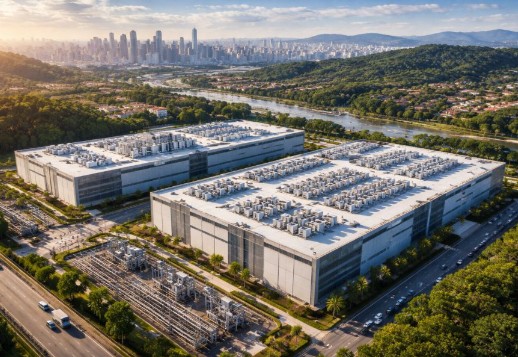
A new data center in São Paulo, Brazil.
Latin America has long punched beneath its weight when it comes to digital infrastructure. The region has fewer than 600 data centres, totalling only about 1.5 gigawatts (GW) of capacity. That is less than you can find in Britain. But businesspeople and politicians are convinced that they can attract many more of the whirring warehouses. They point to surging data use at home, as well as a desire among both Chinese and American tech giants to plonk more data centres outside their domestic jurisdictions. To take full advantage, countries in the region will have to persuade tech firms that they are reliable partners, and ensure local populations stay supportive. They will also have to navigate the heated rivalry between the world’s technological superpowers.
Growing local demand is the primary driver. Most of Latin America’s data is still stored and processed in the United States. That was tolerable when few people were online. Yet internet adoption in the region is now near 80%, higher than in China. Brazilians spend more than nine hours per day on the internet, compared with fewer than seven hours for Americans, according to a report by Atlántico, a consultancy. This causes lags. Content from North Virginia, a global hub, takes 150 milliseconds to reach São Paulo. Content from Vinhedo takes two. Many companies see value in paying to narrow the gap, says Raimundo Diaz of Vistra, an accounting firm.
Yet that is not the only play. Some big tech companies view locations in Latin America as important nodes in networks they are creating to serve users all around the world. ByteDance, the Chinese owner of TikTok, is investing up to $39bn in a huge data-centre campus in north-east Brazil, apparently enticed in part by undersea cables that run from there to Europe, Africa and points elsewhere. Some companies are scouting for sites that are suitable for training AI models (for which proximity to the ultimate end-user is not crucial). In that kind of business Latin America will find itself competing for capital “against Canada, the Nordic countries, the Middle East and South-East Asia”, says David Dias of EY, a consultancy.
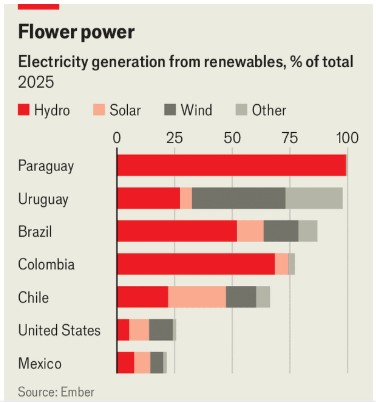 Latin American countries are busily talking up their advantages — over each other, and over hubs farther afield. Many can offer cut-price energy, which is also green (see chart). Lots of hydropower means 85% of Brazil’s electricity is renewable. In Chile, which has acres of solar panels, 68% is. Having plenty of affordable electricity can also reduce water consumption in data centres (by permitting the use of water-efficient cooling systems, which come with the downside of being power-hungry). Construction is generally affordable, too. Building data centres in Silicon Valley costs $14 per watt, according to a study by Turner & Townsend, a consultancy. Latin American rates range from $11.5 per watt in Mexico to $9 in Bogotá, the capital of Colombia.
Brazil has around 700MW of data-centre capacity, close to half the total in Latin America. By 2030 that could rise to as much as 5GW, predicts Alessandro Lombardi, the head of Elea Data Centres, one of the companies building them. The country’s president, Luiz Inácio Lula da Silva, is keen; before the presidential election in October he ushered through a reform slashing an exorbitant import duty that Brazil has been imposing on IT equipment. “Bring the data centres here,” demanded Lula, as the president is known, during his victory speech.
Factories in Mexico have recently made a killing assembling servers destined for data centres in the United States (where, because of local opposition, it is becoming much harder to build new ones). The country would now like to add to its own 300MW of data-centre capacity, much of it clustered in the arid central state of Querétaro, north of the capital.
Chile can offer investor-friendly rules modelled on Singapore’s, says Natalia López of Chile Data Centres, a trade group; Colombia is touting the world’s first free-trade zone for hyperscalers. Paraguay does moonshots, such as a $12bn plan for an American plant near the thunderous Iguazú Falls. Even Argentina, a fiscal basket-case, has seen interest in the southern province of Patagonia, which is sparsely populated and contains Vaca Muerta, a huge patch of shale gas.
Yet to succeed Latin American countries will have to clear away a heap of obstacles. Some of these are technical. The sites with the best internet connectivity are often not the same as those in which electricity is most abundant. Even when energy is plentiful, spotty transmission can lead to blackouts, says Tomás Ocampo of Unblock energy, an Argentine startup that uses gas that would otherwise be flared to power data centres. Permitting can be cumbersome, with long waiting times to connect to the grid.
Technology firms worry that, although the region’s governments have been lining up to promise tax breaks, they can often sound flaky on crucial matters such as intellectual-property rights. Though Latin Americans are much less averse to data centres than peers in the United States, public opinion could shift as investment ramps up. Sporadic protests against new projects in the region have already begun to take place. “There’s a growing sense of worry,” says Fabro Steibel of ITS-Rio, a Brazilian think-tank.
In the background looms geopolitics. That came to the fore suddenly on November 16th when the US Commerce Department declared that Brazilian data centres would need a licence from them to import the most advanced semiconductors. This reflects a worry that they will become a way for China to bypass America’s export controls, by letting Chinese companies remotely train AI models using the latest kit. President Donald Trump has long demanded that Latin America curb Chinese investment in critical infrastructure, notes Bruna Santos of the Inter-American Dialogue, a Washington-based think-tank. Mr Trump could well begin insisting they turn away Chinese money for data centres too. And no one very much likes the idea of pulling that plug.
________________
Credit: The Economist