
















Claims of government coverup grow in Progen generator scandal as top officials are ‘protected’
The government is “failing the litmus test of legitimacy” in the investigation of the Progen generator scandal, says former National Assemblyman and political analyst Wilson Benavides. “For three years this administration has emphasized its fight against corruption and now it appears to be part of it,” he says.
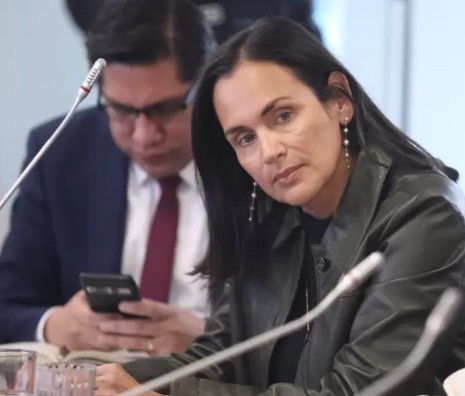
Former Energy Minister Inés Manzano
Benavides is one of a growing number of critics of the government’s reaction to the investigation into the 2024 purchase of mobile electric generators from the U.S.-based company Progen. After the generators were delivered to sites in Quevedo and Salitral, it was discovered that they were previously used, in poor mechanical condition and were incompatible with Ecuador’s electrical system.
The government paid $104 million to Progen prior to the delivery of the units, in violation of rules that require equipment to be tested and approved before payment is made to vendors.
“Because of the electric blackouts, the government was under enormous pressure to increase power generation and standard protocols were violated,” Benavides said. At the time of the negotiations and purchase of the generators, Ecuador was enduring daily 12- and 14-hour blackouts.
According to Benavides, the government is interfering in the investigation, protecting high-ranking officials and threatening journalists who are following the story.
University of San Francisco-Quito professor and political commentator Fabricio Betancourt criticizes the investigation by both the Attorney General’s official and the National Assembly, where supporters of President Daniel Noboa have stopped efforts to question and possibly censor former Energy Minister Inés Manzano.
To date, prosecutors have named 22 defendants in the scandal, most of them technicians and low-level managers at Celec, the national electric company, and in the Energy Ministry. Former energy ministers Roberto Luque and Manzano, who were responsible for purchase negotiations and receipt of the generators, have not been named.
Betancourt adds that Noboa was applying “overwhelming” pressure on Luque and Manzano “to get the deal done” and to install the generators. “The president was scared to death the blackouts would cause him to lose the 2025 election,” Betancourt said.
According to Betancourt and Benavides, audio tapes of Manzano’s conversations with National Assembly members and government officials reveal the government’s response to the investigation. In the tapes that were leaked to the media in May, Manzano says it is “essential to control the story and to manage the narrative” of the scandal.
Last week, Hernán Higuera, an investigative journalist for television channel Ecuavisa, described threats he received for his reporting, which implicated Luque, Manzano and former National Assembly President Neils Olsen in a “coverup.” Higuera said he was ending his investigation following “continuous threats” and the firing of his wife from a government position. In addition, Higuera’s son, a medical intern at a Guayaquil Social Security hospital, was suspended and told his medical career was over.
“Under the circumstances, I cannot continue to follow this story,” Higuera said. “The threats and direct actions against me and my family have taken a great toll.”
Two other journalists covering the scandal also report receiving threats, one of them directly from an “officer of the government.” The journalists asked not to be named for fear of reprisals.
Benavides believes the government’s “mishandling” of the Progen case will be an issue in the November election. “Although the election is for provincial and cantonal offices, I think this will be an issue for candidates who oppose Daniel Noboa and his policies,” Benavides says. “There is growing public anger at the lack of progress in reducing violent crime and the government’s participation in acts of corruption will add to the anger.”



Hogar Esperanza News

Fund Grace News

The Cuenca Dispatch

Week of September 20
Ecuador turns to industrial power cuts to protect Mazar and keep homes from going dark.

Ecuador raises its 2026 growth forecast, but El Niño could spoil the outlook next year.
Cuenca retirees challenge medical and therapy changes at IESS senior center.
Fabianos Pizzeria News
