














Confessions of a teenage antiques dealer
My father ran an antiques business in England in the 1960s, which was a time when the nation collectively decided that the contents of its attics might be worth more than the houses themselves, a belief encouraged by a small industry of books with titles that sounded like instructions from a polite burglar, among them the much-remembered Looking in Junk Shops, first published in 1961 and reprinted often enough to suggest that quite a few people took the idea seriously. There was also a sequel, whose title, More Looking in Junk Shops, came as no surprise.
People would arrive at the store with objects wrapped in newspaper and carried in wicker baskets, wearing a hopeful expression, asking what they had and, more importantly, what it might be worth. The answer, as ever, was that it depended, because in those days there were still rules, or at least rules that people agreed to pretend were fixed. An “antique” was something made before about 1830. Anything later became Victorian, Victorian reproduction, Edwardian, or, more ominously, simply fake, a word that was liable to end the conversation.
 The logic was straightforward: objects made before 1830 were antiques and therefore worth real money; objects made after Queen Victoria came to the throne in 1837 were used furniture or bric-a-brac.
My father’s own economics were simple and, in retrospect, revealing. If he bought something for a hundred dollars, he would price it for sale at a hundred and fifty and offer a ten percent discount to the trade, which left a margin that would make a modern retail accountant wince. However, he operated on the belief that if he gave other dealers a fair deal they would keep coming back, which they did, and that reputation in a small trade was worth more than squeezing an extra tenner out of any single transaction. It was a system that assumed good faith on both sides and a shared understanding of what things were worth, neither of which can now be taken for granted.
What gave this taxonomy its particular force in the 1960s was inflation. People came to believe that buying genuine antiques was not merely a matter of taste but a form of investment with a double return: the object would function in your home for decades and simultaneously increase in value as examples grew scarcer. Function and financial return ran in parallel. Books, dealers, and auctioneers all had a professional interest in maintaining this belief, and they maintained it energetically. Even if ordinary pieces languished, it was commonly said, a serious collector would always pay a premium for quality, which gave reassurance that the best material would find its market in the end.
It turned out to be more complicated than that.
Fashion has proved at least as important as scarcity, and in many categories considerably more so. Entire classes of objects have slipped out of favor. The number of well-heeled collectors prepared to compete for them has diminished. Museums, once assumed to be the final destination for important pieces, have mostly run out of acquisition money since the early years of this century. What no one quite said aloud, but which has become increasingly hard to ignore, is that the investment thesis depended entirely on the next generation wanting these things as much as the last one did. But it didn’t.
The television program that did most to keep the myth alive while simultaneously undermining it is the Antiques Roadshow, which has been running on the BBC since 1979 and has spawned versions across the world, including a long-running American edition.
The format is always the same: an expert examines an object, delivers a verdict on its age and provenance, and then announces a figure that causes the owner to look either delighted or quietly devastated. What the program almost never explains is that the figure given is typically an insurance replacement value, which bears only a loose relationship to what the object would actually fetch. Take that same piece to auction and the hammer price, before the auction house deducts its buyer’s premium and the seller pays commission, might be half the television number or less. Sell it through a retail antiques store and the dealer’s margin plus VAT will consume another substantial slice. The Roadshow has been popular and enduring television, but it has also sustained a generation of optimistic valuations that dissolve on contact with the actual market.
The hierarchy laid out by the popular books mattered because it gave people something to hold onto, a sense that value could be recognized if one only learned the signs, and this led back to the influence of Thomas Chippendale, who in the eighteenth century produced The Gentleman and Cabinet-Maker’s Director, a book of furniture designs that became the standard reference even though Chippendale himself made comparatively little furniture with his own hands. By the age of fourteen, having grown up in the trade, I was reasonably fluent in the difference between a ball-and-claw foot and a cabriole leg, between Chinese Chippendale and Sheraton, and why anything manufactured after 1830 failed to qualify as the real thing.
There was even then a contradiction running through the trade, because while people spoke reverently about authenticity, they were perfectly happy to improve it when it suited them, wiring old oil lamps for electricity without hesitation, turning objects designed for one world into objects that functioned in another. Viewed from a distance, this is not so very different from installing a $15 Temu battery movement and a recorded tick-tock in a grandfather clock and declaring the result perfectly satisfactory.
Those clocks, in the houses I remember back in the day, stood at the foot of the staircase like minor government officials, ticking steadily and striking the hours with a confidence that could be faintly unsettling, particularly if one had read too many Agatha Christie novels, in which the time of death has a habit of being established by a clock striking in the background, only for it to emerge later that the clock had been stopped, or tampered with, or otherwise persuaded to tell a lie.
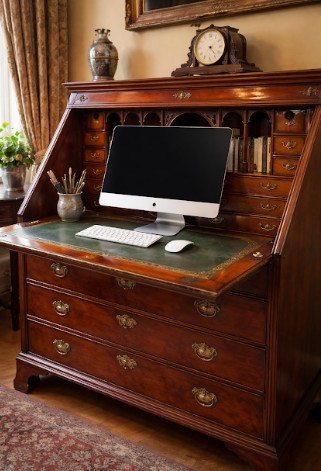
The Georgian slope-front bureau belonged to the same world: a kind of desk, often with a secret compartment behind a spring-loaded panel, which opened up like a small theater set to reveal compartments for letters, bills, ink, and the various paraphernalia of a life conducted on paper. Each space was carefully designed for a purpose that no longer exists. The letters have disappeared. The bills arrive invisibly. The bottle of blue-black ink and the blotting paper have been replaced by passwords for computers that don’t fit on the desk. What remains is a beautifully made object whose usefulness has completely evaporated, which is why even a good example in mahogany veneer with original Georgian brass drawer-pulls and its original key can sit in a London auction room waiting for the bid that never comes, not because it lacks quality, but because no one can work out what to do with it.
The shift is not so much a decline as a reclassification. The bureau and the grandfather clock have not become worthless; they have become decorative, which is a different kind of demotion. They are no longer chosen because they do something or because they will hold their value; they are chosen, when they are chosen at all, because they suit a room. The investment that was also a piece of furniture has become a piece of interior design, and interior design has its own economics, governed not by age or maker or the judgment of experts, but by whether the thing looks right against the wall.
In my father’s time, people entered junk shops asking whether something was valuable, and the answer could be debated with reference to age, maker, condition, and a handful of reference books that seemed to promise certainty.
The more pressing question now is simply where such a thing would go, and whether it would fit into a life organized around objects that require only a power socket and a Wi-Fi signal. The grandfather clock can still stand at the foot of the stairs and mark the hours with authority. But the time it announces no longer organizes the household, the bureau beside it waits for a postman who never opens the gate, and the double promise that once sold them both, that they would serve you well and grow more valuable as they aged, has turned out to be a period piece in its own right.