

















Court deliberates on challenges to three security laws but there is no deadline for a final decision
The Constitutional Court has concluded hearings for 35 lawsuits against three laws the government claims are necessary to fight organized crime. The legal challenges, filed by social and civil organizations claim that the Law of National Solidarity, the Law of Public Integrity and the Law of Intelligence are unconstitutional.
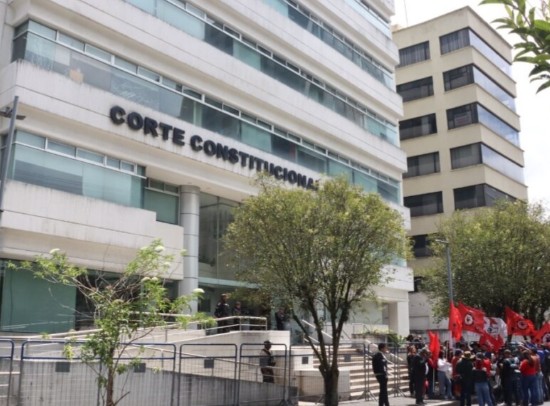
Ecuador’s Constitutional Court
In addition, several suits claim that two of the laws violate the constitutional rule that laws apply to a single topic.
The court heard more than 30 hours of testimony by plaintiffs and the government and is now awaiting the opinions of a three-judge panel. Given the number of cases involved and the complexity of the challenges, the court says it has not established a deadline for the opinions to be delivered.
Under court rules, the three judges, Alí Lozada, José Luis Terán and Alejandra Cárdenas, will write separate opinions which will then be considered by the full court. A final judgement by the Constitutional Court requires the support of five of the nine judges.
Before hearings began during the last week of August, the court cautioned all sides not to expect a quick decision. It also complained about political pressure put on the court by the government. On August 22, President Daniel Noboa led a protest march on the court for its decision to temporarily suspend more than two dozen articles of the three laws passed by the National Assembly in June and July.
Equally concerning, said the judges, was the claim made by Interior Minister Jhon Reimberg and Assembly President Niels Olsen that the court had become the “enemy of the people.”
“Despite the heated rhetoric, it is our job to resolve these issues with impartiality and with respect for the constitution,” said Constitutional Judge José Luis Terán. “There will be comprehensive consideration and debate of the points raised by all parties and, in the end, we will render judgements based on the principle of constitutional supremacy.”
Terán added that the court respects the urgency for final judgement but will not be influenced by external pressure.
During four days of court hearings, lawyers for the United Workers’ Front, the National Union of Educators and other trade and human rights organizations, argued that provisions of the three laws violated various constitutional rights, including the rights of free speech, privacy and public assembly.
Some plaintiffs also argued that the laws have nothing to do with economic matters, as maintained by the government, and that they violated the single-issue rule required by the constitution.
Legal representative for the National Assembly and the president dismissed all accusations and asked the judges to declare the laws valid and allow them to go into force as soon as possible.



Hogar Esperanza News

The Cuenca Dispatch

Week of September 20

Ecuador turns to industrial power cuts to protect Mazar and keep homes from going dark.

Ecuador raises its 2026 growth forecast, but El Niño could spoil the outlook next year.

Cuenca retirees challenge medical and therapy changes at IESS senior center.
Fund Grace News

Fabianos Pizzeria News