






A trip to the mercado and the true taste of Cuenca
Author’s note: This is the second of a four-part series about how an expat with no culinary credentials somehow found himself judging one of Cuenca’s most beloved traditional foods. It’s also a story about the generosity of strangers and the adventures that begin when you simply decide to see what might happen next.
By James Li
A few days later, driving around in an unmarked van with a group of excited Ecuadorians, I concluded we were on a vector and trajectory taking us well away from Cuenca. My wife nudged me and whispered, “What are we doing on the Pan American Highway? Wasn’t the first market just a few blocks from the mayor’s office?”
 Seconds later, some rapid-fire commentary commenced from several people in the back seat, and the next moment our driver made a U-turn on the highway at a roundabout containing about a billion motorcycles, buses and cars. We proceeded back along the highway the other way for several miles. Another excited exchange came from the back at a roundabout filled with excavators, gravel-filled trucks and yellow construction ribbons, along with bumper-to-bumper traffic and one lone bicyclist trying to cross from Valle to Cuenca in the rain. We followed the bike and made another U-turn. The third time along the same route, I recognized a metal dump, a grill shack and graffiti about the election a couple of years prior.

Suddenly, everyone in the back screamed at the driver who slammed on the brakes as a tiny sign flashed by my window. We decelerated from 60 to 0 in under a second, simultaneously exercising a backward Z-turn. Tires smoking, we rolled to a perfect stop in a parking lot crammed full of tiny cars. Hopping out proudly, the driver ran around to our side and whipped open the door before anyone had properly recovered.
For a while, time stopped and sound ceased. Then in a blink, reality was replaced by the image of our group leader and chief, showing perfect poise and elegant hair, standing at the entrance of the door. Extending her hand, she beckoned us to climb out. We all emerged, tumbling like ruffled chickens released from a tight coop into a space filled with friendly chatter, women’s voices at their market stalls, and the gentle patter of rain on the wet metal roofs that stood protecting Plataforma Narancay. This, I was told, was Cuenca’s newest mercado, launched by the city to serve the new southern branch of Terminal Terrestre. As I stood in the opening looking around me at the bright stalls, I inhaled the smell of roast pork and stewed fat. An old woman wearing a black plastic bag on her head tapped my shoulder and politely inquired whether I would like to purchase some garbage bags.
 I snapped back to full situational awareness and, spotting our leader’s hatless slender figure striding with authority through a sea of shorter rounder be-hatted bodies, grabbed my wife’s hand and waded into the crowd.
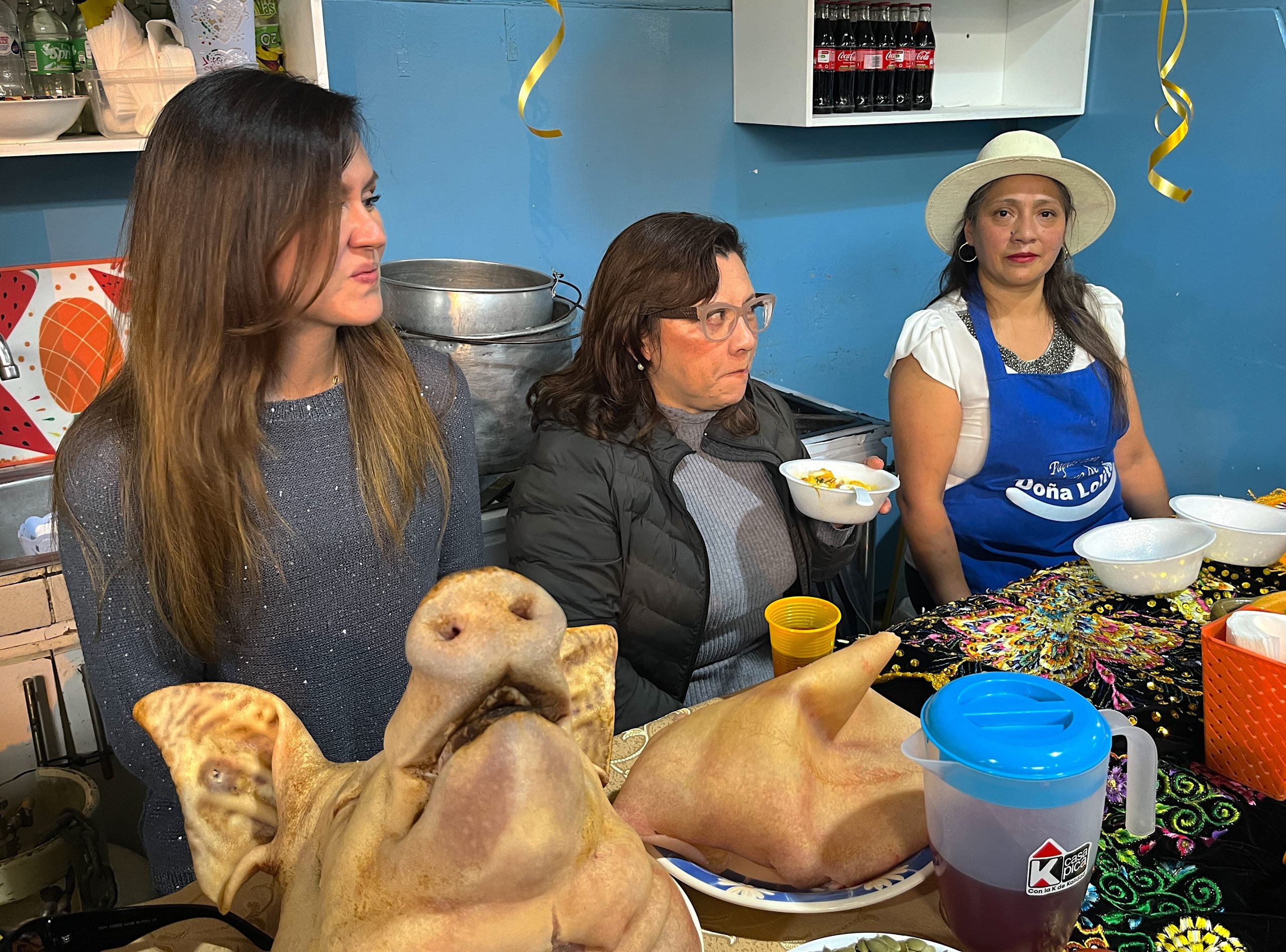
We arrived circuitously at a series of rustic wood counters on the corner of one of the market walkways. Along each counter forming the corner sat a most wondrous sight that included gold and crimson tablecloths, a welcome sign, balloons, flags, and giant pots filled with stewing pork skin, mote, and potatoes. Heaped on top of the pot of potatoes was a mountain of hardboiled eggs. Inside the corner stood Zoila Arévalo, dueña of the stall that had been chosen to represent papas con cuero at Narancay. Dressed in a grey-red chef’s apron, pearls and a bow-tailed straw hat, she stood shyly watching the chaos in front of her stall. Camera operators, reporters with microphones, social media influencers, moms with infants and tasting judges crowded the walkway, all talking at once. Two customers eating breakfast at the counter, eyes widening, grabbed their flowered metal bowls and, abandoning their stools, fled to another corner of the market.
 Our leader firmly gestured to us across the chaos. I found myself propelled, along with our van driver, to the two wooden stools that had just been vacated. Feeling like a watermelon seed that had been launched between a thumb and forefinger, I landed on a stool with a whoomph. Looking up, I was handed a small handled ceramic cup filled with a sweet-smelling warm liquid that looked a bit like cloudy urine. As I sniffed it suspiciously, my van driver companion lifted and noisily drained his with great satisfaction. That was the prompt I needed and, tasting mine, encountered my first chicha, a lightly-sweet enchanting concoction that gave me flashbacks of flower-scented alpine meadows and open skies. That sip brightened my whole day.
I looked up from my cup and found myself eye-to-eye with the gentle smiling face of Zoila, who handed me a steaming ceramic bowl filled with rice, small hand-peeled potatoes, grilled mote, onions, fresh herbs, and chunks of fatty cerdo and cuero, topped with a hard-boiled egg. With two hands, I lifted it from hers and set it in front of me. I stared at it in wonder. It was truly beautiful.
To be clear, this was only the first of many bowls our tasting group would receive before the day was done. I was there simply because of the expansive politeness of Ecuadorians who we had happened to meet after showing ¡Cuenca Eats! to someone in a museum I had to visit because it housed the 5,000-year-old stone figure of an alien astronaut popularized by Erich von Däniken in the 1960s. That someone knew another someone who knew another someone until I’d lost track. A lot of somehows later I found myself sitting at this counter in front of a thousand people who wondered whether I thought Zoila’s papas con cuero was worthy of being the best in the city.
In that moment, I realized I was among people who assumed, based on a fleeting first impression, that I was a decent human being. With nary a blink, they’d shown me something about giving others the benefit of the doubt that I’m rarely capable of doing myself. That realization brought with it an enormous sense of responsibility to make the moment count. To show these people, this city, and these mercado women that they were worthy of being proud of who they were.
I glanced over at my companion, who had received his own bowl and, holding the bowl steady with his left hand, was scooping huge spoonfuls of goodness into his mouth. Inspired by his example, I tentatively tasted a spoonful of my own.
Eyes closed, the taste embodied everything good.
_________________
James Li is an emergency physician and incurably curious wanderer who has lived and worked in Africa and authored dozens of medical research articles in journals such as The Lancet and Chest. He also served as an editor for Annals of Emergency Medicine and is the author of Anesthesia Off the Grid. Together with his wife, he has spent years exploring Cuenca’s markets, traditional foods and neighborhood restaurants. What began as a personal attempt to keep track of favorite meals eventually became ¡Cuenca Eats!, an affectionate and deeply personal look at the culinary life of Cuenca through the eyes of a perpetually fascinated outsider who still finds himself happily surprised by where a good meal can lead. Buy it in Cuenca at Carolina Bookstore, the tourism office at Parque Calderón or on Amazon.