










Cuenca garbage billing update
One of the more interesting discoveries about life in Cuenca is that almost nothing is ever called what you think it ought to be called.
Take garbage collection.
A few days ago my landlady telephoned to announce, with the accusatory tone usually reserved for tax fraud investigations, that money was owing on the Larga Towers penthouse apartment for the last few months of trash pickup.
I had actually been down to EMAC’s offices a few months ago and paid the bill with the understanding that in future it was going to be added to the water bill, but perhaps I was confused, and anyway that was not the case.
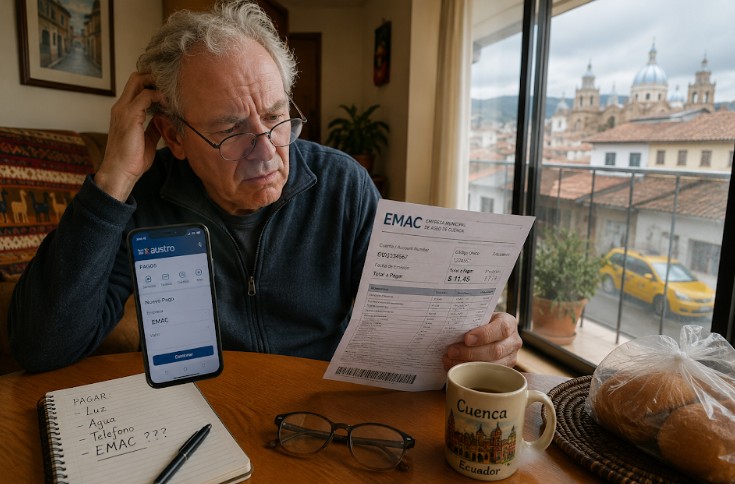 In most countries one might reasonably assume that a garbage bill would be paid through a garbage company, listed under something called “garbage,” and associated with the address where garbage bags are set on a rack on the fence.
This, however, is Ecuador, so I dutifully searched online on the EMAC site using my landlady’s husband’s cedula number, which I happened to have handy, as one does. Nothing, nada, no debt owed by this account. The system insisted that all was well in the universe and that my trash had apparently been removed free of charge.
“No,” my landlady explained patiently. “You have to use the electricity account number instead of the cedula number.
This sounded less like municipal administration and more like one of those medieval riddles where a bridge troll demands answers before allowing passage. What has wires but is not electricity, belongs to the landlord but is not the landlord, and carries away your second hand toilet paper? The answer, naturally, is garbage collection.
What I did not know at the time — and what my landlady probably assumed I already understood — is that there is a genuine story behind the confusion, and it is one that even longtime Cuenca residents have only recently had to learn.
For years, garbage collection in Cuenca was funded through a surcharge on the electricity bill, collected by Centrosur, the regional power company. Most residents never noticed it as a separate item, because it was simply part of the utility ecosystem, invisible and uncontroversial, the way civic infrastructure is supposed to be. Then the national government decided that the Constitution said that municipalities should not collect local service fees through electricity billing, and Cuenca, like every other city, had to scramble to find a quick fix.
Responsibility for garbage collection sits with EMAC, which stands for Empresa Municipal de Aseo de Cuenca. Aseo in Ecuadorian Spanish covers sanitation, waste, and street cleaning. EMAC suddenly found itself needing to bill tens of thousands of households directly, and the transition has been, let’s say, a work in progress.
I then opened my Banco Pichincha app, where utilities are listed under comforting ordinary names like water and light with little graphics of drops of water and light bulbs. There was no category for garbage, trash, refuse, sanitation, waste disposal, poop, or dead guinea pig removal. Nada. The EMAC charge does not yet reliably appear in bank apps such as Banco Pichincha. Eventually it will show up, unannounced, and everyone will behave as if it was always there and that you should have known.
Eventually I went in person to the EMAC office, where the matter was handled in approximately three minutes by a woman who clearly regarded my confusion as entirely normal and perhaps even mildly entertaining. She confirmed what I had by then half-suspected: to search the EMAC system, you need to enter the cédula number of the person whose name is on the electricity meter, because EMAC is still using the customer data originally held by Centrosur. If you are a tenant and the electricity meter is in the landlord’s name, you consult the landlord’s details. Which explains the phone call, because it was the landlord who had received a letter from EMAC threatening to dump a full load of garbage on his front lawn if the arrears on his rental apartments had not been paid.
She also told me that payments could be made through JEP. Now JEP, to its credit (no pun intended), is one of the more functional Ecuadorian banking apps, although this is rather like being voted the best accordion player on a submarine. I had already searched there unsuccessfully, and later discovered that the correct category was listed under EMAC, so my bad. Not trash or aseo, or basura, or garbage collection. EMAC. Which, even when one knows perfectly well what it is, still sounds less like a public utility and more like a Scottish email startup.
For a typical Cuenca apartment, the monthly garbage fee runs somewhere between three and six dollars. The bill is currently calculated using the average of recent months of electricity consumption, because that data already exists. This is not a new tax and not a surprise increase. It is the same money simply routed differently, through a different door in a building where none of the doors are labeled.
The modern world is supposedly obsessed with user-friendly design, intuitive interfaces, and frictionless digital ecosystems, yet here I was attempting to pay for garbage collection through what felt like a Cold War intelligence puzzle.
Enter the landlord cédula number. No, not that number. Use the electricity account number. No debt exists. Look for EMAC on your banking app. Not under utilities or services, though.
Somewhere in Silicon Valley there are software designers earning $300,000 a year explaining tongue-in-cheek to the public how digital technology simplifies our lives. Meanwhile in Cuenca a grandmother in a sweater vest probably understands the entire system perfectly and can pays her garbage bill with one hand in twenty seconds with a bucket of plantains on her head.
The truth is that Ecuador frequently functions through relationships and word of mouth rather than through labels or instructions. Once someone hands you the secret map, the system generally works well enough. The difficulty lies in finding the map in the first place. This is the standard Ecuadorian rollout pattern: online first, functional later.
After all, this is a country where internet bills may be paid at pharmacies, banks resemble bus terminals, and a hardware store may also sell live chickens. so it is all wonderfully human and faintly bewildering.
Eventually I did pay the garbage bill, and when I got home I checked it was the right account after renting an electron microscope to find my electricity account number among the list of tiny cryptograms on the receipt.
EMAC is adding payment channels progressively — banks, cooperatives, digital platforms — so by the time you read this, the experience may already be slightly less Kafkaesque. Or it may not. Or maybe your landlord will take care of it all for you and add an administration fee to your rent.
But somewhere in the electronic depths of Cuenca, an invisible database connected to my landlord’s electricity contract has emitted a small satisfied beep. And for another month at least, they will keep on handling my aseo.