














Cuenca ranks high in international media reports; Earthquake rocks Tarqui; Paute invites you over for a drink; Art of the poncho; Colombia has a hippo offer
Bored? –
(De El Mercurio del jueves, 30/4) Feria de la Chicha y de Bebidas Tradicionales (Feria of Chicha and Traditional Beverages) – The canton of Paute is preparing to experience a day of tradition, flavor, and culture with the Feria de la Chicha y Bebidas Tradicionales. The event seeks to revalue ancestral practices of Agricultura Familiar Campesina (AFC – Rural Family Farming), It will be el sábado, 16/5 starting at 6:00 outside of the Technical Office of MAGP-Paute at the intersection of av. Siglo XX y Nicolás Vásquez in Paute. It will bring together producers with a large variety of traditional drinks made with ingredients such as corn, fruits, and herbs of the region, and there will be tastings and sales. <Herb liquor sounds like it might taste like cough medicine.>
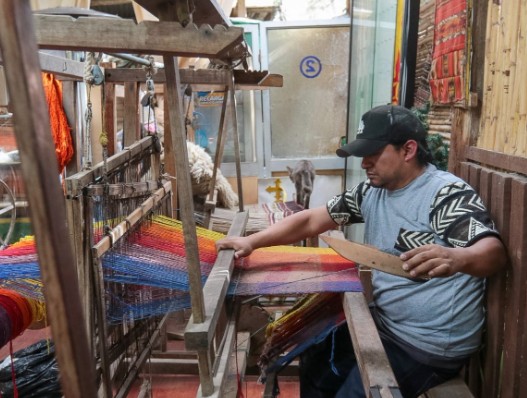
Leonardo de la Torre, a native of Otavalo, makes ponchos in his Sinincay workshop, combining traditional techniques with textile innovation. (El Mercurio)
(De El Mercurio del jueves, 30/4) Durante el feriado habrá atención en los museos (Museums will be open during the holiday) – For the Día de Trabajo (Labor Day) holiday, from jueves to domingo, 3/5, there will be a special agenda for touring the Network of Municipal Museums. The activities will include shows of modern art as well as historical patrimony and screenings at the Planetarium. Hours for the Museo Remigio Crespo Toral, Museo de Arte Moderno, the Planetario Municipal, and the Galería de la Alcaldía will be from 9-17:00. For the Museo de la Paja Toquilla, hours will be from 9-17:00 until el 2/5. The Museo de las Conceptas will be open from 10-17:00 until el 2/5.
(De El Mercurio del viernes, 1/5) Ponchos: hilos y tradición (Ponchos: yarn and tradition) – Making this traditional piece of clothing combines weaving, embroidery and design in circles that involve family workshops, academia, and commercialization. There is also a route to tour the places where ponchos are made from community workshops to spaces for design and sales. The amount of time to make a poncho can range from a few hours to more than a week with prices starting at $25, depending on the garment’s complexity and materials. In Sinincay, Leonardo de la Torre works in the Yarik Artesanías workshop, a family business.
The process starts with sheep and alpaca wool which is made into yarn. Then the warp threads are arranged and stretched on the loom to form the base for the cloth. This step requires about 1,110 threads depending on the width and design of the poncho. The workshop produces traditional ponchos, fajas (girdles?) and hybrid garments with cotton. Sales are at the workshop or a store on Benigno Malo and La Mar. He said the market has changed from 10 years ago when there was much appreciation for this craft, but that has diminished. Now the biggest buyers are tourists from Guayas to the Sierras because of the lower temperatures. <Tourists unprepared for Cuenca’s chilliness who need something warm, now.>
In the academic area, the poncho has been incorporated into contemporary design. Designer Silvia Zeas develops collections based on research and reinterpretation of traditional tecniques. Her work includes the ikat of Gualaceo made by craftspeople of the Jiménez family. Using cotton, alpaca, merino wool and synthetic mixes, prices can exceed $300. She has participated in internacional events and her market includes Ecuador, the US, Canada and Europe. She also does trainings with crafts communities. Her store is in the Cristo del Consuelo sector in San Joaquín. <That’s also the name of a restaurant with cool murals covering the walls.>
Embroidery is another line of production. Carmen Cuji, originally from Chimborazo, makes ponchos with techniques learned from her mother and developed on her own. The embroidery takes 8 to 24 hours with the complete garment taking 40 hours. Her products sell from $40, and are exported to different countries. Influences from other countries come with the use of social media, and she can innovate to adjust to fashion trends. Her location is in the Centro Municipal Aresanal (CEUART) on General Torres y Pres. Córdova. She also conducts workshops, and has trained about 100 people.
(De El Mercurio del viernes, 1/5) Advertisement for EXPO MAMÁ with fashion, beauty, home, jewelry, and health with shoes, food, decorations, perfumes and more than 1000 products – 1, 2, &3/5, froms 10 am to 9 pm – in the Parqueadero Arlo across from the Parque de la Madre next door to the Cámara de Comercio.
(De El Mercurio del viernes, 1/5) Karol G confirma 3 fechas en Ecuador (Karol G confirms three dates in Ecuador) – The singer Karol G will bring her world tour, “Viajando por el Mundo Tropicoqueta” to the Estadio Olímpico Atahualpa in Quito for 3 shows on the 15, 16, & 17 of enero, 2027. Tickets are available through Ticketshow, both on their web site and at physical sales points. Prices range from $40 to $350 with 8 tiers.
Curious? –
(De El Mercurio del jueves, 30/4) Cuenca está en los rakings (sic) de turismo (Cuenca places high in tourism rankings) – Various international platforms confirm Cuenca as a regional reference for well-being and cost of living in 2026. According to data from Numbeo in abril, 2026, for the 2nd year in a row, Cuenca leads in quality of life in South America. The site said the cost of life is “very low” (30.75), and is 11.4% lower than Quito and other urban centers in Latin America. Security is perceived as moderate (54.17), exceeding other cities in the country which is a real incentive for tourists. <Not hard to get that rating when you compare it to cities on the coast.>
International Living, in their 35th Annual Global Retirement Index for 2026, puts Cuenca as a good destination, highlighting its good climate and high-quality medical services. In this ranking, Cuenca keeps appearing as one of the most recommended destinations worldwide for retirees and expats, especially US citizens. <Except that most Ecuadorians don’t speak English well enough to serve all of us gringos who are pumping all our retirement income into the economy. How ungrateful of them not to learn fluent English. (snark)> The magazine pointed out that a couple can live comfortably on a $1,500-1,800 budget. Another international platform touting the virtues of Cuenca is Live and Invest Overseas as an “unbeatable” Latin American destination in terms of cost-benefit, as well as the existence of a large, well-integrated expat population. <I wonder about that well-integrated description since so many expats live in their gringo bubble, only integrating with other expats.>
For Sonia Flores, a tourism engineer, these rankings act as a potent magnet for long distance tourism. However she said that the statistics need to be read with caution. The data from Numbeo come from citizens’ perceptions which mark a real tendency, but do not have the rigor of an official census. <I remember that the nickname for International Living was International Lying when I moved here. I don’t know if it’s still known by that moniker.>
(De El Mercurio del jueves, 30/4) Se levanta la restricción para la venta de cuyes (The ban on the sale of guinea pigs lifted) – <This is good news for all of you who want the very freshest cuy dinner, provided you’re willing to buy, slaughter, dress and cook your own cuy.> After determining that cases found in cuyes corresponded to a fecal bacterial infection, Agrocalidad lifted the restriction on sales of cuyes that went into effect el 17/4. Sales of rabbits are still under study as a preventive measure.
(De El Mercurio del jueves, 30/4) Temblor de 3.8 en Tarqui (3.8 magnitude earthquake in Tarqui) – The Instituto Geofísico reported an 3.8 magnitude earthquake in Cuenca, 11 km. from the city in the Tarqui Parish at 17:25 on Wednesday afternoon. As of Thursday at 18:30, there were no alerts or news reported from either the city or the rural zones of the Cuenca canton. <Did anybody feel it? 3.8 isn’t all that much of an earthquake – just ask anyone from California or Alaska.>
(De El Mercurio del viernes, 1/5) 2 víctimas de violento asalto (2 victims of a violent assault) – <This is the side of Cuenca that International Living doesn’t tell you about.> 2 men were kidnapped and assaulted by a criminal gang about 22:00 on miércoles, 29/4 near the Milchichig redondel on the north side of Cuenca. They were in a car when they were intercepted by 6 armed delinquents, including a woman, in a white Chevy. Under threat, they were forced to get into their own car, and taken towards Azogues to a night club. There, the criminals beat them, causing one victim a head injury. They also took the mens’ clothes, shoes and phones; and used the phones to get into their digital bank accounts to transfer money. They emptied the victims’ accounts. <I wonder if the criminals were dumb enough to transfer the victims’ money into their own accounts.> They took over the mens’ car, and then abandoned them at 5:00 on Thursday in the Las Antenas sector of Llacao after going to another night club. The victims walked and got help from a house where they called 911. The police recommend not parking in desolate areas, especially at night and early morning hours.
(De El Mercurio del viernes, 1/5) Los 80 hipopótamos de Escobar (Escobar’s 80 hippos) – The Colombian government is evaluating sending 200 hippos, an unusual legacy of the drug lord Pablo Escobar, to India after receiving a proposal from the son of an Indian magnate to house them there and mitigate their uncontrolled reproduction. Colombia is thinking about killing the animals starting this year since the 4 hippos that Escobar imported in 1980 for his personal zoo escaped onto the banks of the río Magdalena after his death, and started reproducing <evidently like rabbits>. The 200 hippos are considered an invasive species and form the largest herd outside of Africa. Irene Vélez, the Minister of the Environment estimated that without control, the herd would grow to 500 hippos in 2030. <Is hippo meat edible?>
Anant Ambani, son of Mukesh Ambani, formally asked the Colombian government to suspend the decision to kill the hippos and offered to house them at his enormous animal shelter in Vantara, India. Vélez wrote to the Indian government to confirm if the shelter had the permits and the to capacity to relocate the animals, and if the Indian government will authorize the transfer. <At 2-5 tons each, say an average of 7,000 pounds, that’s 700 tons of hippos which would be several giant cargo plane loads.>