














Cuenca restaurant scene, part 2: How about the food?
By Ray Horsley
What an odd custom, dining out. Somehow, we’ve come to view this routine as perfectly normal, but how might this be viewed by another civilization from our distant past, one unfamiliar with the practice? We go out with the idea of treating ourselves to something special, the pleasant joy of sharing a meal, usually with friends or family, and letting others do all the work. We often try new restaurants in search of something better, although we usually fail. But more often than not, the chore of getting to and from a restaurant, as well as a lot of waiting while we’re there, is more time, effort and money than what we’d have spent inviting friends or family over to our own homes to dine. And that pleasant joy? Today it seems more elusive than ever.
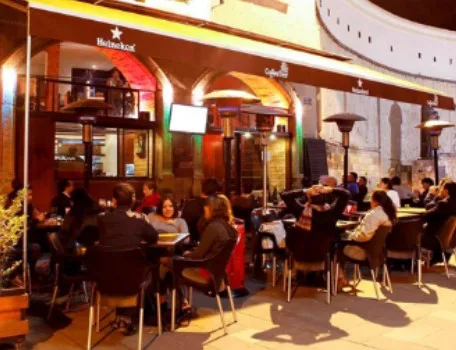 It would be strange indeed to that ancient civilization that restaurant meals are prepared in a kitchen hidden in the back somewhere. It turns out that the most important place we should be able to see is the one place we’re prohibited from entering.
I love the occasional open-kitchen design. One of my favorite restaurants, Mangiare located in Cuenca’s San Sebastian neighborhood, is a good example of this. But it’s rare. Most of the time we can neither see what’s going on as meals are prepared, nor can we communicate directly with the cook. This is done through an intermediary, the server. These two disconnects are not good.
Restaurant meals are prepared in vastly different ways than home-cooked meals are, vastly different and vastly worse for our health. At home we often use filtered water for everything from soup to nuts, especially drinks like tea and coffee. I can’t imagine many restaurants bothering with filtered water for coffee or anything else. A common staple in restaurants are the ubiquitous French fries; nutritionally poor, white potatoes, submerged in boiling oil for a while. We would never prepare such a thing at home.
Another example, at home we sparingly use olive oil purchased reasonably recently. Restaurants, always with an eye on the dollar, use the cheapest vegetable oil to be found, possibly with trans fats, possibly re-used one too many times. And while we may spend a little more to purchase stainless steel and cast-iron cookware for our homes, restaurants inevitably use the far cheaper and questionable alternative; aluminum.
My imaginary civilization from the past might also observe the irony in our collective preoccupation with health care, as long as we, ourselves, are not responsible for it. Every political election promises that the government will take care of us. And every political term that follows, no matter who wins, fails to do so, at least according to our ever-rising expectations which seem to mirror our ever-declining health. Our civilization is chockfull of mammoth hospitals, neighborhood clinics, a mind-boggling number of specialists and therapists of all kinds, a constant stream of new viruses and conditions, drugs to combat everything including other drugs, high tech procedures and surgeries, medicine cabinets in every home, all somewhere in the trillions of dollars annually. But if there’s somebody offering me a yummy, extremely toxic, cheese covered chilli dog at only $1.50, ah what the heck. I’ll take one. And I’m happy to see it includes some of those bright, orangish-yellow, squiggly things which my grandparents would not recognize as any kind of food. As we go to restaurants with ever-increasing frequency, we eat whatever they dish up. There seems to be just two criteria which determine what we select: price and taste. Well, maybe health comes into play at some point, but it’s a distant third if it’s considered at all.
This brings us to the available options. So many restaurants are so similar you might think they’re all one big chain of franchises. If beef, pork, chicken, shrimp and trout were removed from all restaurant menus, we’d have little left. The assumption that no meal is complete unless the plate contains dead animal parts is, in fact, a lie. We really need to do away with this. That imaginary civilization from our distant past would probably find it odd that every single meal we eat has to include slaughtering and devouring animals. There’s a huge irony in this.
Our ancestors had nowhere near the information we have. They knew nothing of cholesterol, vitamins, fiber or any nutrition science, yet they ate the most nutritious diet possible. In sharp contrast, we know exactly what these things are, what they do to us both good and bad, what we should get more of and what we should avoid. Yet for some reason we can’t resist giving in to the most unnutritious, unhealthy choices to be found. And it’s not like nutritious food isn’t available. Here in Cuenca our municipal markets sport an impressive array of the most healthy foods on earth, year-round! Most are organically produced locally and all are free of the US maladies found in genetically modified frankenstein-foods. Yet somehow few of these leafy greens or spices make it into Cuenca’s restaurants. Why is that?
So without getting into a debate over which fad-diet is best or how many walnuts you should eat for your daily dose of omega-3, I’ll try to go with what has become generally accepted as a healthy meal. Then let’s try to find a restaurant that serves it. To keep it simple we’re really just looking for two things: an oil-free dish of food with no animal parts. This excludes dairy such as cheese, ice cream and even milk in your coffee. It’s only going to pump into you the same growth hormones pumped into, and designed for, a 1,300-pound cow.
And a word about oil. This is the toughest one: no oil. It’s over-used. Personally, I don’t add any oil to my diet, but if I wanted to, it’s just best that I do it myself. Otherwise, I’m blindly letting a perfect stranger choose which oil, how old it is, and how much of it to add, all behind closed doors. One day years ago, as I exclaimed to myself one too many times after ordering “Oh no! I forgot to tell him no oil” and ending up once again with food floating in a puddle of glistening oil, I finally got into the habit. These days my “no oil” request usually solicits the response “even if it’s olive oil?” Yes, I also prefer none of the euphemistic olive oil. First off, it’s impossible to verify it’s really olive oil and not the omni-present and toxic vegetable oil. (Don’t let the word ‘vegetable’ fool you.) Secondly, it takes over 20 olives to make just one spoonful of olive oil. I love olives but I’m not going to eat 20 of them with a meal. This is the one request that throws off both servers and cooks the most.
Another thing I’m still trying to get into the habit of policing, cutlery. Please don’t serve me hot food or hot drinks in styrofoam. This is a problem at nearly all open air fairs, getting a cup of piping hot coffee in a styrofoam cup. Who knows what kinds of chemicals I’m consuming? Food courts at malls are also guilty of this, often serving entre meals of hot food on a styrofoam plate.
So let’s have some fun with this. My challenge is to find a restaurant here in Cuenca (I know of a few) where I can order a meal using the following five criteria:
1) It must be an item on the menu just as it’s listed. No adjustments. Otherwise, your vegetarian burrito turns out caved in, flat and tasteless.
2) It must be a hot, meal-of-the-day on anything other than styrofoam. No cold salads of iceberg lettuce and a tomato wedge. That’s not a meal.
3) No animal parts or products. This includes dairy and fish, especially high cholesterol shell fish. And probably best not to allow margarine or lard substitutes for butter. Coffee? Almond and soy milk are good replacements for the cow stuff.
4) No oil. This includes no olive oil.
5) It’s got to taste good! It may not have the same mouth feel as a bacon wrapped, cheese filled, deep fried pork sausage, but that’s OK. Spices of all kinds can and should be used to make the meal enjoyable to consume.
There’s a strange expectation with walking into a restaurant. We don’t think twice about entering any other kind of store, be it clothes, cell phones, hardware, whatever, and walking out if they don’t have what we’re looking for. But after being seated in a restaurant and looking at what they offer, we somehow feel obliged to buy something, anything, and eat it, whether they have anything we like or not. The opposite should hold true. Restaurant owners and workers need our input. Walking out, subtly, politely and above all respectfully, is an excellent way to provide it. At the end of the day, if we request healthy choices, they’ll serve them.
¡Buen provecho!



Hogar Esperanza News

The Cuenca Dispatch

Week of September 20

Ecuador turns to industrial power cuts to protect Mazar and keep homes from going dark.

Ecuador raises its 2026 growth forecast, but El Niño could spoil the outlook next year.
Cuenca retirees challenge medical and therapy changes at IESS senior center.
Fabianos Pizzeria News

Fund Grace News
