













Cuenca’s reputation as Ecuador’s arts capital grows with a new generation of artists and new programs
By Stephen Vargha
It has been said art appreciation is a fundamental skill that enhances our understanding of the world around us, our history, and of ourselves.
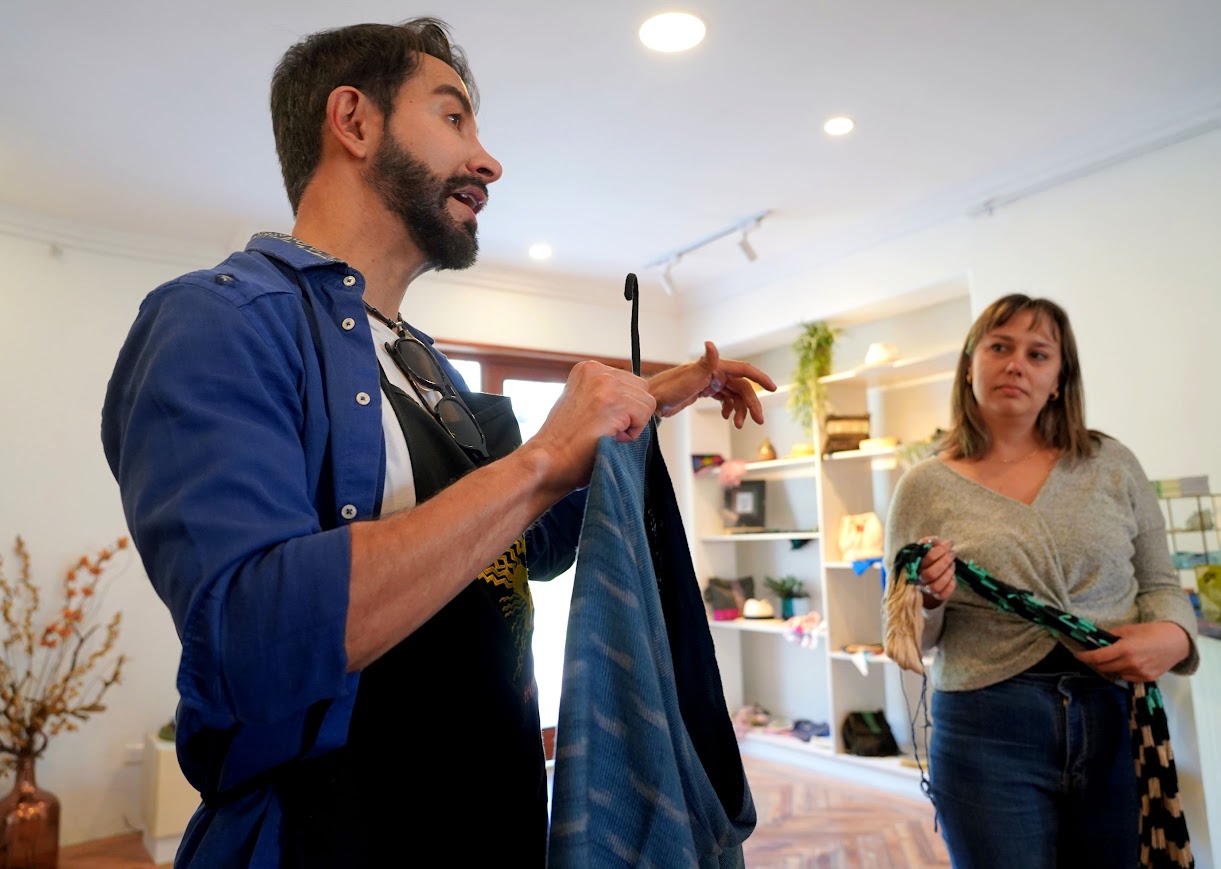
Felipe Cardoso is one of the organizers of Allpatelier. During his tour in March, he explained the art of ikat, a dyeing technique that is used to pattern textiles.
Art appreciation is the immersion and understanding of paintings, sculptures, architecture, books, poems, and other forms of expression.
Cuenca has a long history of art and appreciation of it, from poets such as Honorato Vázquez Ochoa to Remigio Crespo Toral to César Dávila Andrade to Issa Aguilar Jara.
Then there are the Cuencano artists who create beauty with their hands such as Eduardo Segovia, Eduardo Vega, Edgar Carrasco, and Miguel Illescas C.
And Cuenca has produced highly talented painters including Oswaldo Guayasamín, Joaquín Pinto, Catalina Carrasco, and Diego Sánchez.
Because Cuenca has produced so many talented artists, there is an appreciation, knowledge, and understanding of the timeless qualities that identify all great art.
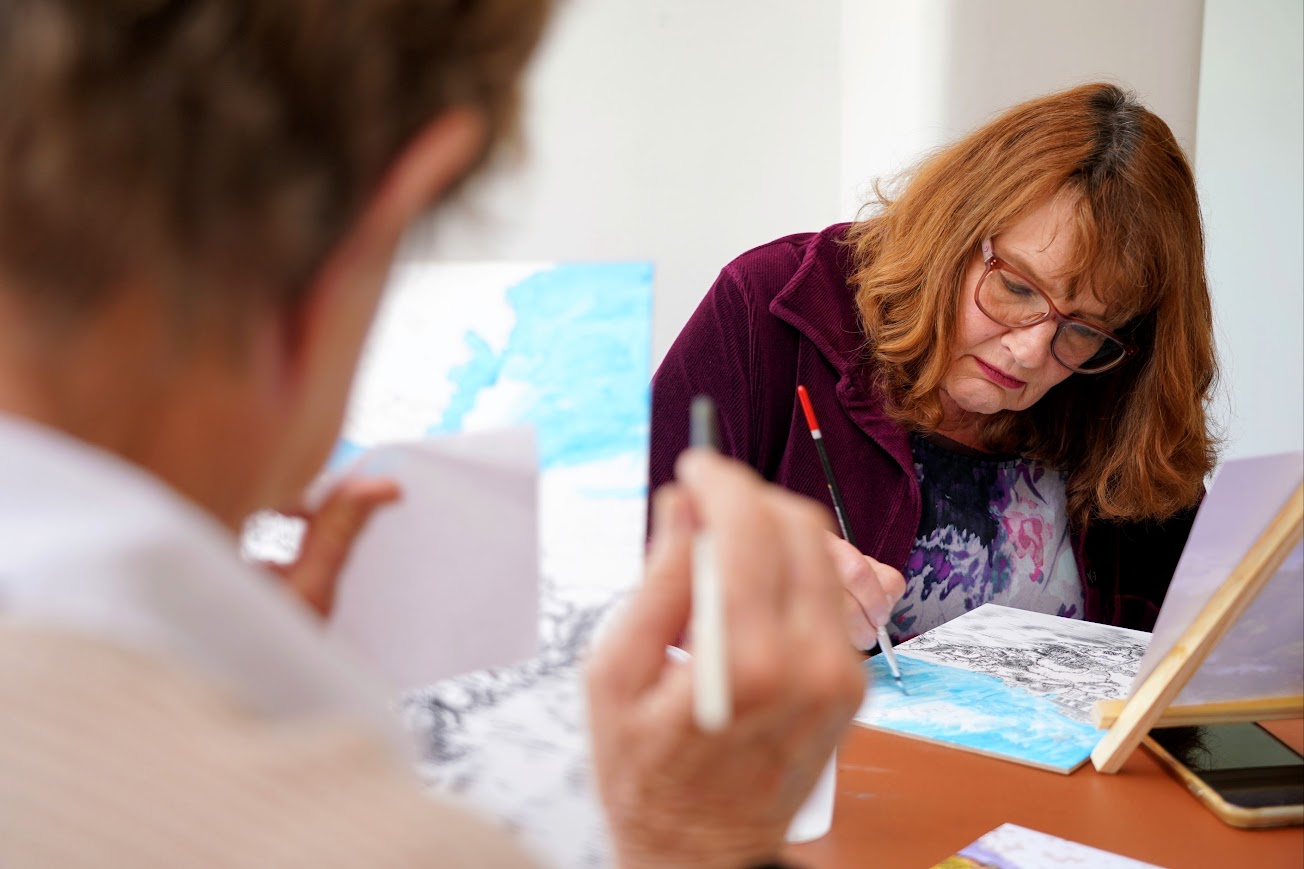
Jan Carrier has been to every art experience. Some of her artwork hangs on the wall at her home.
People in Cuenca appreciate art, opening themselves to new perspectives, understanding the cultural and historical context of art, and how it reflects the culture and society in which it was created.
To many, that insight into artwork makes it more meaningful. It provides value for the human creative processes as well as the fundamental elements of its production.
That is why Cuenca is known as “The Arts Capital of Ecuador.” And some have exclaimed that Cuenca is a “Rising Arts Capital of Latin America.”
“I don’t think I could live without the arts,” said Jorge Vallejo. “I would be insane without the arts.

Accomplished pianist Peter Dudar provides music to every art experience.
Vallejo, 29, was born and raised in Cuenca. He graduated from the University of Cuenca with a degree in Arts.
“When I was 19 years old, I had some experiences with the Tomebamba River. It gave me an appreciation for nature and art,” said Vallejo. I do a lot of autobiographical art. It is how I perceive the world and transfer it to a painting.”
Artistic ability is often thought of as a combination of both natural talent and hard work. However, Vallejo argued that artistic ability is actually rooted in appreciation, rather than creation.
“Painting is an art of meditation,” said Vallejo. “While we are painting, we are not stuck in one part. You become the observer. To me, when you are the observer, your body becomes the vessel.”
One reason why art appreciation is so important is that it allows an artist to understand and learn from the work of others.
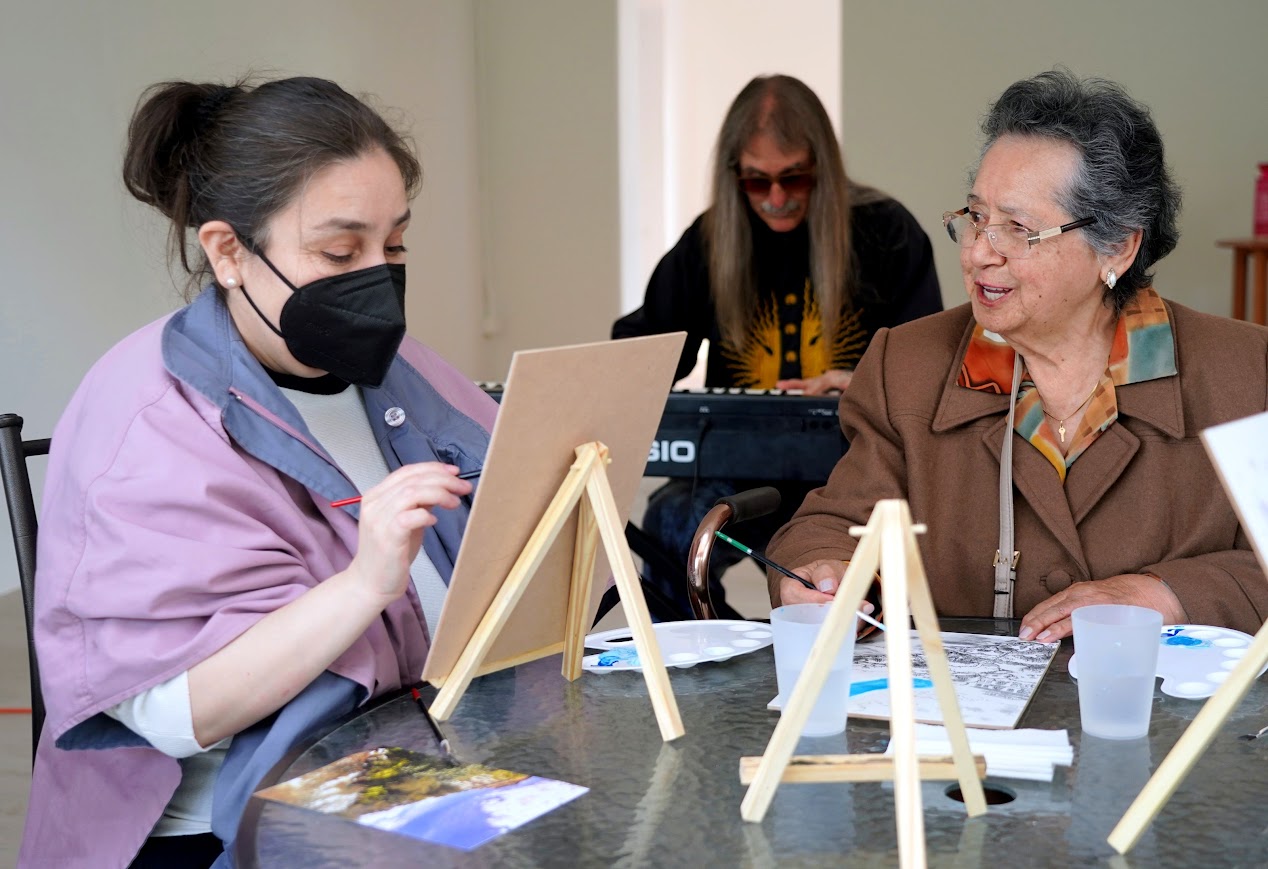
While painting, live music from pianist Peter Dudar is provided.
“My husband and I became artists because of Jorge and Felipe,” said Jan Carrier. “I think my best result was my painting of a hummingbird. Our hummingbirds are now on our house wall.”
Carrier and her husband, Stevan, moved from Tampa, Florida, via Boquete, Panamá to Cuenca two years ago.
“We’ve been to all of them. This is our sixth one,” said Carrier.
She is talking about “Allpatelier.” It is an arts class as well as a cultural and history lesson. The March artistic experience was called, “Memories of the Tomebamba.”
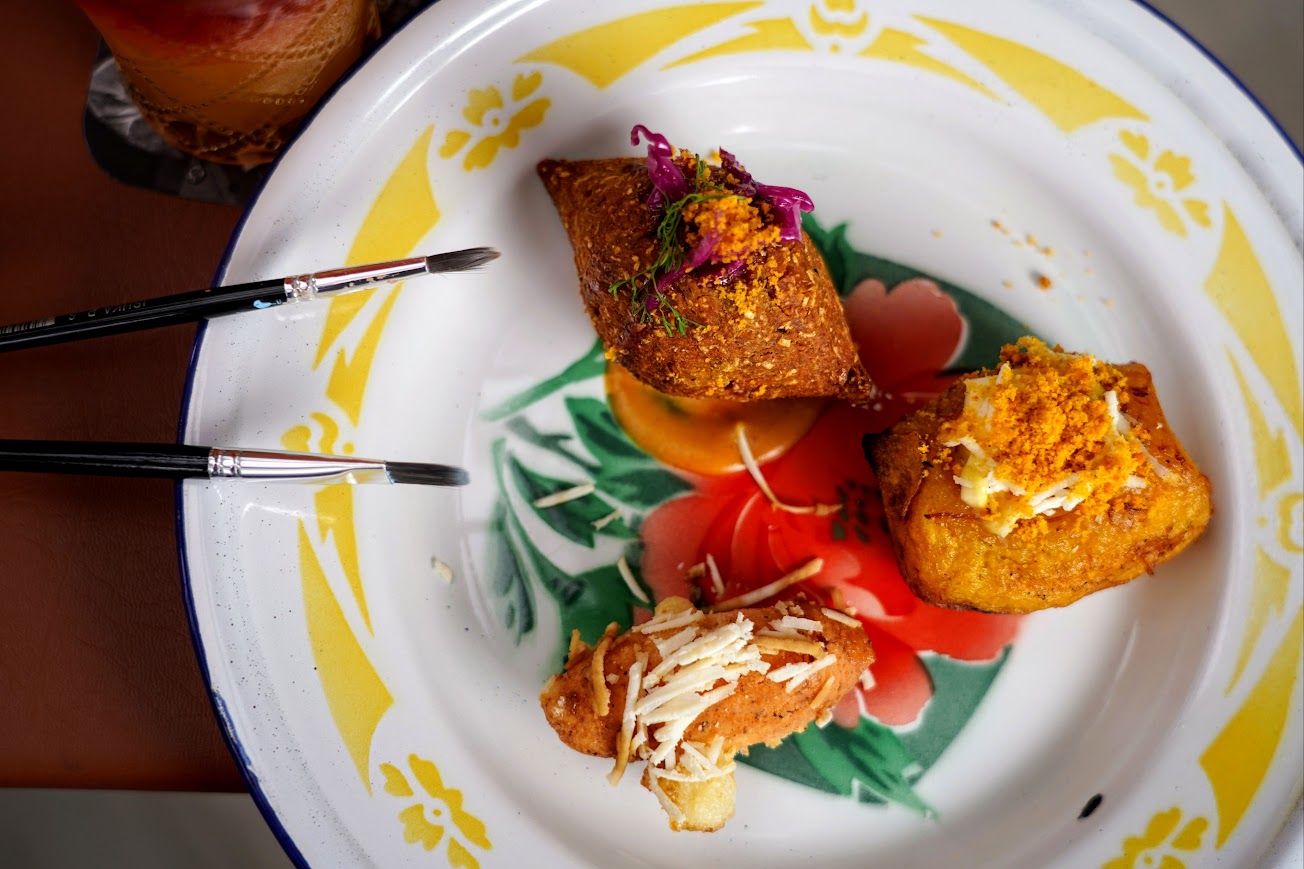
Food and painting are part of the art experience at the monthly Allpatelier.
Every artistic experience is conducted in English and Spanish as the participants are both expats and Cuencanos.
“My passion is arts and tourism. We always try to talk about Cuenca and culture,” said Felipe Cardoso. “We try to promote the arts through our classes.”
Cardoso, 39, grew up in Cuenca. He is currently with the Office of Tourism of Azuay Province. Prior to that, Cardoso worked for Ecuador’s Ministry of Tourism for Zone 6, which includes Azuay, Cañar, and Morona Santiago provinces.
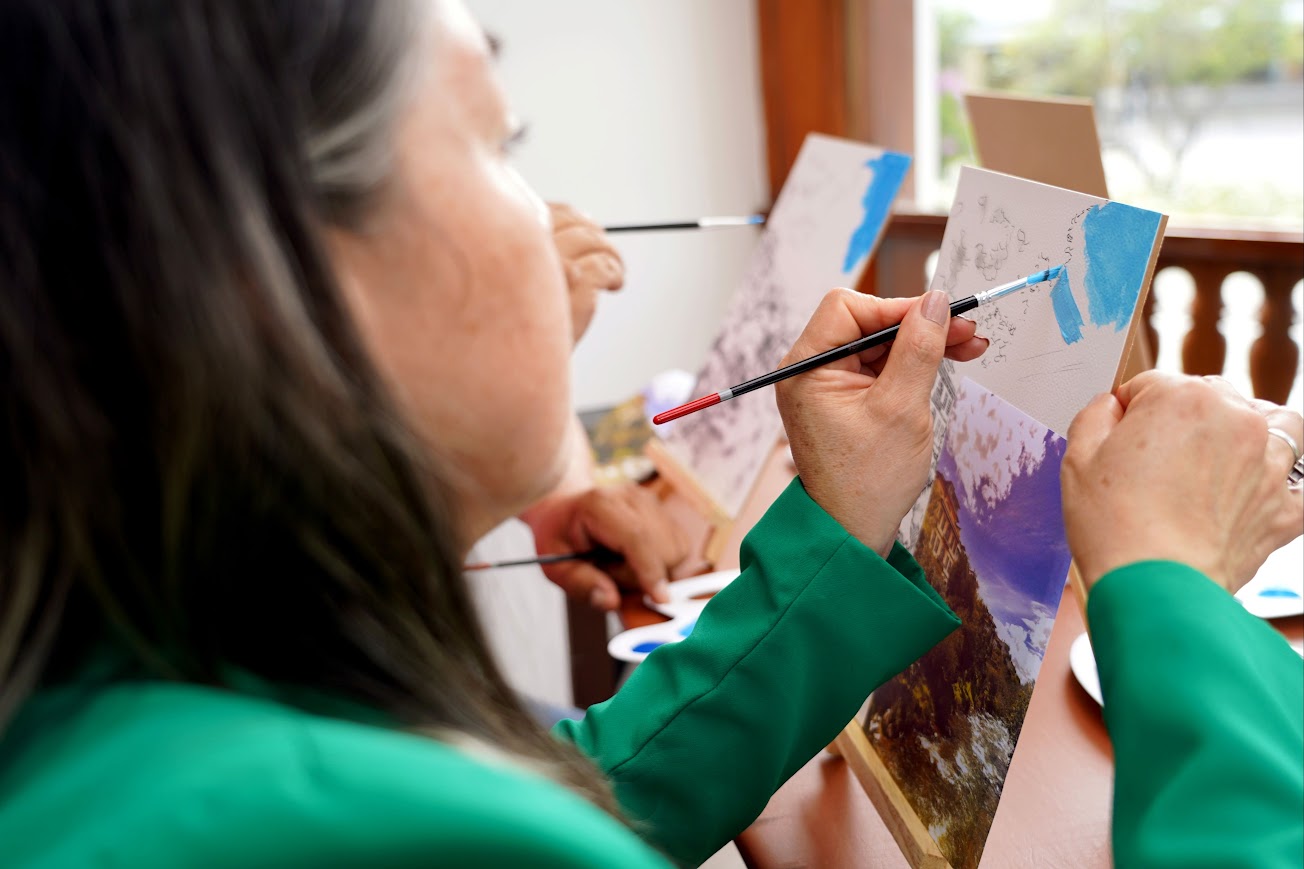
There is a new theme every month. For March, it was “Memories of the Tomebamba.”
“We talked about the Tomebamba and its history as that we are painting (in March’s session),” said Cardoso. “We always choose different patrimonial places.”
Their first artistic experience was in September at Nómadas Bistró, on Calle Larga. The art subject was Chola Cuencana, the living symbol of mestizo identity in Cuenca.
Two months ago, it was at Hotel Inca Real, a Republican-style building built in the early-nineteenth century and restored in 1991.
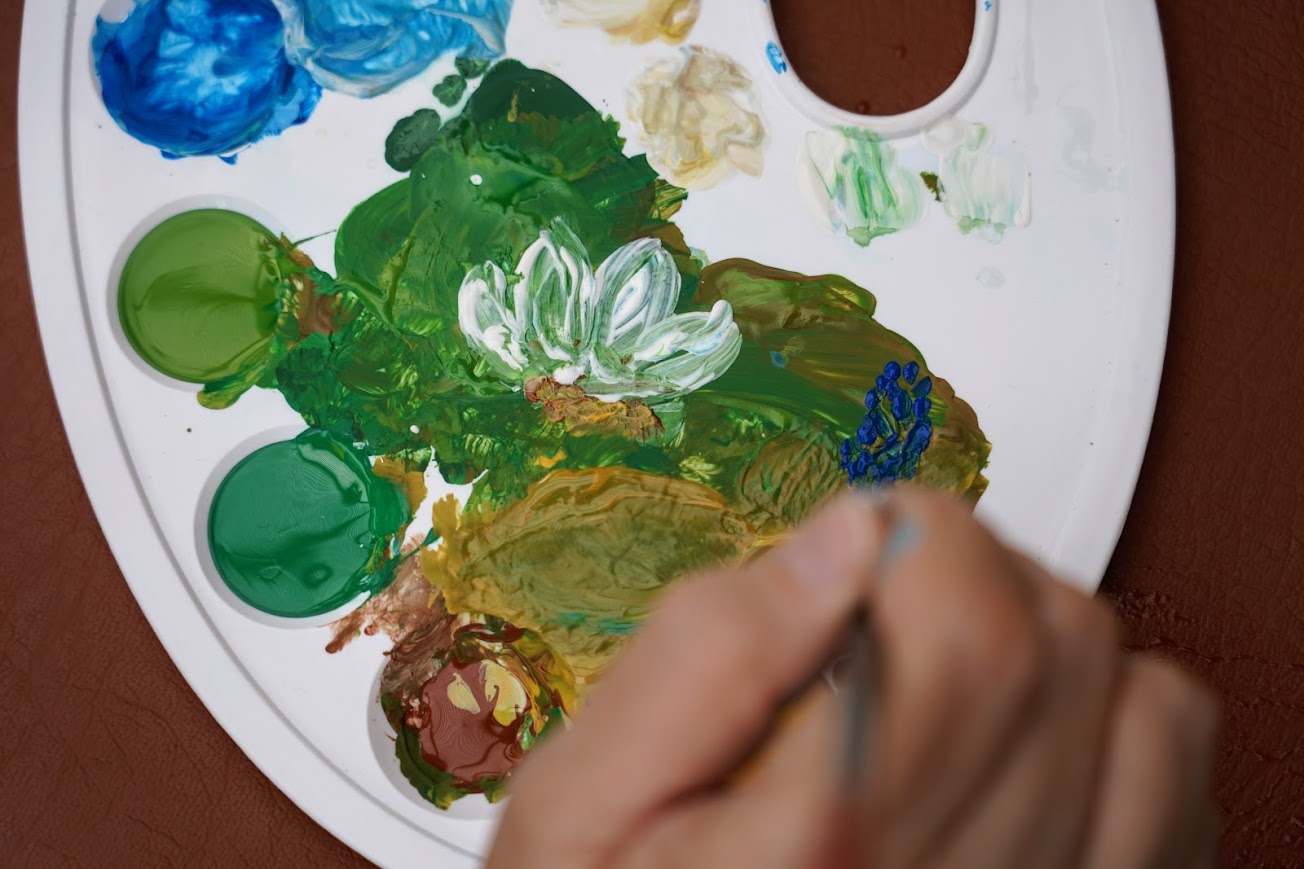
Happiness about the art experience is expressed on a painter’s palette.
“We gave them a tour of the hotel and explained the evolution of architecture in Cuenca,” said Cardoso.
For March, Allpatelier was held at La Esquina De Las Artes. Located directly across the street from the University of Cuenca’s Teatro Carlos Cueva Tamariz, at the corner of Av. 12 de Abril and Agustín Cueva, La Esquina De Las Artes was built as one of the first large homes on the south side of the Tomebamba River over 70 years ago.
Today, it is a cultural center, focused on the performing arts, visual arts, and gastronomy.

Every art experience involves a tour of a patrimonial home. For March, it was held at La Esquina De Las Artes, across the street from the University of Cuenca.
Cardoso led a tour of the renovated cultural center including a visit to Kinara, a store that sells art and traditional ikat textiles, and to Los Priostes Sazón Criolla, a restaurant with upscale Ecuadorian food.
It was a perfect place for the arts session that focused on the Tomebamba River as the participants could see the river from their seats on the second floor.
“Last month, we held Allpatelier at the Museum of Aboriginal Culture (Museo de las Culturas Aborígenes),” said Peter Dudar. “The museum has over 5,000 pre-Columbian pieces.”
Representing more than 20 pre-Columbian cultures going back some 15,000 years.
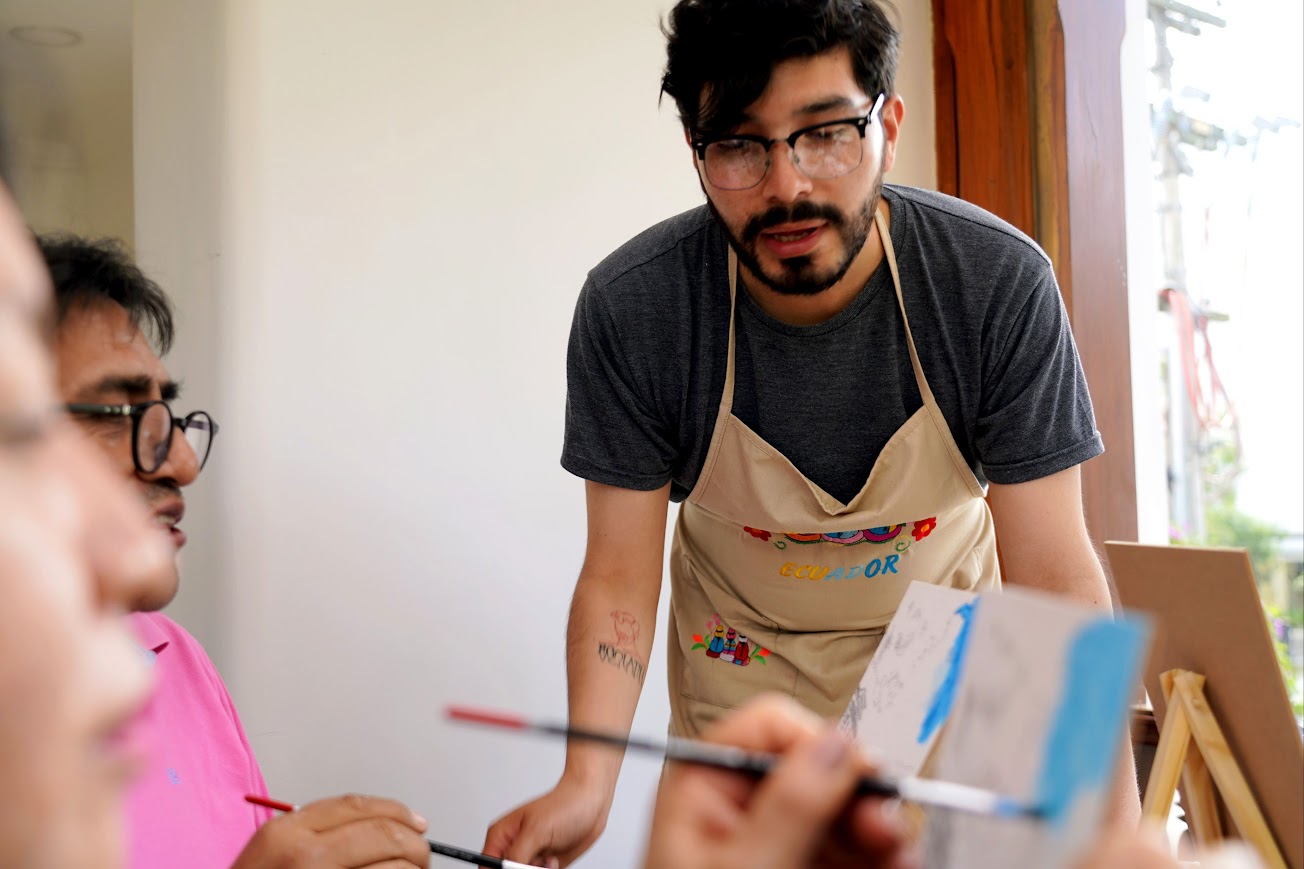
Artist Jorge Vallejo helping out fellow artists at the art experience.
Many know Dudar and his wife Sally Marr, who passed away last year, for their great generosity. They founded Compassion Kitchen, to help make and deliver around 2,000 free meals per month to people who will get little else to eat.
With his classical training as a pianist, Dudar performed for over two hours on his electronic keyboard while the participants painted their interpretations of the Tomebamba River. His huge repertoire is performed at every session.
“I think Felipe and Jorge came up with the idea,” said Dudar. “Because Sally was at Otis Parsons, the best art school in the United States, she and I used to do something similar in Los Angeles.”
The three men’s friendship help create Allpatelier.
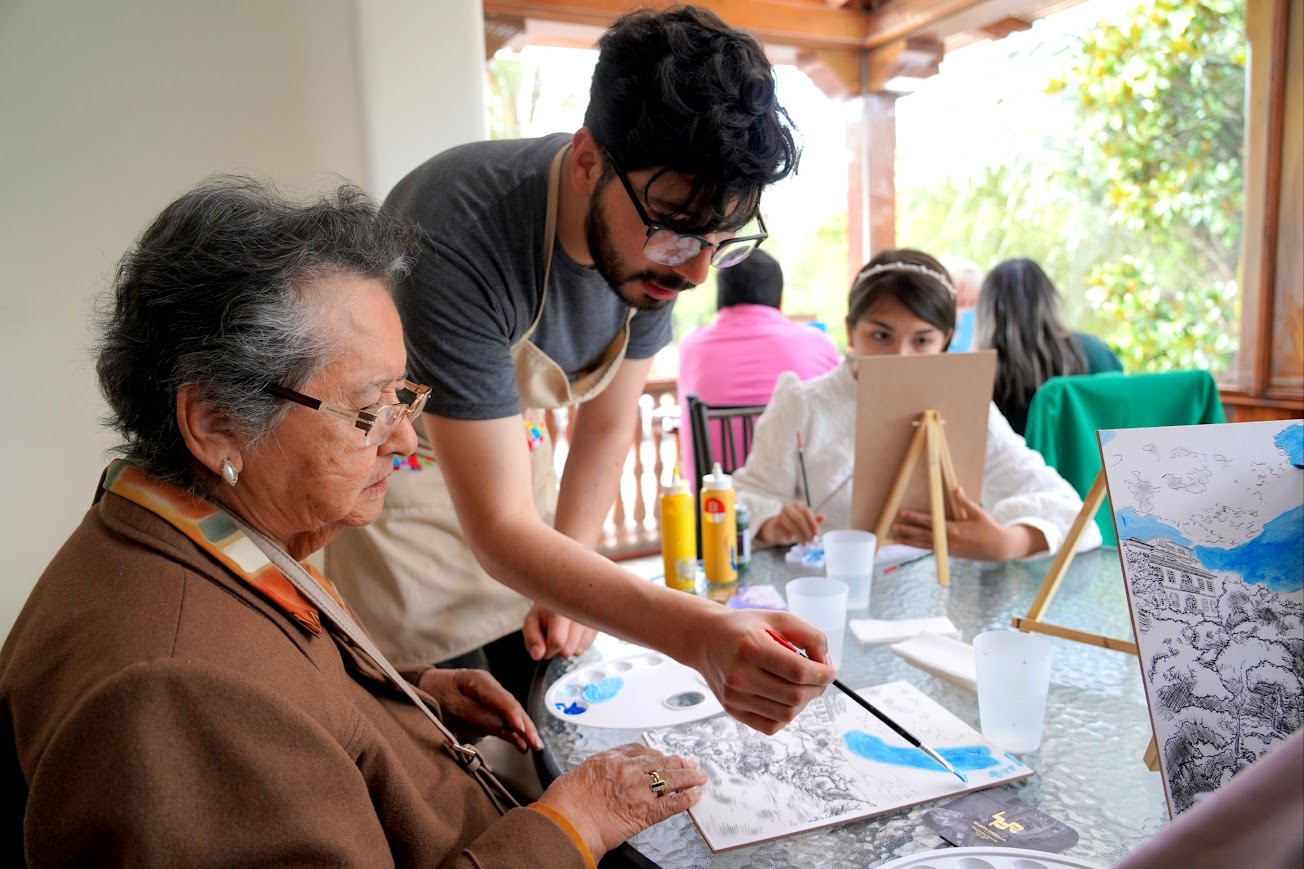
Jorge Vallejo uses his experience as an artist to help other artists with their paintings.
“It was 12 to 13 years ago I met Peter. He was an activist for the trees, and he needed my help to get interviews with the media,” said Cardoso. “I met Jorge four years ago because of common friends and because of our love of art.”
Vallejo has an arts workshop in El Centro with three other artists and conducts classes. His strong passion was perfect for Allpatelier.
“We are dehumanizing ourselves. We need the arts to resist it,” said Vallejo. “Humans are always performing. The arts allow me to be whomever I want to be.”
By learning painting techniques and styles from Vallejo, an individual can improve their own artistic abilities. This is really true in any area of art, whether it be painting, music or writing.
“It’s a fun way to make artwork for the house,” said Carrier.
Carrier sat next to her husband and two other people as she painted a scene of the Tomebamba River. By studying their own work alongside that of others at Allpatelier, one can identify areas in which they need to improve and work towards becoming a better artist.
Each artistic experience costs $35 per person with a different theme that is tied to the culture and history of Cuenca as well as Ecuador.
“We haven’t decided what April’s class will be. It will be about coffee or cacao,” said Cardoso. “It will have food, drinks, and live music from Peter.”
________________
Allpatelier, https://www.facebook.com/profile.php?id=61561035293042, Instagram: @flippcv / @jovencappus, 099-482-1507, 099-546-0141, allpatelier@gmail.com
Jorge Vallejo, Estudio 94, Honorato Vásquez y Presidente, Borrero, Second Floor, Cuenca, https://www.facebook.com/profile.php?id=61567886283087, 099-546-0141
Photos by Stephen Vargha
Stephen Vargha’s second edition of his book about Cuenca, “Una Nueva Vida – A New Life” is available at Amazon in digital and hardback formats. His award-winning blog, “Becoming Cuenca,” supplements his book with the latest information and hundreds of professional photos by him.