











Did seven inches matter?
Looking back at the Covid years is rather like looking back at a war. Everybody remembers the confusion, but not necessarily in the same order, and almost every decision can be defended by saying that nobody knew what would happen next.
next.
Anthony Fauci and other public-health officials in the USA had an impossible task. They were expected to provide definite answers about a new disease when the answers were still changing. Unfortunately, they did not always help themselves and advice was sometimes delivered as if it was a scientific fact when it was actually a temporary rule, or just guesswork, devised under conditions of uncertainty.
 Consider social distancing outdoors. Even at the time, it seemed improbable that walking past somebody in a park presented the same risk as sitting beside that person for two hours in a badly ventilated doctor’s waiting room. Nor did it seem likely that families scattered across a sunny beach were in quite the same danger as people crowded into a bar.
I had no scientific basis for thinking this. It merely seemed like common sense. Outdoors, the air moves and exhaled particles disperse. Sunlight is generally bad for the health of viruses and a beach is certainly not a sealed railway carriage.
Subsequent evidence largely confirmed that Covid was much less likely to be transmitted outdoors. Transmission was certainly possible in tightly packed crowds like soccer stadiums, particularly when people remained close together, shouting, singing or groaning. But an uncrowded beach was one of the safer places a person could be.
The problem was that government regulations are seldom designed to accommodate every distinction found in ordinary life. They tend to be broad, uniform and easy to enforce.
In the United States, people were instructed to remain six feet apart. In Britain, Ecuador, and much of the rest of the world, the prescribed distance was two meters. Two meters is approximately six feet seven inches.
Apparently, therefore, an American was considered safe at six feet, which could easily be measured with a yardstick, while a British person required another six or seven inches.
Nobody seemed especially troubled by this discrepancy and there was no international scientific controversy about the missing inches. British epidemiologists did not accuse Americans of recklessly standing too close together, and American experts did not complain that Britain was wasting valuable standing space on the London underground.
That alone should have told us that neither measurement represented a scientifically discovered boundary, but both were handy approximations expressed in the customary measuring systems of different countries.
Risk did not remain constant at five feet eleven inches and suddenly disappear at six feet. Nor did the virus circulating in London recognize the superior protection provided by the additional seven inches. Risk diminished gradually with distance and depended upon airflow, duration, crowd density, what people were doing, and maybe even altitude.
Nevertheless, convenient administrative measurements acquired the authority of laws of nature.
“Remain six feet apart” fits neatly on an American sign. “Keep two meters apart” fits neatly on a British one. “Judge the risk according to ventilation, duration, crowd density, vocal activity and prevailing viral variant” does not fit neatly anywhere.
This is not unique to public health. It is the very nature of government–regulations intended to cover millions of people inevitably produce absurdities at the margins. During an emergency, the margins can become remarkably large.
Vaccinations, when they arrived, produced an even more complicated mixture of science, government and national culture.
I was living in Ecuador and received the Chinese Sinovac vaccine. It was not an mRNA vaccine like Pfizer or Moderna. It used the older method of presenting the immune system with an inactivated version of the virus and since I had recently had a thrombosis in my leg and was already scared of dying, like that old-time religion, it was good enough for me.
Sinovac, research eventually showed, was less effective than the original Pfizer and Moderna vaccines at preventing symptomatic infection. It nevertheless provided useful protection, particularly against serious illness and death, which I particularly wanted to avoid. The World Health Organization approved it for emergency use, and it was administered widely in Latin America, Asia and elsewhere.
I never had Covid-19, as far as I know. I cannot say whether this was because of Sinovac, because I happened to avoid infection, or because I had an infection so mild that I never recognized it. Personal experience cannot answer a scientific question, though people have never stopped trying, especially on social media.
What interested me was that Americans who were apprehensive about the new mRNA technology were not offered Sinovac as an alternative. There were understandable regulatory reasons. Sinovac did not seek or obtain authorization from the US Food and Drug Administration or establish itself as an American supplier. Pfizer and Moderna also produced stronger initial trial results.
But there was surely some institutional and national chauvinism mixed into the response. A vaccine developed in China was unlikely to be welcomed enthusiastically into the United States during an intensely political pandemic, but the peculiar result was that the United States eventually recognized Sinovac vaccination received abroad for passengers entering the US, while not allowing Americans to choose it at home.
An American could therefore arrive from Ecuador with a valid Sinovac vaccination certificate, while his neighbor in Florida could not request to be given the same vaccine.
Someone who said, “I am willing to be vaccinated, but I would prefer a familiar inactivated-virus vaccine,” was expressing a position that might have been cautious without being irrational. Instead, public discussion frequently divided everyone into two camps: those who trusted science and those who opposed vaccination altogether.
That division concealed several quite different attitudes. Some people believed that vaccination itself was fraudulent. Some were concerned specifically about a newly introduced technology. Others believed the vaccines were beneficial, but objected to the government or employers making them mandatory. (However the same objections are hardly ever raised in the case of annual TB testing, which is mandatory for anyone who works in prisons or any healthcare facility.)
And some, I strongly suspect, were simply afraid of needles.
I have no evidence that this explained any particular person’s refusal. But fear of injections is common, and human beings are wonderfully inventive when finding respectable reasons to avoid something frightening or unpleasant.
It is embarrassing for an adult to say, “I don’t want somebody to stick a needle in my arm, because it hurts.” It sounds much more dignified to speak about constitutional liberty, pharmaceutical corruption, genetic manipulation, or insufficient long-term research.
The rationalization need not be consciously dishonest. We frequently experience an emotion first and discover our intellectual justification afterwards. A person feels anxious about being vaccinated, searches the internet, finds an argument supporting avoidance and eventually becomes sincerely convinced that the argument caused the anxiety.
One clue was the constantly moving objection. If mRNA technology was the problem, a person might have accepted Johnson & Johnson, Novavax or Sinovac. When every alternative generated a new objection, it was reasonable to wonder whether the real conclusion had always been, “I do not want that injection.”
Before Covid, widespread resistance to vaccination was not especially visible in most countries. There were determined opponents, and the discredited claim that childhood vaccines caused autism had done considerable damage. Certain communities experienced outbreaks of measles because vaccination rates had fallen. Resistance to polio vaccination also existed in parts of Africa and Asia.
But these remained relatively contained problems and vaccination had not yet become a comprehensive political identity.
Throughout much of the world, the more urgent difficulty was not persuading people to accept vaccines. It was obtaining enough vaccines and delivering them.
That was particularly true in Latin America. The Pan American Health Organization concentrated heavily on affordability, procurement, refrigeration, distribution and reaching people in remote communities. Its Revolving Fund allowed countries to pool their purchasing power and obtain vaccines at manageable prices.
An unvaccinated child in a poor or rural community was often not the child of an ideological anti-vaccination parent. The clinic might be fifty miles away, the vaccine might be out of stock, the refrigerator might not work. The nurse might not have arrived. The parents might be unable to sacrifice a day’s wages to make the journey.
These were less dramatic obstacles than conspiracy theories, but they affected millions of people.
My recollection of Ecuador during the Covid vaccination campaign is that availability was far more prominent than resistance. People wanted to know when they would become eligible, which vaccine they would receive and where they should go. Sensibly, the elderly got first dibs. There must have been hesitant individuals and rumors circulating on social media, but at the time I was unaware of anything resembling the organized resistance movement in the United States.
Ecuador had also experienced the horrifying early outbreak in Guayaquil, when hospitals, morgues and funeral services were overwhelmed. Bodies sometimes remained in homes for days, and some families, unable to obtain collection in the tropical heat, placed their dead outside wrapped in plastic or sheets. Global headlines describing “bodies in the streets” were therefore true, although they sometimes created the misleading impression that large numbers of people had simply collapsed and died where they lay, which was not really the case.
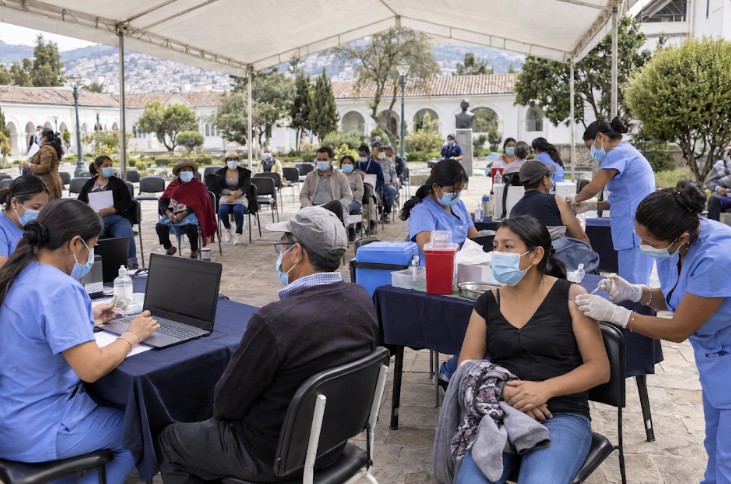
The government obtained Sinovac, Pfizer, AstraZeneca and other vaccines and organized a mass campaign. People went to vaccination centers, usually held outdoors under tents on university campuses, showed their cedulas or passports, rolled up their sleeves, and received what was available. Vaccination felt like a medical and administrative procedure, not a declaration of political allegiance.
It was also free, and everyone could have it, even if they were tourists or expats.
For a while people had to carry vaccination certificates round their necks to enter shopping malls where mysterious footprints had appeared everywhere on the floor to show you where to stand while waiting to enter a bank or store. And if you wanted to travel to the US, you could soon get a neatly typed up negative test letter for $10 after taking the test and waiting ten minutes,
That may be the most important lesson when looking back. The virus was global, but the social meaning of vaccination was local.
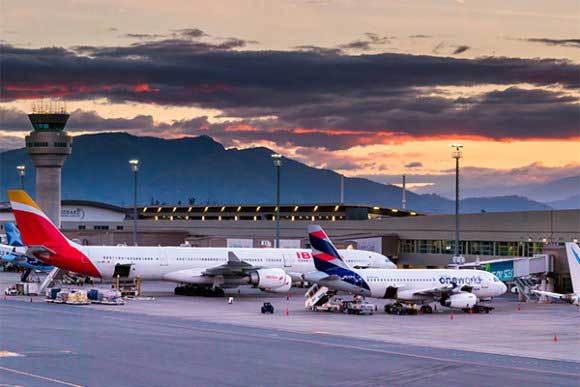
In the US, if you wanted to travel to Ecuador from the US you needed test results taken within 72 hours, but this could cost $200 per person and there was still no guarantee that you would get your result in time to fly. This was the case when my two daughters came to visit Ecuador, but I was still able to get them on a plane at Fort Lauderdale by talking loudly in Spanish and waving a stamped Health Department document in Spanish and my cedula under the noses of the airline gate agents. Remarkably, an international airport the size of Fort Lauderdale had no facility offering immediate testing inside the terminal.
In Ecuador, the central question was whether the government could obtain and distribute enough doses. In the United States, vaccination became entangled with party politics, individual liberty, distrust of government, pharmaceutical companies and cultural identity.
The injection might have been physically similar, but it meant something different in each country.
Public-health officials undoubtedly saved lives, and the vaccines substantially reduced serious illness and death. But officials also weakened trust when they spoke too confidently, failed to acknowledge uncertainty or treated reasonable questions as moral defects.
Governments require simple rules like not allowing toothpaste through airport security checks in case the tubes contain mint-flavored explosives. Science rarely supplies simple rules.
Perhaps the fairest conclusion is that at the time almost everyone was operating with incomplete information: governments, doctors, journalists, vaccine manufacturers and ordinary people. Some mistakes were unavoidable and others arose from institutional arrogance, political pressure or the familiar bureaucratic desire to turn complicated reality into a rule that would fit on a poster.
Six feet in one country, but two meters in another. Size may have mattered in other contexts, but when it came to Covid, nobody seemed particularly concerned about the missing seven inches.
And some vaccine objections may have arisen because an adult who was terrified of being pricked with a needle preferred to argue about the Constitution.