

















Does experience still matter in the age of AI?
A recent comment on one of my Cuenca High Life articles stopped me in my tracks.
The commenter argued that artificial intelligence is advancing so quickly that many of the skills people spent decades developing may soon have far less value than they once did.
After all, AI can already write articles, create marketing plans, analyze information, generate computer code, answer customer questions, and perform many tasks that were once considered professional work.
His argument was straightforward.
 If technology can do so much, what value remains in the experience of a retired teacher, manager, consultant, writer, engineer, or business owner?
It is a fair question.
Why Are People Questioning Experience in the Age of AI?
Many people are questioning experience in the age of AI because technology now performs tasks that once required years of training and professional expertise.
Most of us grew up believing that experience was one of life’s most valuable assets. We accumulated knowledge. We learned from mistakes. We developed judgment. And we gained perspective.
Then artificial intelligence arrived and seemed to challenge many of those assumptions almost overnight.
 Some observers see this and conclude that experience is becoming obsolete.
I am not convinced.
What Conversations Are Expats Actually Having?
Most expats are discussing life decisions rather than artificial intelligence itself.
When I sit in cafés around Cuenca and talk with expats, I rarely hear people discussing AI directly. Instead, conversations usually focus on healthcare, finances, family decisions, relocation challenges, relationships, and adapting to change.
Those are not technology problems.
They are human problems.
Technology can help solve them. Technology can provide information. And technology can even suggest options.
However, information alone is rarely enough.
 What Does Experience Provide That AI Cannot Easily Replicate?
Experience provides context, judgment, and perspective that are difficult to automate.
A person who has navigated a difficult marriage, raised children, changed careers, started businesses, survived economic downturns, cared for aging parents, moved across borders, and built a life in a foreign country possesses something that goes beyond information.
They possess perspective.
An AI system may know thousands of possible answers. Experience often helps us recognize which question actually matters.
That distinction may become more important, not less important, as artificial intelligence becomes increasingly capable.
Can Experience and AI Work Together?
The greatest opportunity may come from combining experience and AI rather than viewing them as competitors.
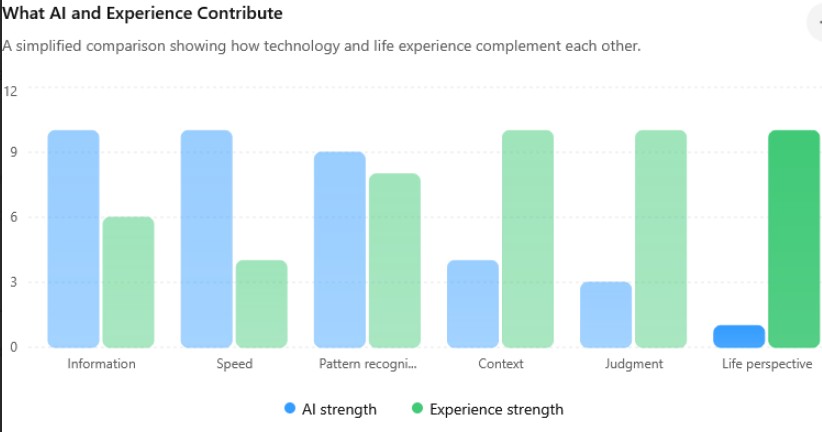 Ironically, the people who may benefit most from AI are not necessarily the youngest users.
 They may be people who already possess decades of judgment and life experience.
The combination is powerful.
One brings speed.
The other brings wisdom.
One provides information.
The other provides context.
One generates possibilities.
The other helps determine which possibilities are worth pursuing.
What Might the Future Look Like for Older Adults?
The future may belong to people who learn how to combine life experience with new technology.
 Many people over 50 have already adapted repeatedly throughout their lives. They have adjusted to changing careers, economic cycles, personal challenges, and major technological shifts.
Artificial intelligence may simply be the next adaptation.
A recent article titled “Experience Still Matters in the Age of AI” explored this question from a personal branding perspective. It raised an interesting possibility. As AI becomes more capable, the challenge may not be proving that experience matters. The challenge may be learning how to communicate, package, and apply that experience in a rapidly changing world.
That seems like a conversation worth continuing.
Especially for those of us who have already spent much of our lives adapting to change.
For readers interested in exploring what experience actually gives us beyond knowledge and information, I examine that question more deeply in a companion article on Next Cradle.



Hogar Esperanza News

Fabianos Pizzeria News

Fund Grace News

The Cuenca Dispatch

Week of September 20

Ecuador turns to industrial power cuts to protect Mazar and keep homes from going dark.

Ecuador raises its 2026 growth forecast, but El Niño could spoil the outlook next year.

Cuenca retirees challenge medical and therapy changes at IESS senior center.