













Early success of Ecuador’s anti-narco campaign prompts widespread optimism
By Brian Winter
When masked criminals in Ecuador invaded a TV station, took prison guards and police hostage and paralyzed the business capital of Guayaquil in early January, the prevailing reaction across the Americas was: Oh no, here we go again.  Another country overwhelmed by organized crime. Another possible narcostate in the making.
But in the weeks since, Ecuador has shown unexpected resilience, led by its new president, Daniel Noboa. The 36-year-old leader has overseen a firm but calibrated response, jailing hundreds of suspected gang leaders and reestablishing some control of prisons and other institutions while also, in the words of one regional official, “not going full Bukele” – not casting aside the constitution or human rights in the manner of El Salvador’s hard-line leader.
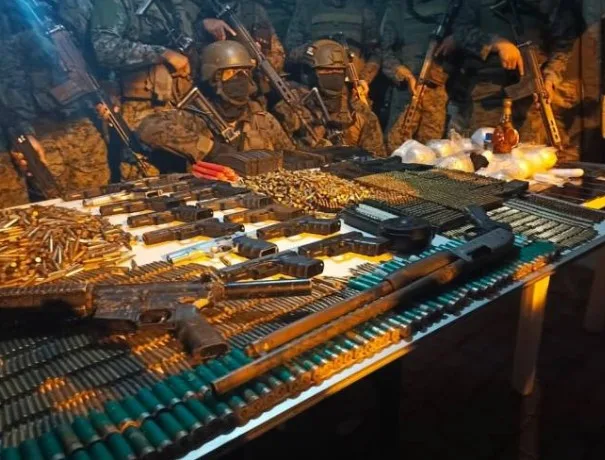
Weapons and ammunition seized from a prison in Guayaquil.
A poll taken in mid-January, after Noboa declared a “state of internal conflict” to battle the gangs, showed the president with 80% approval, extraordinary for one of Latin America’s most polarized and sometimes ungovernable countries.
“Ecuadorians are deeply worried. They fear they could lose their country,” Maria Teresa Escobar, a journalist based in Quito, told me on this week’s Americas Quarterly Podcast. But people are also “optimistic … because for the first time, a government recognizes that this is not a (normal) crisis, but an internal and very violent conflict. That brings hope.”
Noboa has a limited window to keep that momentum going – and he will need help from both Ecuadorians and allies abroad.
And yes, “help” means money. Quite a bit of it.
Noboa took office on November 23 in a country where government revenues fell 10% last year, largely because of the security crisis, pushing the fiscal deficit to almost 5% of GDP. Ecuador’s past as a serial defaulter means it has little access to private credit. Cash is so tight that some government salaries for January will be paid with a two-week delay, with priority given to security forces, followed by doctors and teachers.
Noboa has asked the United States and Europe to help refinance Ecuador’s debt and provide funds “so that we are not financially strangled while we wage this war.” Officials were in Washington last week to seek support from the International Monetary Fund and other multilateral banks. Getting it is not a slam dunk: Ecuador already has a $6.5 billion loan program with the IMF, and Noboa himself has decried “brutal inefficiency” in how the public sector, one of Latin America’s largest in relative terms, spends money.
Still, many voices inside the Biden administration and elsewhere in Washington seem to recognize that partners like Noboa, who holds an MBA from Northwestern and a Masters’ degree from George Washington University, don’t come along very often. Ecuador’s challenge is firmly in “act of God” territory: An existential battle with Mexican, Colombian, Albanian and other organized crime groups who, flush with cash from the doubling of cocaine production in Latin America over the last decade, are battling each other, and the government, for critical ports and smuggling routes. Previous leaders have been unable or unwilling to stop cartels from penetrating and, in some cases, controlling Ecuadorean institutions.
There is also a domestic consideration: In the first 11 months of the 2023 fiscal year, the U.S. Border Patrol apprehended almost 99,000 Ecuadorians entering the U.S. without authorization, a whopping 312% annual increase. There has rarely been a better chance to address the “root causes” of what polls suggest is President Biden’s number-one vulnerability in this election year. Options include not just more IMF support but including Ecuador in special trade benefits extended to some Caribbean nations, a bipartisan idea currently before the U.S. Senate.
“This is something this administration could do in short order for one of our diminishing number of friends and allies in Latin America,” Todd Chapman, a former US ambassador to Ecuador, told me.
There have also been offers of intelligence sharing and other help from Brazil, Argentina, Colombia, Peru and others who seem to understand, to varying degrees, that allowing Ecuador to deteriorate further would destabilize the whole region. The creation of a new “border security network” among Andean countries may offer some promise.
That said, there is no doubt that much of the money for the security buildup will have to come from Ecuadorians themselves. Noboa’s proposal to increase the value-added tax from 12% to 15% has run into resistance in Congress. Even some allies have complained the tax is highly regressive, and that Ecuador’s wealthy should pay more of the burden.
Ecuadorians may want to consider a page from Colombia’s recent history. During his first year in office in 2002, facing a similar crisis, President Álvaro Uribe convinced his country’s wealthiest citizens to pay a one-time “security tax” of 1.2% of their liquid assets. He guaranteed the funds would be used only for building up the army and police and set up a special committee allowing private-sector leaders to monitor the spending in near real-time.
The tax ended up raising about $1.3 billion in today’s dollars, allowing Colombia to expand its security forces by about 25,000 people in Uribe’s first year in office. Homicides fell 20%, beginning a significant long-term decline in violence.
“It’s an idea that could work for Ecuador,” Uribe told me this week. “There are no easy paths.”
_________________
Brian Winter is the editor-in-chief of Americas Quarterly and an analyst of Latin American politics, with more than 20 years following the region’s ups and downs.
Credit: American Quarterly