












Ecuador struggles to identify sources of illegal arms
By Carlos Bravo and Gavin Voss
In recent years, Ecuador has been engulfed in a wave of violence driven by organized crime — a crisis fueled in part by the authorities’ inability to identify where criminals are obtaining their firearms.
 The expansion of organized crime over the past five years has led to a historic security crisis. In 2024, Ecuador recorded the highest homicide rate in South America. Since 2019, the country’s homicide rate has surged more than 500%, rising from 6.7 to 38.8 per 100,000 people, driven by clashes between criminal groups like the Choneros, the Lobos, and the Tiguerones.
These groups are increasingly relying on high-powered firearms to carry out attacks against rivals and assert territorial control. In Ecuador, nine out of 10 violent deaths are committed with firearms, according to Carla Álvarez, a firearms expert who spoke to InSight Crime.
Authorities struggle to trace the origins of many seized weapons, according to data obtained by InSight Crime. Of the 13,613 firearms seized between January 2023 and April 2024, 27% were of unknown origin. Another 25% were manufactured in Ecuador and 10% in the United States, according to police data.
A former official from Ecuador’s Defense Ministry, who requested anonymity for security reasons, said nearly 40% of the firearms classified as “unknown origin” are believed to be produced artisanally — illegally manufactured in informal workshops across the country. Another 25% are produced industrially, while the method of manufacture for the remaining 35% is unclear.
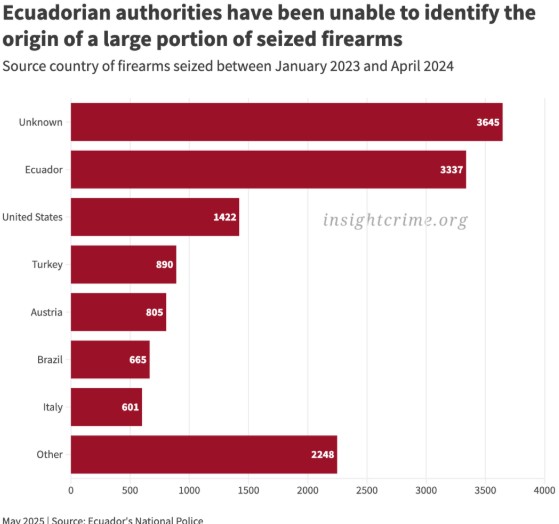 The lack of traceability is especially troubling when it comes to long guns, which Ecuador does not produce at an industrial scale. These weapons are mostly trafficked into the country — primarily from the United States, Turkey, and European nations — and are used by transnational criminal groups to consolidate control over territory and drug trafficking routes. In contrast, improvised or homemade firearms are more commonly used in street crimes like robbery.
Authorities’ inability to trace the origins of firearms or disrupt their flow stems from institutional dysfunction and judicial processes that focus on prosecuting individuals while neglecting the origins of the weapons used.
Part of the problem lies in the absence of reliable records and the lack of institutionalized, automated procedures to ensure coordination between the armed forces, the police, and the judiciary.
The institutions’ databases are not fully integrated, and law enforcement agencies often ignore contextual variables that could help determine where the weapons came from, according to a police officer who works in criminal intelligence and spoke to InSight Crime on condition of anonymity for security reasons.
“The judicial process focuses on those caught red-handed in possession of weapons, not on the weapons themselves,” the officer said.
Seized weapons are sent to police storage facilities until judicial proceedings are completed, after which a judge orders either their destruction or donation. But authorities have prioritized disposing seized weapons over tracing their origins — a decision that also weakens the judicial process.
“Not knowing where most of the firearms come from directly impacts the administration of justice,” Álvarez said. Without a clear chain of custody, it becomes difficult to identify a weapon and link it to an individual — a problem that undermines prosecution and sentencing.
The inability to trace firearms is a region-wide issue. A 2017 investigation by InSight Crime exposed the many challenges authorities in Honduras faced as they tried to control the influx and circulation of firearms in the country.
To address the issue, Ecuador needs a more comprehensive approach to its firearms policies and procedures. A key step, Álvarez argued, would be to ratify the United Nations Arms Trade Treaty (ATT). Ecuador has yet to ratify the treaty, which aims to regulate the international arms trade and prevent weapons from being diverted to unauthorized users. It also requires states to report arms imports and exports.
“Firearms management must be improved,” Álvarez said. “There’s very little information about what weapons are being imported.”
________________
Credit: InSight Crime