















Ecuador’s Amazon coffee farmers get ahead of Europe’s new anti-deforestation import rules
By Sibélia Zanon
“What motivates us most is being able to say, ‘I take care of the environment, I don’t cut down trees, and my coffee will be valued more highly,’” said Victoria Alverca Peña, a farmer for 25 years and co-founder of APECAP, a small coffee and cacao producers’ association in Zamora Chinchipe Province. “I’ll be able to sell it under better conditions, and my work will be much more valued.
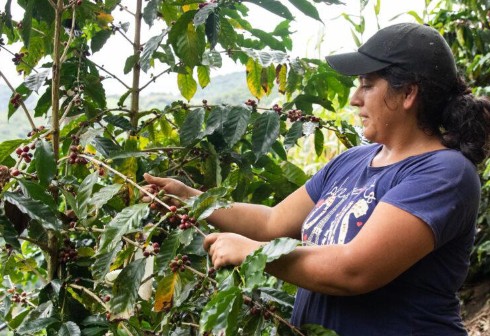
Coffee cherry picking in the Southern Ecuadorian Amazon. Image courtesy of Ecuador Integrated REDD+ Program – UNDP.
“In our farms, besides coffee, you’ll find cacao, timber trees, fruit trees and even short-cycle crops,” she added. “When the coffee plants are still young, we can grow crops like corn, cassava or plantains. This provides us with food security.”
At the end of this year, the European Union Deforestation Regulation (EUDR) is set to go into force, prohibiting imported products linked to deforestation from entering the EU market. Coffee is among the target commodities, and in southern Ecuador, a group of coffee growers has been ahead of the curve in preparing for the EUDR implementation. Since 2019, nearly 400 farmers here have adopted a model that combines forest conservation, traceability, and geospatial monitoring as part of the Deforestation-Free Coffee Initiative, at work in 23 areas across the region.
Between 2019-2021, the project developed Ecuador’s first deforestation-free coffee production model. The effort relies on a national protocol developed by the Ecuadorian government and the United Nations Development Programme (UNDP), which uses satellite imagery, traceability systems, and independent verification to track where coffee is grown and whether forests have been cleared or degraded to make way for coffee farms. As part of the initiative, UNDP and the government also work with Italian coffee company Lavazza, which includes Amazonian coffee in its supply chain, creating demand for traceable products.
Between 2022 and 2024, approximately 86 metric tons of this coffee was exported, mainly from Zamora Chinchipe, a densely forested and mountainous province in southern Ecuador that has been consolidating its reputation as a high-altitude coffee-producing hub. The most significant growth occurred in 2025, when exports in a single year matched the combined total for 2022-2024. The initiative has now reached a cumulative 172.5 metric tons over four years.
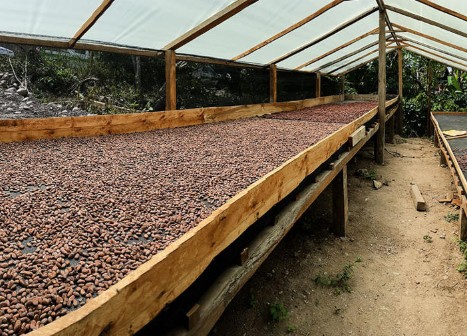
Coffee drying in Zamora Chinchipe Province, in the southern Ecuadorian Amazon.
“This is not just about exporting more tons, but about consolidating a model that demonstrates that conserving Amazonian forests can be compatible with competitiveness, compliance with international regulations and dignified income generation for small producers,” Juan Merino, the project coordinator from the UNDP, told Mongabay by email.
In its early years, the project focused on strengthening the organizational and commercial capacities of producers’ associations, promoting sustainable and deforestation-free farming practices, and developing a traceability system that could meet the requirements of international markets. The gradual incorporation of new producers and price premiums for deforestation-free coffee also encouraged organizations to prioritize this market segment, creating new economic opportunities for farmers in the Amazon region.
Despite its results, experts say the experience still faces challenges in scaling up.
Building deforestation-free supply chains
This transformation on the ground comes amid major shifts in requirements for access to the European market. Approved in 2023, the EUDR establishes new rules aimed at preventing deforestation-linked products from a group of seven commodities from entering the EU market. The law was originally due to go into force in December 2024, but has since been postponed twice, first to December 2025 and later to December 2026. The latest deadline applies to large operators and traders, while micro and small enterprises have until June 2027 to comply.
The regulation requires companies to prove that the products they want to sell into the EU don’t come from land deforested after 2020, and to provide detailed geolocation data for production areas. Considered one of the most comprehensive laws ever adopted to tackle deforestation linked to global trade, the regulation has the potential to reshape tropical agricultural supply chains.

About 90% of the coffee produced under the Deforestation-Free Coffee Initiative goes to Europe.
Over the past four decades, Ecuador has lost approximately 1.2 million hectares (3 million acres) of forest cover, according to data from MapBiomas Ecuador, a satellite-based land-use monitoring initiative. Over the same period, agriculture, forestry and other productive activities expanded by more than 18%, becoming some of the main drivers of native vegetation loss in the country, including in its Amazonian region.
Analyses by the Amazonian Network of Georeferenced Socio-Environmental Information (RAISG), a coalition of research organizations monitoring environmental and social trends across the rainforest, and MapBiomas Amazônia indicate that between 1985 and 2023, the entire Amazon lost more than 88 million hectares (217 million acres) of forest — roughly an eighth of the biome’s original cover, or an area three times the size of Ecuador. During the same period, cropland and pasture areas expanded by approximately 598% in lands cleared of natural vegetation, highlighting intensified land use as a key driver of forest loss across the Amazon region that spans nine South American countries.
In Ecuador, the Deforestation-Free Coffee Initiative emerged as part of broader efforts to reduce pressure on forests, with farmers adopting practices to improve coffee production while maintaining forest cover.
Under the initiative, coffee is grown alongside timber and fruit trees and other crops in agroforestry systems, while producers receive guidance on fertilization, composting and crop management. According to Peña, the local farmer, the goal is to increase productivity on existing farmland rather than clear new areas for cultivation.
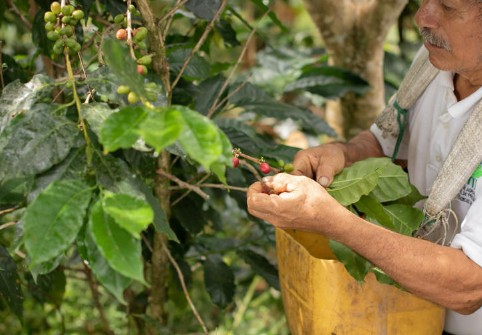
Under the Deforestation-Free Coffee Initiative, coffee producers in Ecuador have helped fight deforestation and increased productivity through sustainable practices.
The project has also introduced more systematic farm management practices. Farmers are encouraged to keep field notebooks recording harvests, pruning activities, production costs, and other information that helps them monitor their farms over time.
“For many producers, especially older ones, keeping records was difficult at first,” Peña said. “Now, their children and grandchildren often help with the notebooks. We can compare results from previous years, see whether yields improved, and understand what worked and what didn’t.”
APECAP, the association she co-founded, regularly organizes exchanges between farmers, allowing them to compare different approaches to coffee production. “We take a producer harvesting 20 bags and visit one producing 60,” Peña said. In such cases, the higher-yielding farms typically combine denser coffee plantings with shaded cultivation systems, she said. Some farmers have increased planting density from about 2,000 to 3,000 coffee plants per hectare, or about 800-1,200 plants per acre, while also improving fertilization and crop management.
Currently, 373 producers participate in the initiative, with a combined cultivated area of nearly 5,000 hectares (about 12,300 acres). Within these areas, more than 1,200 hectares (3,000 acres) of natural forest remain conserved. Since the project’s inception, farms have been monitored through georeferenced perimeter mapping, cross-checking with official forest-cover maps and analysis of data from Global Forest Watch. The methodology allows tracking of how the forest cover change on each property over time.
By improving productivity and market access for coffee already cultivated on existing farms, the initiative aims to strengthen sustainable production systems without expanding agricultural areas in the Amazon. The strategy emerged in a region where agricultural expansion has been a major source of pressure on forests. A study produced under Ecuador’s PROAmazonía program found that cattle ranching was the main land use associated with deforestation at national level, while cultivation of coffee, cacao and oil palm were among the agricultural activities linked to expanding farmland in parts of the Ecuadorian Amazon.
Regular monitoring helps farmers prove that their coffee comes from farms that haven’t been recently deforested, while working together reduces costs and improves market access.
“The project contributes to reducing pressure on the forest,” UNDP’s Merino told Mongabay. “This is especially relevant considering that, in the project’s intervention area, we identified an average annual deforestation rate of approximately 3.44% between 2016 and 2022.”
Access to international markets has brought more stable income to producers, reducing their vulnerability to price volatility. To help farmers meet quality standards and better navigate these opportunities, more than 100 producers and technicians participated in barista and international market workshops between 2020 and 2024.
According to FAPECAFÉS, a federation that brings together coffee producers’ associations in southern Ecuador, about 90% of the coffee produced under the initiative goes to Europe, with France, Germany and Italy among the main destination markets. Early shipments included roughly 17 metric tons exported to Italy, a volume that later doubled to about 34 metric tons. By the end of 2025, exports had reached 172.5 metric tons — equivalent to five shipping containers — worth $1.7 million.
In 2025, the Ecuadorian government launched a nationwide effort to register and georeferenced, or map with coordinates, the more than 100,000 coffee and cacao producers across the country’s 24 provinces. The aim is to help farmers from both Amazonian and non-Amazonian growing regions meet the traceability requirements of the EUDR.
Efforts similar to Ecuador’s Deforestation-Free Coffee Initiative have been tested in Costa Rica and Colombia. Experiments involving other commodities, such as cacao (also subject to EUDR scrutiny) and dairy, are also underway.
Drawing on his experience with sustainable commodity and landscape initiatives in Latin America, Beto Mesquita, director of sustainable landscapes at the NGO Conservation International, said projects such as Ecuador’s as valuable learning opportunities.
“These cases generate useful examples and help us understand what works and what doesn’t,” he said. “To scale this up, you need to bring in other actors and combine it with public policies and a level of technical assistance and rural extension that can meet the demand.”
Obstacles to the transition
Scaling up deforestation-free production systems remains a challenge. Lisandro Inakake, project manager at Imaflora, a Brazilian nonprofit that certifies forestry and agricultural activity, said many initiatives have delivered positive results at the local level but struggled to move beyond pilot projects. “There are many pilots and little consolidation,” he said.
The coffee industry is often highlighted as one that’s culturally aligned with traceability demands. “It’s part of the business model. I want to know that bean, with that quality, from which micro lot it came. It’s cultural,” Inakake said.
He added coffee tends to allow for greater traceability at the farm level. Still, he said, expanding deforestation-free production requires continued support for smallholder farmers.
According to Merino, the coffee project in southern Ecuador aims to transform the model into a scalable platform, incorporating new producers, expanding traceability, and strengthening access to increasingly demanding markets — without losing sight of the forest conservation that underpins the initiative.
________________
Credit: Mongabay



Hogar Esperanza News

Fund Grace News

Fabianos Pizzeria News

The Cuenca Dispatch

Week of September 20

Ecuador turns to industrial power cuts to protect Mazar and keep homes from going dark.
Ecuador raises its 2026 growth forecast, but El Niño could spoil the outlook next year.
Cuenca retirees challenge medical and therapy changes at IESS senior center.