
















Ecuador’s employment crisis: Despite population growth, the number of formal jobs continues to drop
By Liam Higgins
Between April 2015 and April 2025, Ecuador not only failed to generate enough formal employment to keep pace with its growing working-age population — it actually lost jobs.
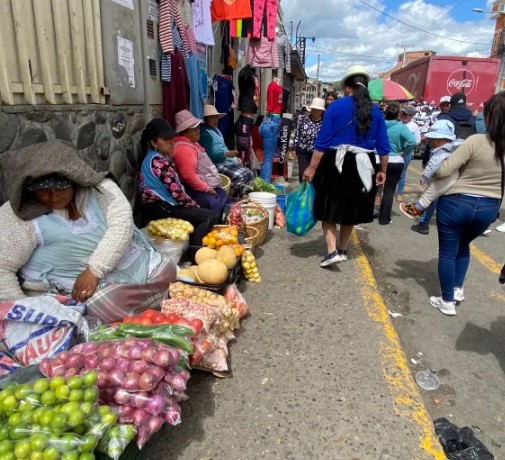
The government says that 60% of Ecuadorians work in the informal market but experts say the real number is much higher.
According to experts both in and out of government, the employment decline is a key factor in the country’s security crisis, especially in the coastal provinces.
According to economist Luis Tobar Pesántez, Director of Economics at the Salesian Polytechnic University, “Comparing total employment over the past decade, there is a net loss of 52,870 formal jobs.” A disturbing detail in the numbers, he says, is that the only segment showing a slight increase is public sector employment, with 25,896 new positions. In contrast, private sector employment declined.
According to government data, private employment fell from 2,273,006 in April 2015 to 2,246,994 in April 2025. Meanwhile, public sector employment rose from 623,824 to 649,720. In other words, during a decade marked by fiscal crises, political instability, and sluggish growth, the state was the only net creator of jobs — albeit with increasingly limited resources and growing fiscal deficits.
In addition to the contraction in private sector employment, even traditional job categories saw declines. Domestic employment dropped by 39,432 positions — from 105,013 to 65,581 — while affiliations to the agricultural-based Peasant Social Security program decreased from 370,810 in 2015 to 357,488 in 2025.
What is particularly alarming, says Pesántez, is that the economically active population grew by more than 1.1 million people, from 7.37 million to 8.49 million over the past decade.

One obstacle for foreign investors, economists say, is the difficulty and expense of moving profits out of the country.
Ecuador has struggled to attract foreign investment. In 2024, the country ranked second to last in Latin America for foreign investment, receiving just $318 million — the lowest level since 2012. Although the first quarter of 2025 showed a slight increase — $125 million, compared to $109 million in the same period of 2024 — the increase was not due to new projects but from a reduction in debt payments between related companies.
“The absence of public, private, domestic, and foreign investment — driven in part by a lack of confidence in the country — has led to inadequate job creation, especially for young people, where the problem is reaching alarming levels,” says Pesántez.
According to University of San Francisco professor Jorge Quinde, employment is, in fact, growing in one area — the informal market. “The government says that informality accounts for 60% of employment in the country, but I believe the figure is much higher, at least 70%,” he says. “Most of this, unfortunately, does not pay a living wage and the part that does is usually illegal, such as drug transport and sales and gold mining. And, of course, those in the informal market do not pay taxes.”
Quinde claims the government has done “far too little” to reign in informality. “Part of the reason is that there is not sufficient formal employment available, so it turns a blind eye.”
Ecuador’s Central Bank (BCE) announced last week that the economy grew 3.4% in the first quarter of 2025, and it may reach 4% by year’s end. However, former Economy Minister Fausto Ortiz claims this is merely a “statistical rebound,” not a sign of structural improvement.
Following a 2% economic contraction in 2024, the rebound in 2025 merely recovers lost ground, Ortiz says. Averaged from 2023 to 2025, GDP growth is about 1% per year, below the 1.5% annual population growth rate. “This means the economy is not expanding fast enough to create jobs or improve living standards,” Ortiz says. “There’s no way to ignore this gap. At this rate, economic numbers cannot disguise the lack of opportunities, which feeds the broader security crisis.”
In short, lack of employment is contributing directly to rising insecurity and crime, he adds. “It is not surprising that the problem is most acute in the areas where there is the largest mismatch between population growth and job creation, such as Guayas and Manabi Provinces.”
Economist Pedro Mendoza claims that “employment is not created by decree or statistical tricks,” but by trust and a favorable environment for investment. “Fresh capital inflows into Ecuador depend on general stability and an infrastructure of clear, predictable business rules,” he says. “This must exist before there is major investment in new factories, shops and services. Without this, only the informal economy will grow and, as we know, this leads to crime and corruption.”
There is another problem, Mendoza says. “To attract more international investment, it must be easier for investors to send money out of the country,” noting that the exist tax on foreign money transfers is an impediment to investment. He adds, “It is important to understand that the positive growth numbers presented by the government are not the result of new investment but more to a decrease in profit repatriation and debt payments abroad.”
According to almost all economists, President Daniel Noboa’s government faces a critical challenge. “If the 2025 rebound is to evolve into real growth, the administration must do much more to create a favorable investment climate,” says economist Andrés Rodríguez. “It must build trust, create conditions favorable for investment and ensure that every point of GDP growth translates into new jobs.”
This will not be easy, Rodríguez concedes. “Noboa’s government must actively confront legal uncertainty, labor rigidity, political volatility, and overall fiscal instability. And of course, he must also follow through on his commitment to control crime.”