














Ecuador’s jubilado visa in 2026: What the rules actually say now and how they change
By Christoph Wackher
The pension bar moves every January, and last October’s reform of the migration law matters to people already living here, not only to newcomers.
Much of what circulates about the jubilado visa is passed along by word of mouth, and word of mouth ages. Two things have moved recently: the income figure, which changes every January, and the Ley Orgánica de Movilidad Humana itself, reformed in October 2025. I read the current rules in Spanish, from the Foreign Ministry’s procedure page, the law and its regulation. Here is what they say, and what they don’t say.
The number is not a fixed number
The test is not written in dollars. The regulation (Art. 65) asks for an official document from the paying institution abroad, public or private, certifying a monthly pension of at least three Salarios Básicos Unificados: three times Ecuador’s basic wage.
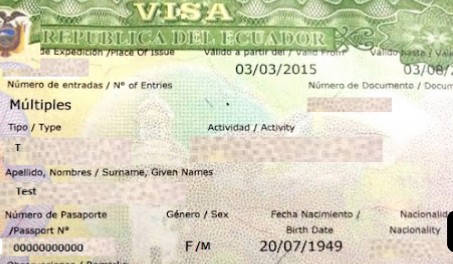 On 15 December 2025 the Ministry of Labour set the 2026 basic wage at $482, up $12 from 2024. So the bar this year is $1,446 a month. On the 2025 wage of $470 it was $1,410. Each dependant on the application adds $250 a month, so a pensioner with one dependant need $1,696 for the visa.
It will move again in January 2027 with the new wage. If your pension sits close to the line, check the figure on the day you file, not the one you remember.
Papers, fees and filing
You need a passport with six months left on it; the pension certificate, apostilled or legalised; a criminal-record certificate from your country of origin or every country you lived in during the last five years, translated and apostilled; proof of health insurance, national or foreign, valid for the whole visa period (a foreign policy must say it covers you in Ecuador); and proof of lawful means of support.
Filing is online only, through e-VISAS. The $50 application fee must be paid by 23:55 Ecuador time the same day, or the request is deleted. Another $270 is due when the visa is granted, $320 in all. Applicants 65 and over get 50 percent off the cost; a disability of 30 percent or more brings a full exemption. Apostilles, translations and any facilitator are extra. You can file from inside Ecuador while your status is regular, for example on a tourist stay.
The Ministry publishes no standard processing time, so I will not quote one. One long-time Cuenca resident found his cédula renewal “fairly fast and painless”, and advises using a facilitator, but asking around for a good one.
What the October 2025 reform changed
The reform appeared in Registro Oficial No. 151 on 24 October 2025. Five changes matter to retirees.
Tourist stays are now 90 days per chronological year from first entry, extendable once by up to 90 days (Art. 56).
The criminal record rule is now in the law (Art. 64): 180 days from issue. The procedure page counts those days up to your last entry into Ecuador; a certificate still inside 180 days when you file avoids the question.
A new document, a “certificado de registro migratorio”, joins the law’s essential requirements, details left to the regulation. The procedure page, last updated 31 December 2024, does not list it yet, so check e-VISAS before you file.
Fines (Art. 170). Carrying out activities outside your visa category are fined one basic wage, $482 this year; a repeat means the visa is cancelled with a two-year bar on reapplying. Permanent residents who spend more than 180 days abroad in a year during their first two years are fined half a basic wage, $241.
Long absences (Art. 68). After those first two years, permanent residency is cancelled if you are away for two or more continuous years.
If you already live here
Temporary residency lasts up to two years and can be renewed multiple times (Art. 60, untouched by the reform). Your cédula carries the same validity as the visa, and the law sets no cap on time abroad while you are a temporary resident.
The cap arrives with permanent residency. You qualify after at least 21 continuous months as a resident and must file before your current residency expires (Art. 63.1). At that point you present an Ecuadorian criminal-record certificate, and the regulation (Art. 58.4) accepts it only if your time outside the country stayed within 90 cumulative days over the life of your visa. Plan long trips home around that.
What the rules leave open
Two things I could not settle, and I would rather say so than guess.
Work. Article 51 gives foreign residents the right to work, but the jubilado category exists for people living on a pension, and the new fine applies to activities outside your category. The procedure page does not say whether local employment counts. Ask the Foreign Ministry first.
IESS. The same article says residents’ contributions are calculated on the income they declared to obtain residency. Read literally, that is 17.60 percent of a $1,446 pension, $254.50 a month, rather than the $84.83 minimum (17.60 percent of the $482 wage). I could not confirm from IESS how it applies this to pensioners in practice.
The full checklist, with every source linked, is at georank.place/ecuador-retireme
________________
Christoph Wackher builds GeoRank, a free map-based tool for comparing places to live.