













Ecuador’s war against organized crime and its implications for Latin America
By Armando Regil Velasco
Ecuador has become one of Latin America’s most important testing grounds for whether a democratic state can recover territory and institutions infiltrated by transnational criminal organizations. Once considered one of the region’s safer countries, in recent years it has become a strategic hub connecting cocaine-producing areas in Colombia and Peru with international trafficking networks that move drugs to the United States and Europe.
Under President Daniel Noboa, the Ecuadorian state has redefined organized crime: Once treated as a law-enforcement problem, it is now designated a national-security threat. Since declaring an “internal armed conflict” in January 2024, his government has deployed the military, imposed repeated states of emergency, expanded intelligence operations and strengthened security cooperation with the U.S.
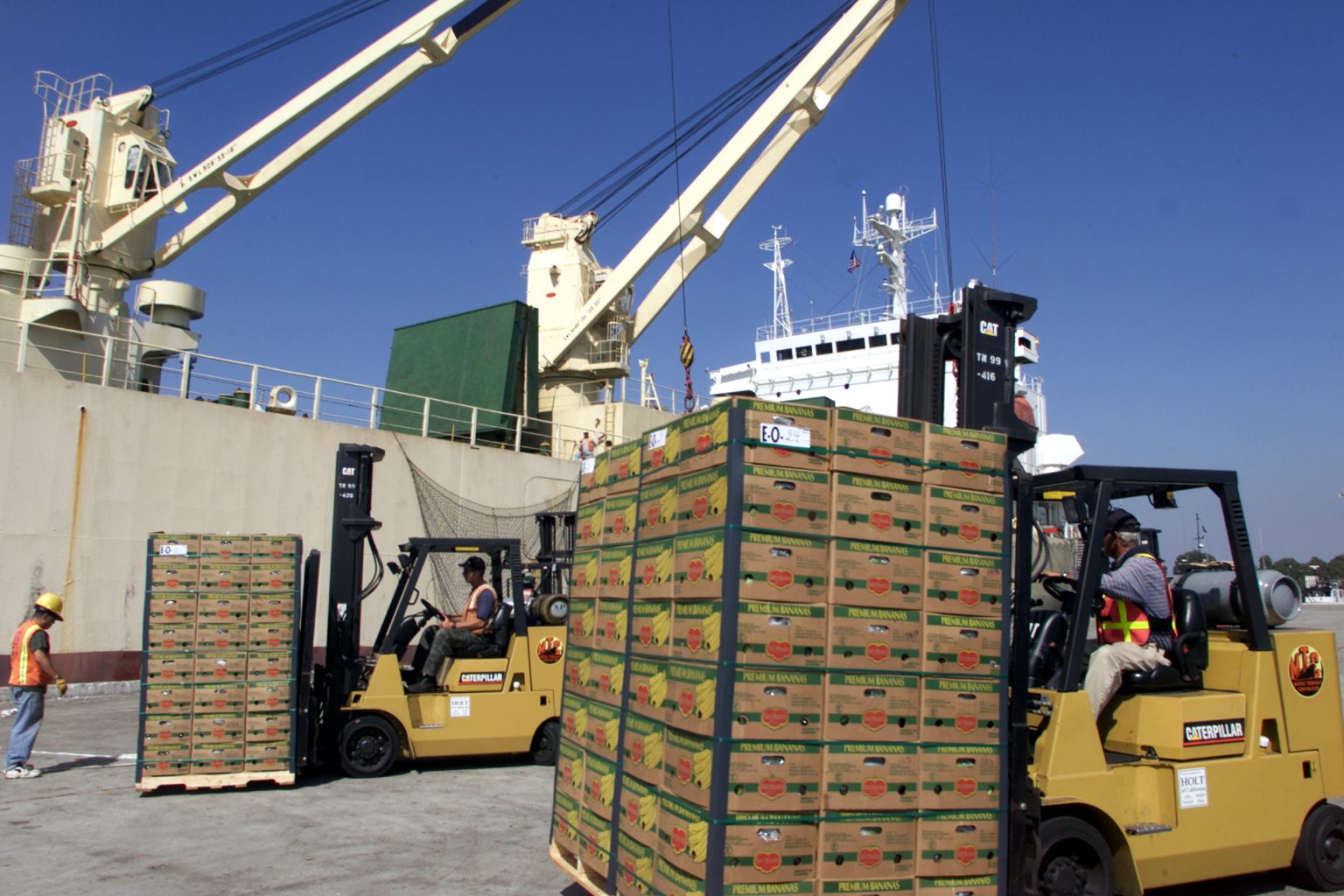
Cocaine traffickers from Colombia and Peru often conceal illicit materials in seaborne shipments of bananas from Ecuador to Europe via the Panama Canal and the U.S. and Mexico on the Pacific Ocean. (Getty Images)
Yet the central question is no longer whether Ecuador and its neighbors can arrest gang leaders or temporarily reduce homicides. It is whether the state can dismantle the economic, territorial and institutional ecosystems that allow criminal organizations to regenerate.
There have been signs of improvement. Between January and July 2026, Ecuador recorded 4,882 homicides, compared with 5,295 during the same period in 2025. The national decline, however, masks a more complicated picture: Murders increased in 79 cities, and the totals for June and July exceeded those for the same months in 2025. Rather than disappearing, criminal violence instead appears to be migrating.
That pattern illustrates the fundamental difficulty Mr. Noboa faces. Military pressure can reduce the operational freedom of established gangs, but eliminating their leaders can also accelerate fragmentation. The number of identifiable gangs increased by 54 percent between 2023 and 2024, according to data cited by Human Rights Watch.
Ecuador’s strategic vulnerability
Geography explains much of Ecuador’s transformation. The country sits between Colombia and Peru, the world’s two largest cocaine-producing states, while its Pacific ports provide access to lucrative international markets. Ecuador itself is not a major coca producer. Its value to organized crime lies primarily in logistics.
Containerized exports, fishing fleets and commercial ports provide traffickers with enormous opportunities to conceal narcotics within legitimate trade. The same infrastructure that made Ecuador a successful exporter of bananas, shrimp and other commodities has also made it attractive to transnational criminal networks.
Ecuadorian organizations such as Los Choneros and Los Lobos have developed relationships with powerful foreign groups, particularly Mexico’s Sinaloa and Jalisco New Generation cartels. In August 2026, the U.S. Treasury sanctioned an Ecuador-based network associated with Los Choneros and Los Lobos that allegedly used fishing businesses and vessels around the coastal city of Manta to move thousands of kilograms of cocaine to Mexico and ultimately the U.S. Washington had already designated the two groups as foreign terrorist organizations in September 2025.
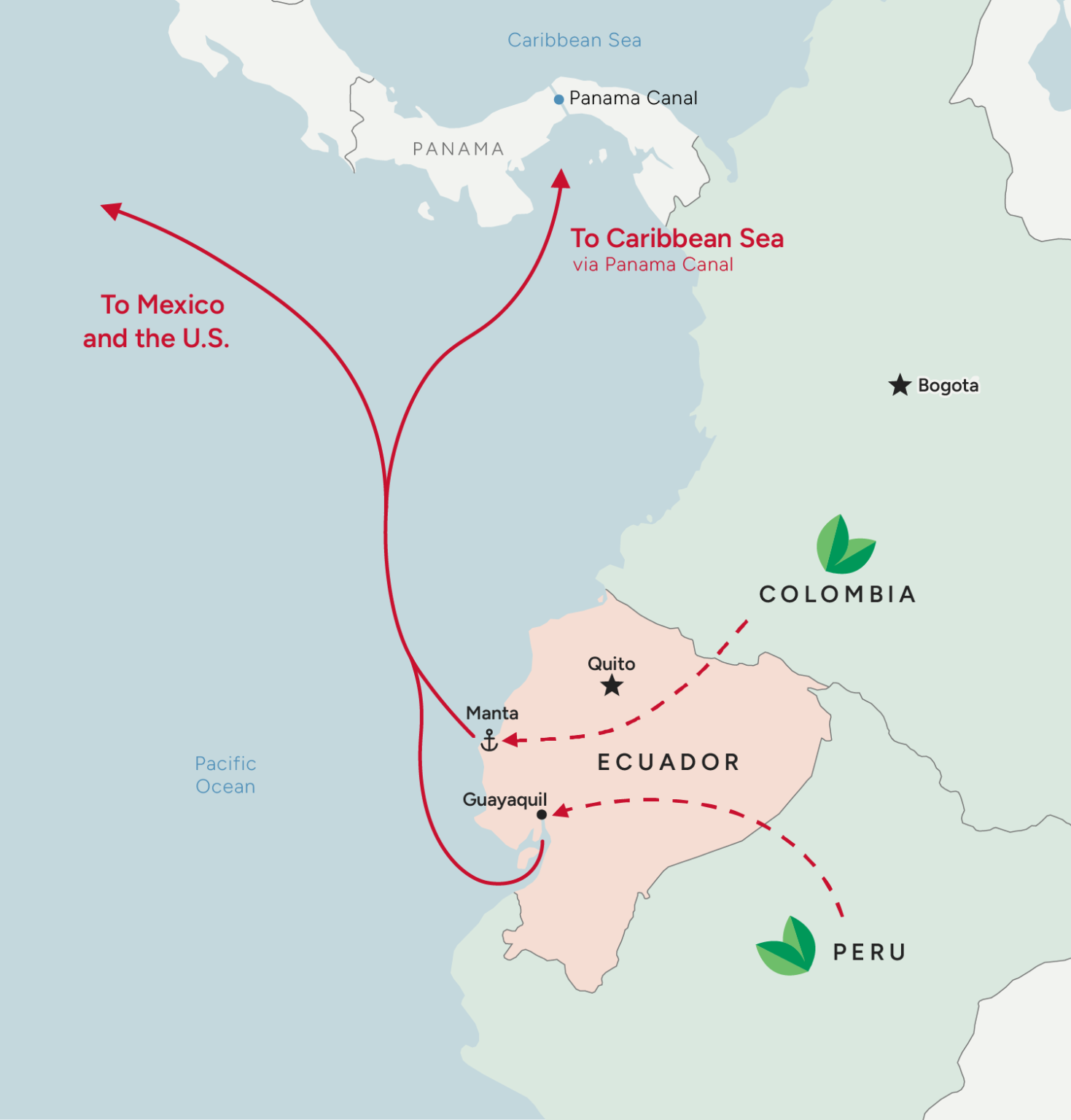
In Colombia and Peru, drug gangs grow coca plants and refine the leaves into cocaine. The illicit goods then move through Ecuador, reaching its ports for delivery to international markets via seaborne container ships, often concealed within deliveries of bananas. (GIS)
This means Ecuador is confronting something larger than domestic street gangs. Local organizations function as nodes within far more powerful and sophisticated transnational supply chains involving cocaine producers, maritime transport networks, money laundering systems and foreign cartels.
The capture and extradition of major leaders demonstrate the state’s ability to strike these organizations. Jose Adolfo Macias, or “Fito,” the leader of Los Choneros, escaped from prison in January 2024, was recaptured in June 2025 and subsequently extradited to the U.S. after escaping again. Since May 2024, Ecuadorian authorities have captured at least 17 high-value criminal targets.
But leadership decapitation presents a paradox. Removing powerful bosses can weaken organizations while splintering them into smaller factions that compete violently for territory, trafficking corridors and extortion markets.
Prisons remain another battlefield. Despite militarized prison control, Ecuador recorded 1,220 inmate deaths in 2025, including at least 206 deaths from violent clashes. Overcrowding compounds the problem, with the inmate population hovering about 30 percent above planned capacity. Criminal organizations have historically used prisons not only as places of detention, but as command centers from which leaders coordinate trafficking, extortion and assassinations.
The economic cost of criminal power
The outcome of Ecuador’s security campaign will have consequences extending well beyond homicide statistics. The country’s economy showed considerable resilience in 2025. Real gross domestic product (GDP) expanded 3.7 percent after a contraction in 2024, and the International Monetary Fund (IMF) projects growth of approximately 2.5 percent in 2026. Ecuador’s GDP value reached roughly $130 billion in 2025.
Persistent insecurity, however, functions as an informal tax on the economy, sapping its potential. Companies must spend more on guards, transportation security and insurance. Extortion raises operating costs for small businesses. Violence discourages tourism and investment, while insecurity around ports threatens industries dependent on reliable international logistics.

Although organized crime threatens tourism in many areas of Ecuador, some locations such as Cuenca and the Galapagos Islands remain safe destinations.
The geographic concentration of violence makes the problem particularly damaging. The IMF estimates that approximately 90 percent of Ecuador’s homicides occur in coastal provinces home to roughly half the population. These areas include some of the country’s most important ports, commercial centers and export corridors.
If security improves, Ecuador could convert its Pacific geography from a vulnerability back into an economic advantage. More secure ports, improved customs controls and greater legal certainty could support investment and reinforce the country’s position as a leading Latin American exporter to North America, Europe and Asia.
Failure to rein in lawlessness would produce the opposite effect. Criminal penetration would further increase business costs and encourage capital flight and emigration. It would also force the government to devote already-scarce fiscal resources to security rather than infrastructure, education and development. In that sense, the war against organized crime is becoming inseparable from Ecuador’s long-term drive for economic competitiveness.
A geopolitical test for Latin America
Ecuador’s struggle also has wider geopolitical implications. For the U.S., Ecuador has become an increasingly important security partner on South America’s Pacific coast. Cooperation has expanded in intelligence, maritime interdiction, sanctions and extradition. U.S. assistance has also supported operations against criminal groups designated by Washington as terrorist organizations.
However, there are political limits. In November 2025, Ecuadorians clearly rejected a constitutional change that would have permitted foreign military bases, with nearly two-thirds voting against the proposal. The result demonstrated that strong cooperation with Washington does not automatically translate into domestic support for a permanent foreign military presence.
The strategic significance extends beyond Ecuador. If criminal organizations can capture ports, prisons, municipalities and commercial corridors in a relatively small but democratic country, similar networks could expand elsewhere along the Pacific coast of Latin America. Colombia and Peru are particularly relevant because Ecuador’s trafficking economy is directly connected to cocaine production in both countries.
Success in the fight against transnational crime would offer a different precedent: a model combining national military pressure with police intelligence, judicial reform, financial investigation, extradition and international maritime cooperation.
The question, therefore, is not whether Ecuador can eradicate organized crime. No modern state has eliminated transnational narcotics markets entirely. The question is whether Ecuador, and states in a similar predicament, can reduce criminal organizations from territorial and institutional powers to primarily clandestine networks that the state can continuously disrupt.
Scenarios
Most likely: Ecuador gradually restricts criminal organizations without eliminating them
The most likely scenario is that Ecuador slowly curbs the territorial freedom of its largest criminal organizations without dismantling them. Military and police operations will continue to concentrate on ports, prisons, trafficking corridors and violent coastal provinces. Intelligence cooperation with Washington will improve Ecuador’s ability to identify criminal leadership, trace financial networks and intercept maritime cocaine shipments.
High-profile arrests and extraditions will further disrupt established hierarchies. The state will gradually regain operational control over strategic locations, although homicide rates will remain exceptionally high by historical standards.
Economically, greater security around ports and major cities will subsequently improve investor confidence and reduce some of the extraordinary costs imposed on businesses. If the government can demonstrate that the security situation is becoming manageable, Ecuador’s relatively stable dollarized economy and export sectors could further bolster the economic recovery.
Geopolitically, Ecuador will emerge as one of Washington’s closest security partners on South America’s Pacific coast while stopping short of hosting permanent U.S. bases. Cooperation will instead emphasize intelligence, training, sanctions, extradition and maritime operations.
Ecuador is not likely to defeat organized crime completely. But it will avoid the more dangerous outcome of allowing criminal organizations to become parallel authorities capable of permanently challenging the state.
Somewhat likely: Ecuador succeeds tactically but struggles to prevent criminal regeneration
Ecuador’s security campaign could deliver tactical victories without a lasting strategic payoff. Security forces continue capturing major leaders and disrupting established organizations, but every successful operation produces new factions. Criminal groups become smaller, more decentralized and more difficult to penetrate.
Violence fluctuates rather than consistently declining. Some cities see security improvements while murders migrate toward other municipalities and trafficking corridors. Prisons, ports and local governments remain contested spaces.
The economic consequences steadily worsen. Businesses would continue absorbing security and extortion costs; investment would remain cautious in violent regions and the government would face sustained pressure to increase security spending.
For neighboring countries, this scenario would create persistent displacement effects. Pressure on Ecuadorian trafficking routes could push cocaine shipments through Colombia, Peru and other Pacific corridors without significantly reducing the overall narcotics trade.
Ecuador would remain a functioning democracy, but organized crime would become a permanent national-security challenge, as it has in other Latin American states where governments have weakened criminal organizations without dismantling the economic systems that sustain them.
Least likely: Criminal organizations achieve parallel authority, becoming a regional problem
The least likely but most consequential scenario is that criminal organizations successfully adapt to Ecuador’s rising military pressure while penetrating institutions faster than the state can strengthen them.
Under these conditions, gangs would deepen control over strategic neighborhoods, ports, prisons and trafficking corridors while expanding corruption inside municipal governments, police forces and the judicial system.
The real danger would not simply be rising murders. It would be the gradual emergence of areas where formal state institutions remain present but effective authority is exercised by criminal organizations.
Investment and tourism would decline, capital flight could accelerate and the government would face rising fiscal costs precisely as economic activity weakened. Ecuador’s reputation as an investment destination and logistics hub would suffer lasting damage.
The geopolitical consequences would extend throughout the hemisphere. Washington could face growing pressure for deeper involvement in intelligence, maritime interdiction and counterterrorism operations. Colombia and Peru would confront greater cross-border criminal activity, while Mexican cartels could gain even stronger footholds along South America’s Pacific coast.
Ecuador’s crisis would then cease to be primarily a domestic security challenge and become a regional one.
For now, this remains the least probable outcome. Ecuador retains functioning national institutions, substantial public support for restoring security and increasingly powerful international partners. But the lesson of the past several years is clear: The decisive measure of victory will not be how many soldiers patrol the streets or how many gang leaders are captured. It will be whether Ecuador can rebuild institutions faster than organized crime can adapt to and infiltrate them.
________________
Armando Regil Velasco is founder and chief executive officer of i2Co: School of Transformative Leadership, and chief executive officer of Data Disrupt for Systems Transformation, an artificial intelligence consultancy.
Credit: GIS Reports