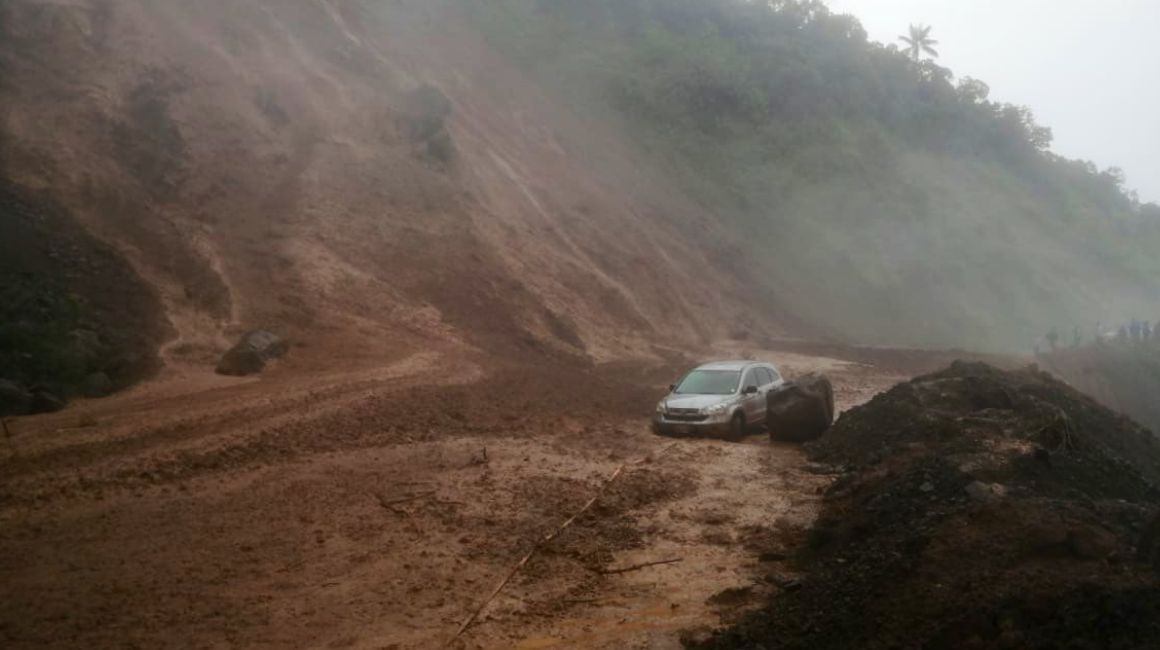














El Niño deaths rise as flooding rains continue in coastal provinces and the Galapagos Islands
Heavy rain continued to flood Ecuador’s coastal region and the Galapagos Islands during the weekend as the El Niño death toll rose to 15. In the Galapagos, several families were evacuated on Santa Cruz Island as rising water flooded their homes.
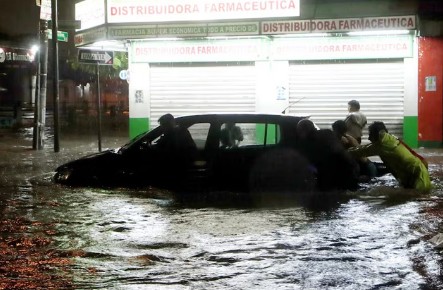
A car is pushed through flood waters in a south Guayaquil neighborhood on Saturday.
In Guayaquil, the search continues for a father and son who were swept away when they attempted to cross a flooded drainage ditch in the Florida Norte sector. In south Guayaquil, the body of a teenage boy was recovered Saturday after he drowned in a drainage pipe attempting to rescue a dog.
Also on Saturday, the Guayaquil Fire Department pleaded with residents to avoid fast-flowing streams and drainage ditches and asked motorists to avoid driving through flooded streets. In a statement, the department said that more than 200 vehicles have been damaged as drivers attempted to cross flooded areas and many of them remain on roadways where they were abandoned. It added that a taxi driver trapped in deep water died of an apparent heart attack Friday night south of the airport.
On Sunday, Education Ministry officials announced that 23 schools in coastal provinces, including 16 in Guayas, would hold virtual classes as a result of flooding. Five schools in Milagro, south of Guayaquil, were among those closed.
Officials in the Galapagos said it would issue a statement Monday morning listing closures of tourist locations on Santa Cruz and Isabela Islands. It also said it was working with cruise lines regarding flooding on out-islands that would affect tourist activities.
A spokeswoman for the National Electricity Corporation (CLEC) said Monday morning that electric distributors face a “delicate situation” as the new week begins. She said that low water level of the Mazar reservoir in Azuay Province is a “continuing concern.”
At 7 a.m. Monday, the Mazar reservoir water level stood at 2,123.65 meters above sea level, a drop of three meters from a week ago and 8.7 meters above the critical operational level. The inflow from the Rio Paute was 27.29 meters per second, about 25% of normal flow.
In its five-day forecast, the National Meteorology and Hydrology Institute predicted a continuation of recent weather patterns, with heavy rain in the coastal region and the Galapagos, moderate rain in the Amazon and light rain in the sierra.