











Endangered leatherback turtles find new nesting beaches in Ecuador as Pacific Ocean warms
By Gaby Clark and Andrew Zinin
A new study found a record-breaking number of eastern Pacific leatherback turtle nests along several beaches in Ecuador during the 2025–2026 nesting season, more than 1,000 miles (1,600 kilometers) from their usual nesting grounds in Mexico and Costa Rica.
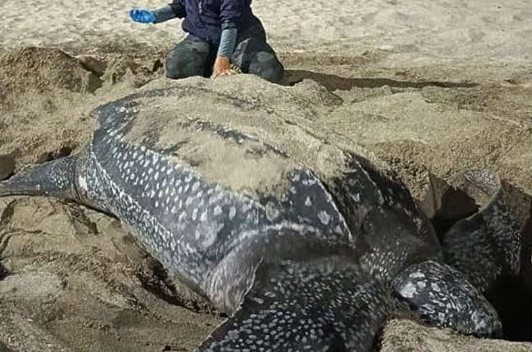
An eastern Pacific leatherback turtle
The findings suggest leatherbacks may be adapting to the warming ocean by seeking out new nesting sites along coastlines under cooler conditions, says a leading marine ecotoxicologist from Simon Fraser University.
“Historically, observing female eastern Pacific leatherbacks on Ecuador’s beaches was a rare or unusual event, but our findings suggest they are adapting their reproductive cycle to thrive and survive in coastal Ecuador,” says Juan José Alava, adjunct professor at the School of Resource and Environmental Management and leading co-author of the study.
“It signals new hope for a subspecies of leatherback on track for extinction in the eastern Pacific within 60 years. They are making their way alongside nature against all odds, representing hope for this species and other sea turtle species even as they reach tipping points.”
In the study published in the journal Chelonian Conservation and Biology, researchers reviewed more than 45 years of records detailing sightings of female turtles of reproductive age, nests, hatching success, nesting attempts and strandings along Ecuador’s coast. They tracked that activity alongside El Niño and La Niña events that drive cycles of warmer and cooler sea surface temperatures.
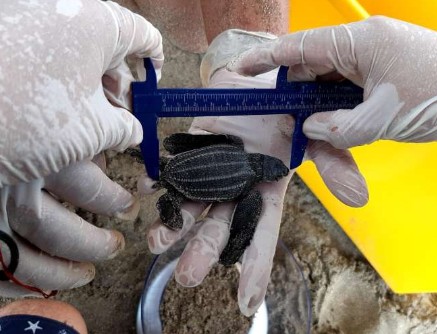
Measuring a newborn leatherback
Records show increased activity and nesting in Ecuador during cold episodes—or La Niña events—in the southeastern tropical Pacific Ocean over the last decade. Researchers also found the nest yield, or number of eggs per nest, and hatch rates in Ecuador were comparable to those in the traditional nesting grounds farther north. In some cases, Alava says, nests in Ecuador produced more hatchlings than usual.
The eastern Pacific leatherback is the only sea turtle that thrives in both warm and cold environments. They migrate thousands of miles each year from their tropical nesting sites to feeding grounds in subpolar Pacific waters, where they fill up on jellyfish during the summer months. Interestingly, leatherbacks have also been observed in waters off Canada’s west coast (British Columbia) with more than 150 records from 1931 to 2024.
Their population has plummeted by more than 90% since the 1980s, driven by natural stressors like warm El Niño episodes worsened by anthropogenic climate change and human-made impacts such as fishing bycatch, plastic pollution, vessel strikes, egg harvesting and nesting habitat loss.
Ongoing monitoring and concerted conservation efforts, bycatch mitigation and effective coastal zone management to protect Ecuador’s nesting beaches are crucial for the long-term survival of the eastern Pacific leatherback, Alava says.
“Management and conservation efforts should be championed in close consultation and participation with local and traditional ecological knowledge through coastal, community-grounded interventions.”
________________
Credit: Phys Org