












Environmentalist Lily Cole celebrates the ‘rights of nature’ in Ecuador’s cloud forest and the Galapagos
Text and photography by Lily Cole
As we drove into the Mashpi-Tayra Reserve, in the Chocó Cloud Forest on the western slopes of the Andes, after a three-hour, equator-crossing ride from Quito, the first thing that struck me was the size of the leaves: taller than my research assistant, my nine-year-old daughter. The air was alive with life: a cacophonous chorus as enveloping as the clouds.
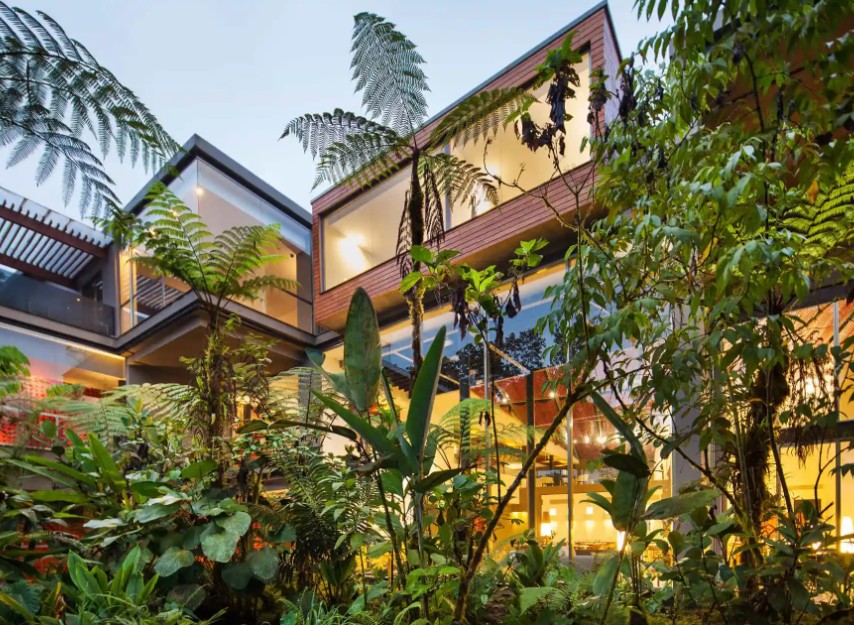
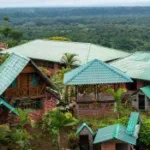
The Mashpi Lodge in Ecuador’s cloud forest.
They say that it never stopped raining in Chocó, even through ice ages and droughts. According to the refugia hypothesis, for millions of years these cloud forests have been in dialogue with the Pacific Ocean, offering a wet refuge for Andean birds, orchids, frogs, plants and insects to survive, thrive and diverge, like Jorge Luis Borges’ labyrinth in which “time forks perpetually toward innumerable futures”.
Yet, after this long miracle of survival, in recent decades the majority of the Ecuadorian Chocó ecosystem has been deforested, largely for agriculture, logging and mining. It was in response to this devastation that, in 2000, Roque Sevilla, former mayor of Quito, bought a 600-hectare plot of the forest to protect it from a bankrupt logging company. Sevilla established a hotel – Mashpi Lodge – on the site of the old sawmill. Tourist revenues and a carbon-offset fee from guests have helped fund the reserve’s expansion to more than 3,000 hectares. The soil was riddled with gold, but Sevilla knew the true gold was a standing forest.

Fashion model and environmentalist Lily Cole
Mashpi Lodge is built largely of glass, so it feels as if you never leave the forest. We spent our days trekking pathways, wading rivers, and in the lodge’s lab, where a team of six runs research across the reserve. So far, 24 new species have been identified at Mashpi.
One night we surrendered to the rain, following the call of the Mashpi glass frog, endemic to the reserve and as crazy-looking as its name implies. Despite our guide’s almost mythic ability to spot tiny creatures, the frog was elusive. That unwillingness to show up is part of the beauty of wildlife, distinguishing it from a modern world where everything is numbingly available on demand. Wild is to walk amongst glass frogs and stalking pumas, knowing that they have their freedom – including the freedom to hide.
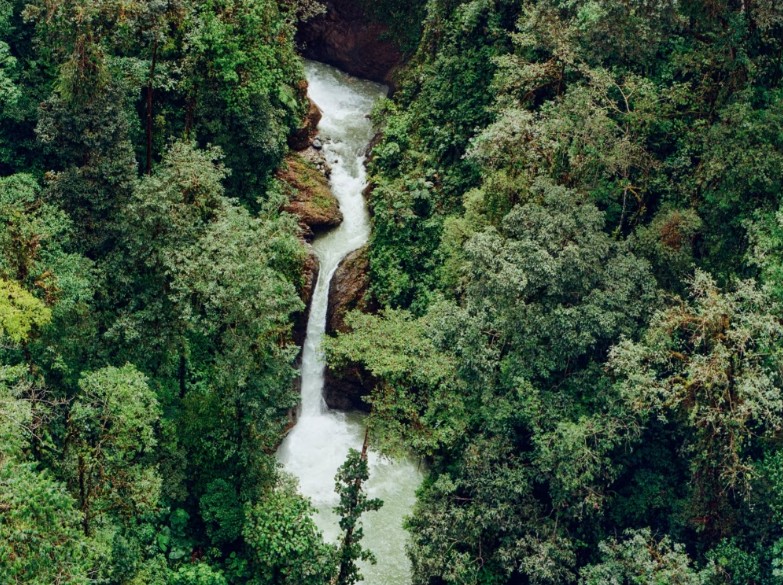
The River Magnolia in the Mashpi-Tayra Reserve, seen from Mashpi Lodge’s Dragonfly cable-car system © Lily Cole
The ungovernability of the wild makes it all the more incredible when the brilliant iridescent flash of a giant blue morpho butterfly winks at you from the sky, or when the chitter-chatter of a pair of toucan barbets arrives like the gossip of an old couple. As they spoke their incessant duet, they kept flicking their heads towards us, as if keen to tell us something urgent.
The toucan barbets look like watercolours: blue, yellow, orange, black; their bellies as red as the IUCN list of near-threatened species that they appear on. They belong to a rare lineage, and only live in this very specific range of the Andean slopes. Like 10 per cent of the birds and plants in this region, their fundamental survival – their right to exist – depends on these ecosystems. Losing them would prune a 20- to 30-million-year-old branch of the evolutionary tree.
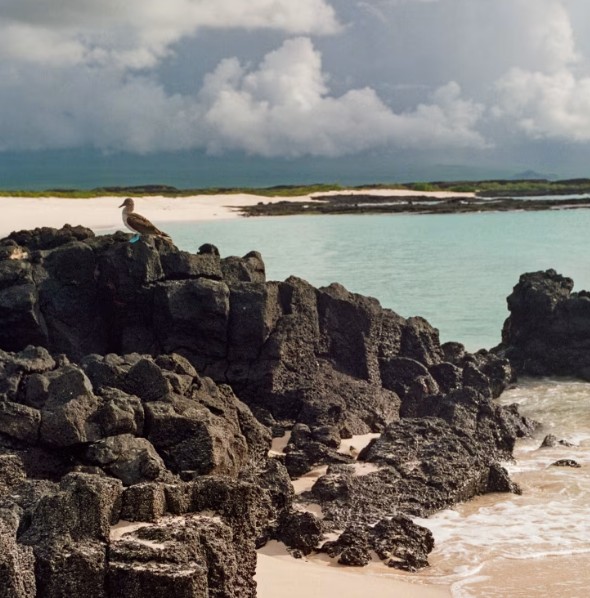
A blue-footed boobie on Santa Cruz Island.
The right to exist: in a 2008 referendum, Ecuador voted for a new constitution that, shaped by Indigenous communities, became the first in the world to give nature (Pachamama) legal personhood, granting ecosystems and species their right to exist. The impact has been historic. In 2021, the constitution was successfully used to revoke permits for mining exploration in another region of Chocó.
The constitution has also inspired a global movement that has seen the granting of personhood to rivers, forests and ecosystems in Bolivia, Colombia, New Zealand and the US. Ecuador’s vanguard moral-legal compass for nature is perhaps why the Galápagos Islands, an archipelago 900km off the country’s coast, are today the most protected archipelago in the world, with about 95 per cent of their original biodiversity intact.
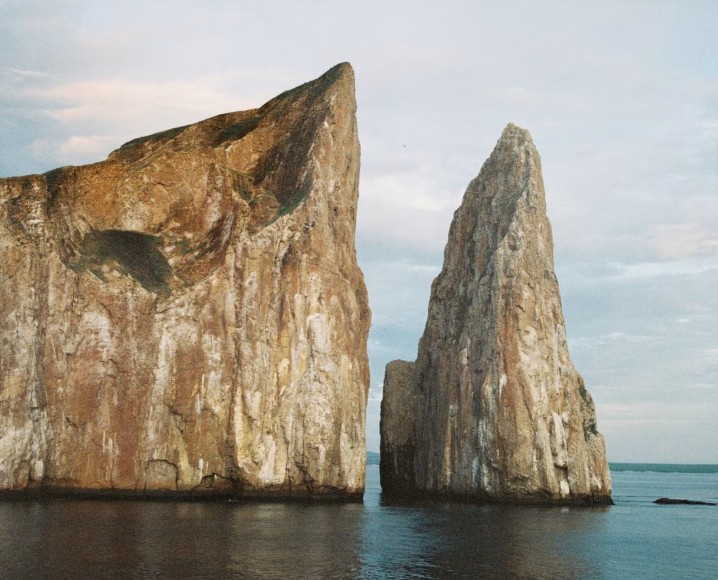
Kicker Rock, San Cristóbal Island © Lily Cole
Arriving there was to travel to another planet. The first “person” we met – before immigration agents – was a male Galápagos land iguana. He perched on the pavement’s edge, unperturbed by the line of people peering down and taking photos of his yellow spiked mohawk. Wildlife in the Galápagos is notably relaxed around humans; there is a 2m distancing rule, which the animals regularly ignore.
For centuries the islands were used by pirates for hunting tortoises, and then by whalers seeking lamp oil; but ever since the advent of the electric lightbulb the nature on these islands has rebounded. The Galápagos are both a national park and a marine reserve. Humans must stick strictly to the marked paths. If you hit a giant tortoise with your car, you could be hit with a $13,800 fine.
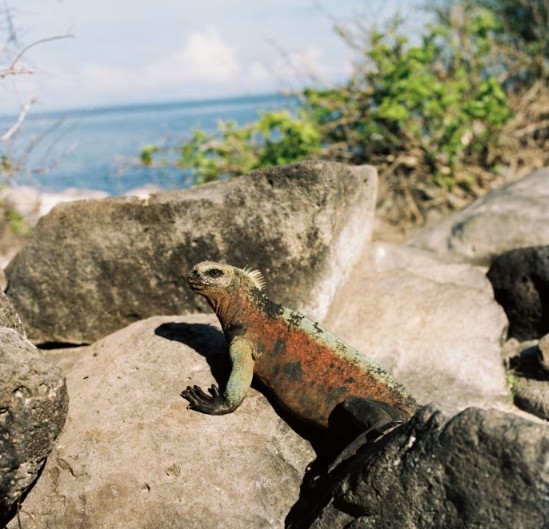
A marine iguana, Punta Suarez, Española Island © Lily Cole
The Galápagos is an archipelago of survivors. It is made up of fauna whose ancestors most likely endured months at sea, drifting from a nearby continent – floating on a large leaf, perhaps – to wash ashore; and then persevered through extreme climatic conditions. The islands are home to some of the highest levels of species endemism on the planet: about 80 per cent of the land birds, 97 per cent of the reptiles and mammals, more than 30 per cent of the plants, and more than 20 per cent of the marine species exist nowhere else on Earth.
The rhythmic sound of giant tortoises, some 100 years old, munching grass. A blue-footed booby, its feet like Blu Tack. The aptly named magnificent frigatebirds with their bright red throats ready to blow up. The round black eyes of a young sea lion, like two obsidian pools, spiralling underwater. Grey Galápagos sharks circling the boat. Black volcanic rocks cloaked in white bird shit, like Jackson Pollock drip paintings. Pink, yellow, orange, turquoise, red, brown iguanas, each unique. Black marine iguanas swimming against white sand – the only lizard in the world to have taken to the sea for its sustenance.

South Plaza Island. In the distance, North Plaza Island and beyond that, Gordon Rocks © Lily Cole
On our last day, my daughter and I swam to a beach from the boat. It was devoid of any of the usual paraphernalia – no roads, cars, buildings or umbrellas. You could be time-travelling many millennia back. In front of a whale skeleton, sea lions slept along the water’s edge. Three pups were piled dreamingly on top of each other, one drawing sand angels with its flippers.
The majority of the archipelago’s GDP is tied to tourism, which of course is contingent on its wilderness. “Protecting nature isn’t a cost,” Christiana Figueres, a Costa Rican diplomat, tells me, “it’s the smartest investment any economy can make.” Costa Rica took this path in the 1980s, when it decided to put nature at the heart of its economy. It has since tripled its forest cover whilst growing the economy. As EO Wilson said: “Destroying rainforest for economic gain is like burning a renaissance painting to cook a meal.”
It is now well documented that the economic benefits of protecting nature outweigh those of exploiting it; and yet Ecuador’s visionary work was very nearly undone. On 16 November, Ecuador’s president, Daniel Noboa, ran a referendum calling for the country’s constitution to be rewritten, in part framing the initiative as a way to unlock Ecuador’s economic potential.
Given Noboa’s open support of increasing extractive mining practices, and his elimination of the country’s Ministry of the Environment, Water and Ecological Transition, many feared a Yes vote would pave the way to eroding the rights for nature and Indigenous communities that were enshrined in the 2008 constitution. But Ecuador voted overwhelmingly “No”.
“Hope lives on! It is a magnificent outcome,” Robert Macfarlane, writer and member of the More-Than-Human-Life collective, wrote to me. “Ecuador has proved itself once again a small country with a vast moral imagination.” Achuar leader Uyunkar Domingo Peas Nampichkai said: “The people have spoken. The world wants the rights of nature to be respected.”
My daughter and I didn’t travel to another planet. We travelled to our planet. The one that has been evolving for billions of years – that birthed all life and sustains any future we might hope to have. In order for life to continue to thrive, we need to evolve our economies, our legal systems, our vision, our thinking. To create Borgesian forks in time, to make possible innumerable futures. Thank Pachamama that enough people, in Ecuador and around the world, know that to be true.
________________
Credit: Financial Times