













Esmeraldas oil spill impacts a million residents and devastates rivers, beaches and a wildlife refuge
By Shanna Hanbury
The massive oil spill in Ecuador, in the northwestern Esmeraldas province, has covered multiple rivers and a key wildlife refuge in thick, black sludge, impacting more than half a million residents.
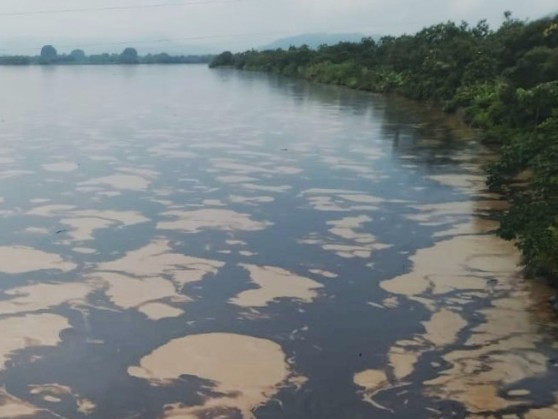
At the Esmeraldas River Estuary Mangrove Wildlife Refuge, a protected area spanning 242 hectares (598 acres) at the intersection of the Esmeraldas River with the Pacific Ocean, the oil has coated mangrove channels, smothering vegetation, poisoning aquatic life and contaminating sediments.
A rupture appeared in a 500-kilometer (310-mile) pipeline operated by the state-owned oil company Petroecuador on March 13, according to a statement by the company. Following this, crude oil flowed downstream for more than 80 kilometers (50 miles) through the Esmeraldas River and its tributaries towards the mouth at the Pacific Ocean.
Witnesses described a “geyser” of oil erupting for up to seven hours, according to marine biologist Eduardo Rebolledo Monsalve of the Pontifical Catholic University of Ecuador’s Esmeraldas campus. Monsalve has been canvasing the region to assess the damage.
“The entire southern shore of the Esmeraldas River is completely saturated with oil,” Monsalve told Mongabay by email. He added that two of its tributaries, the Viche and Caple rivers, have turned anoxic, meaning they have lost all oxygen.
“The spill means a temporary loss of aquatic life, with long-term damage depending on environmental conditions such as rainfall and river flow,” Monsalve said. “I estimate that in smaller rivers, the impact could last around three years if the rainy seasons are mild.”
Local authorities declared an environmental emergency on March 14, with the mayor of the city of Esmeraldas, Vicko Villacis, stating that the “disaster is causing unprecedented ecological damage.”
Petroecuador said it is still determining the volume spilled. The pipeline transports up to 360,000 barrels of crude oil per day from the Amazonian Lago Agrio oil field in the eastern Sucumbios province, through the Andes mountain range, to a refinery in Esmeraldas on the western coast, where it is processed and sold largely for export.
At the Esmeraldas River Estuary Mangrove Wildlife Refuge, a protected area spanning 242 hectares (598 acres) at the intersection of the Esmeraldas River with the Pacific Ocean, the oil has coated mangrove channels, smothering vegetation, poisoning aquatic life and contaminating sediments.
On March 18, Ecuador’s Ministry of Environment, Water and Ecological Transition published a plea for non-profit organizations and volunteers to help with the cleanup and recovery of flora and fauna.
The refuge is home to three different species of mangrove trees and more than 100 species of fishes, birds and mammals, including the South American coati (Nasua nasua), an animal closely related to the raccoon, and the blue crab (Cardisoma crissum), a crustacean with high cultural and economic value in the region.
The ministry has ordered Petroecuador to carry out immediate containment and cleanup efforts and has activated emergency conservation funds to monitor and mitigate further damage to the protected area.
The spill in Esmeraldas province is not the first of its kind. According to Amazon Frontlines, a U.S.-based environmental non-profit, more than 1,496 oil spills have been recorded in the Amazon region in Ecuador, Brazil, Peru and Colombia.
________________
Credit: MonGabay



Hogar Esperanza News

Fund Grace News

Fabianos Pizzeria News

Property Kuralt

Property Manabi

The Cuenca Dispatch

Week of August 16

Azuay stays under state of exception as authorities track criminal groups expanding around Cuenca.

Older adults and people with disabilities can now request vehicle tax break online.
That unresolved bank complaint has another place to go and the service is free.
Property Amazon
