













Expat life in Ecuador: How personality types correlate across different cultures
Welcome to ‘Expat Life in Ecuador: How Personality Types Correlate Across Cultures.” where we explore the ins and outs of relocating to Ecuador and the role that personality types play on how people adapt to their new environments. If you’re an expat or are thinking of becoming one, you’re in the right place. Just click the button below and listen to this podcast.
If you prefer, read along to find out how to make the choice that best fits your unique situation.
By Jim Smith
Expat life in Ecuador can be an exciting yet challenging journey, especially for North Americans looking to build a fulfilling life abroad. Personality types play a significant role in how people adapt to new environments and understanding these personality dynamics can be especially valuable for expats in Ecuador. This article will explore how personality traits impact expatriate success, how cultural differences shape personality prevalence, and why understanding these factors is crucial for expats in Ecuador.
 Personality Traits and Expatriate Success
Certain personality traits can be particularly influential when adjusting to life in a new country. For expats moving from the U.S. to Ecuador, traits like flexibility, resilience, and curiosity are key to thriving.
- Flexibility is vital for adapting to cultural differences, such as how Ecuadorians often take a more relaxed approach to time compared to the punctuality-focused American culture. Being flexible can help expats smoothly navigate these differences without undue stress.
- Resilience is another critical trait, helping expatriates cope with setbacks like language barriers and cultural misunderstandings. Those who are resilient tend to view these challenges as opportunities to grow rather than obstacles to overcome.
- Curiosity drives expats to learn about local customs, explore new foods, and participate in community events. This trait enhances their ability to integrate and form meaningful relationships with locals, which can be instrumental in creating a sense of belonging.
 The Enneagram and Cultural Insights
The Enneagram Test is a powerful tool for understanding personality types and how they interact with new cultural environments. The Enneagram categorizes personalities into nine distinct types, each with unique motivations and behaviors. This insight can be incredibly helpful for expats who want to understand themselves and the people around them better.
- Self-Awareness: Taking the Enneagram test can help expats understand their natural reactions to stress and change, which is especially useful during the adjustment phase.
- Improved Relationships: By learning about their own personality type and those common in Ecuador, expats can foster better communication and understanding with locals.
- Personal Growth: The Enneagram also encourages personal growth by highlighting areas for improvement, making it a useful tool for those who want to enhance their expatriate experience.
Cultural Variations in Personality Prevalence
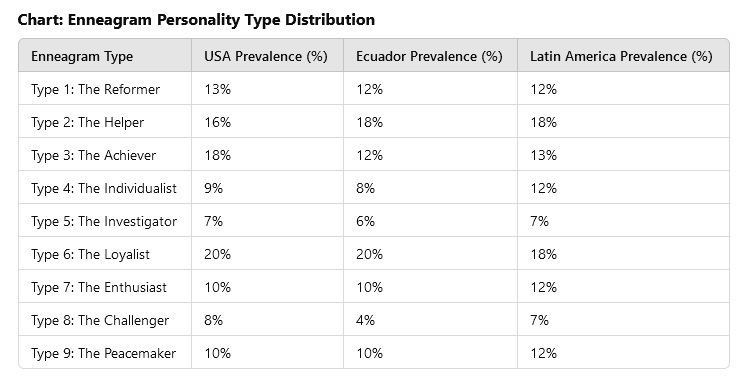
Interestingly, the distribution of Enneagram types varies between Ecuador, Latin America as a whole, and the U.S. These differences can provide valuable insights into cultural nuances, and how personality type shapes interactions across borders.
- In Ecuador, types like The Helper (Type 2) and The Loyalist (Type 6) are more prevalent, reflecting a strong emphasis on community and support. This cultural emphasis makes Ecuadorians more community-oriented, which can be a great advantage for expats who value connection and collaboration.
- In the U.S., there is a higher representation of The Achiever (Type 3) alongside Type 6. U.S. culture places a premium on individual success, ambition, and self-reliance, which can sometimes contrast with the more community-focused culture of Ecuador.
- Across Latin America, Types 2 and 6 are commonly found, which indicates a cultural tendency towards helping others and valuing loyalty. Type 5 (The Investigator), however, remains one of the rarer types in all regions, emphasizing how curiosity and analytical thinking are less commonly distributed compared to more relationship-driven types.
Understanding and Leveraging Cultural Differences
For expats, understanding the cultural backdrop of personality types can significantly enhance their experience. Knowing that Helpers and Loyalists are common in Ecuador can help expats approach social situations with greater empathy and awareness. Building relationships in Ecuador often means emphasizing community involvement, participating in social gatherings, and showing genuine interest in others.
 Expats who score high as Achievers might find it challenging at first to adjust to the more relaxed pace and collectivist nature of Ecuadorian society. However, embracing traits like flexibility and curiosity can help them bridge this cultural gap and ultimately thrive.
Practical Steps for Expats
- For Those Living in Ecuador: Embrace local culture by attending events and festivals, practice patience as relationships take time to build, and seek out expat communities for support.
- For Those Considering Moving: Take the Enneagram Test to better understand your strengths and challenges, prepare through cultural sensitivity training, and set realistic expectations for the adjustment process.
Conclusion
The journey of expatriating to Ecuador is shaped not only by logistical preparations but also by understanding how personality types and cultural dynamics intersect. Personality traits like flexibility, resilience, and curiosity are crucial for adapting to life in Ecuador. Leveraging tools like the Enneagram can offer valuable insights that enhance self-awareness and improve relationships with locals. Understanding how personality types vary across cultures —from the community-oriented Helpers and Loyalists in Ecuador to the individual-driven Achievers in the U.S. — can help expats navigate social interactions and build meaningful connections. With an open mind and a willingness to grow, expatriation can be a deeply rewarding and transformative experience.
For a more in depth look at this subject from a global perspective click here
_________________
Jim Smith is CEO of YCHANGE International a small business consultancy and past Chairman of the Board of Commissioners of Home Forward (the Portland Housing Authority). He currently resides in Cuenca.



Hogar Esperanza News

Property Manabi

Fabianos Pizzeria News

Property Kuralt

Fund Grace News

The Cuenca Dispatch

Week of August 23

Ecuador’s economy grew 2% during the first half of 2026 compared with the same period a year earlier, according to new Banco Central del Ecuador data.

Cuenca gets a prime view of next week’s deep partial lunar eclipse.

Ecuador’s economy grows 2% in the first half of 2026.
Nice apartment banner