













Fifty-eight women were buried in this pre-Inca tomb in Peru. Who were they?
By Ariadna Baulenas i Pubill
The Wari people founded their capital in the Ayacucho Valley, now south-central Peru. From here their culture spread, forming what may have been the first Andean empire.
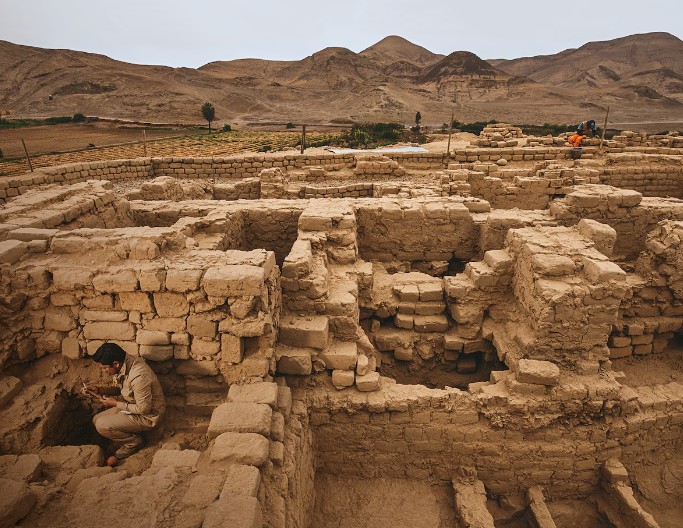
Archaeologist Roberto Pimentel Nita reviews a find in the intricate system of rooms within the mausoleum at El Castillo de Huarmey.
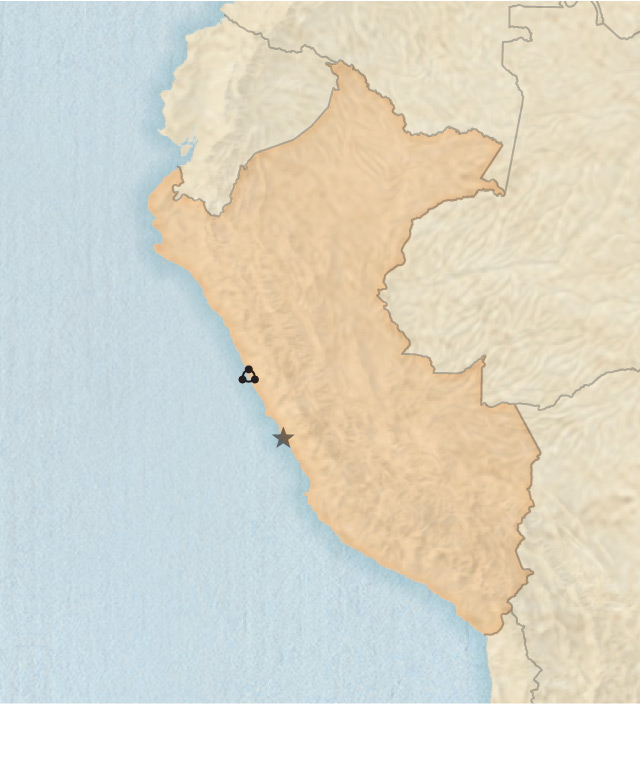
It was almost 550 miles north of the Wari capital, in the Ancash region, that an excavation in 2012 resulted in a remarkable discovery, shedding new light on Wari society. There, in the arid landscape of Peru’s desert coast, a Polish-Peruvian team found the first intact Wari mausoleum at a site known as El Castillo de Huarmey (the Castle of Huarmey).
Almost a century earlier, in 1919, Julio C. Tello — who’s known as the father of Peruvian archaeology — visited the site, but was forced to leave due to an outbreak of bubonic plague. Later, El Castillo de Huarmey was largely forgotten by researchers, but unfortunately not by huaqueros (tomb plunderers). Illegal digging caused significant damages, and an earthquake in the 1970s brought artifacts to the surface, which attracted more thieves.
A mausoleum revealed
Despite the challenges, two archaeologists, Miłosz Giersz and Roberto Pimentel Nita, began to excavate the site in 2010. They knew that even after removing the thick layer of surface rubble, their chances of finding anything left untouched were minimal, but they were willing to take the risk. In time, their tenacity was rewarded.
 The site contained nothing less than a large mausoleum dedicated to ancestor worship, a sizable necropolis, and a residential area. The mausoleum, situated at the crest of a hill, is a magnificent, orthogonal building partially set into the bedrock, with a red painted facade. Only the lower sections of its walls had been preserved, but they were enough to indicate that it was once a labyrinthine complex with more than 20 chambers.
In the center of this complex, the archaeologists found a small room with a series of niches in its walls that was dominated by a large throne-like bench. This room became the focus of the excavation campaign when a subterranean chamber was discovered below it. The excavation of this hidden space revealed the first intact collective burial of Wari elite ever found.
The chamber consisted of a large central room and three lateral subchambers, inside which were the remains of 58 women, all wrapped in funeral bundles and buried with a wealth of precious grave goods. The dry conditions inside the tomb had ensured that the contents were remarkably well preserved. The bodies themselves had been buried in a seated position, and fabric remains suggest the bundles had been wrapped with green and white material, held in place by a thick mesh.
In one of the subchambers, the team found the body of a high-ranking noblewoman, nicknamed the “Huarmey Queen.” She was about 60 years old when she died, and was buried with valuable objects, including ear flares, a symbol of power in the Andean world typically associated with the male elite. She clearly commanded great political power.
Elite burials
The archaeologists recovered more than 1,300 objects from the site, including jewelry, weapons, vessels, and weaving implements. The materials are of high quality, and some were considered a luxury at the time: red spondylus shells (imported from Ecuador), obsidian, turquoise, and fine metals. The Huarmey Queen’s weaving tools, part of her grave goods, were made of gold.
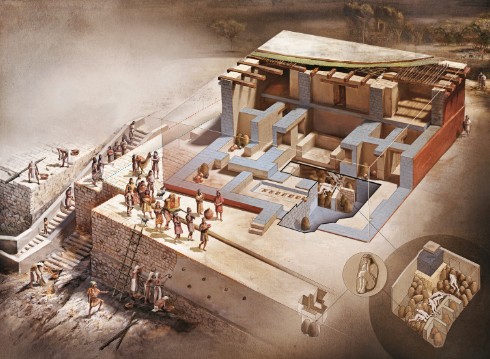
The mausoleum at El Castillo de Huarmey. (Fernando Baptista, Geographic image collection.)
Biological analysis of the remains suggests that none of the people buried at the site suffered from serious illnesses during their lives, confirming that they were members of the select elite of the Wari state.
The tomb must have remained open for some time, as insects, fly pupae, snakes, and their eggs had lodged among the bundles and even inside the skulls of the dead. This indicates that not all the funeral bundles were buried at once. When it was time to close the chamber, the Wari filled in the space with earth, stones, and mud. The bodies of six sacrificed teenage girls were also left behind. Then, they covered the entire tomb with a layer of rubble, which also served to secure a large wooden rod that pointed vertically from the burial chamber toward the throne above.
Eternal watchers
The last bodies to be buried were those of a man and a woman who had been guarding the tomb. To prepare them for this role, the left foot of each had been amputated to prevent them from running away. The pair, of lower social status, had both been sacrificed. They were found more than a thousand years later, still standing guard over the tomb. The question of whether or not other guardians of eternity are waiting for the archaeologists in El Castillo de Huarmey will only be answered with time and careful excavation.
__________________
Credit: National Geographic



Hogar Esperanza News

Property Manabi

The Cuenca Dispatch

Week of September 06

U.S. sinkings of Ecuadorian fishing vessels trigger court scrutiny after 28 crew members are released.

Cuenca targets a November launch for its first new international link to Chiclayo.

Exports hit a quarterly record, but Ecuador’s import bill is rising even faster.
Fabianos Pizzeria News

Fund Grace News