















Fixing the highways and keeping Cuenca safe are the two biggest challenges for city government
Editor’s note:This is the first part of a three-part article concerning the most important issues facing Cuenca as well as what Mayor Cristian Zamora is trying to accomplish in his first term.
By Stephen Vargha
Cities face numerous challenges. And Cuenca is no different.
“Cuenca has two main issues that the national government needs to address: Roads and Security,” said Felipe Ochoa-Mogrovejo, Director for International Relations of the City Government of Cuenca.
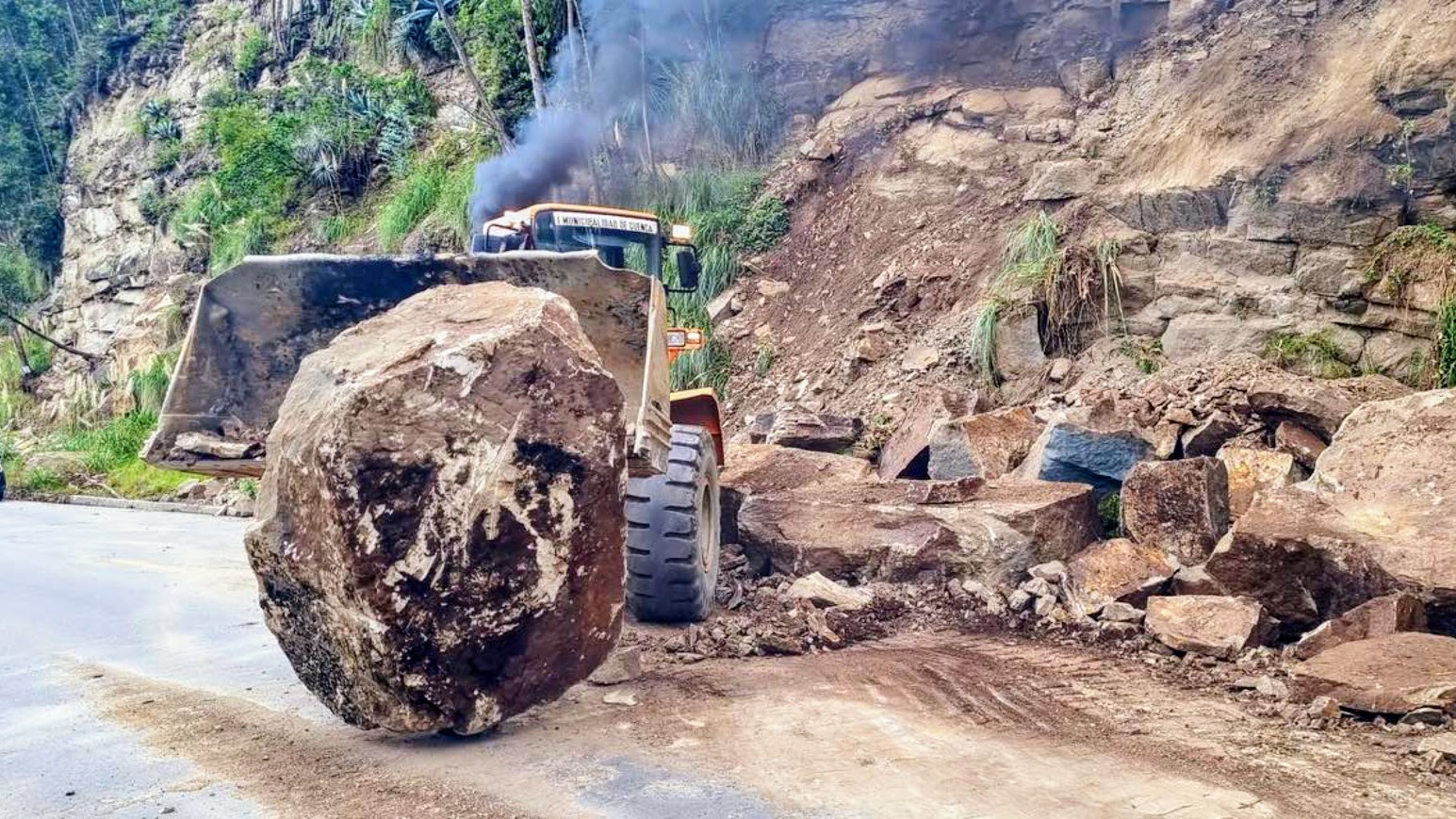
A huge boulder on the nationally maintained the Cuenca-Molleturo-El Empalme highway is removed by the City of Cuenca. | Photo courtesy: City of Cuenca
“The Cuenca-Guayaquil highway is a really bad road,” said Ochoa-Mogrovejo. “It’s always having problems due to landslides and the road sliding down the mountain.”
Known officially as the Cuenca-Molleturo-El Empalme highway, more than 6,000 vehicles travel daily between Azuay and Guayas provinces. When it is open to vehicular traffic.
The road is notorious for huge problems at Km 49. In late-2022 and 2023, a 2.5-kilometer detour had to be taken due to the mountain sliding down over the highway.
Ecuador’s Ministry of Transport and Public Works stabilized the area with 10 terraces on the slope. More than 470,000 cubic meters of earth (approximately 790,000 tons) had to be removed. The project cost approximately $8.5 million.
“The other really bad road is the Cuenca-Girón highway,” said Ochoa-Mogrovejo. “Both of these roads were closed during Carnaval. It impacted our major industry, tourism.”
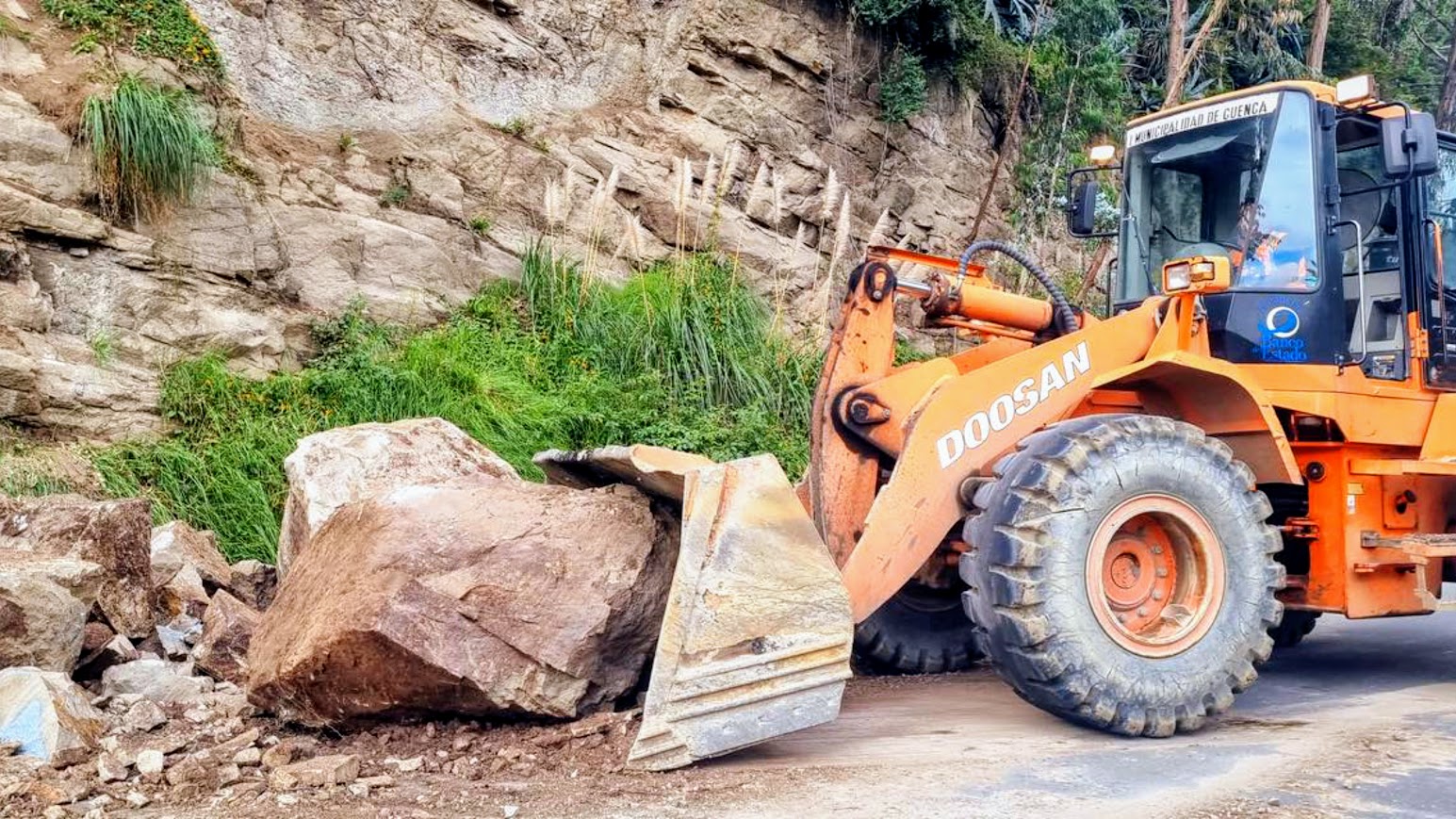
During the long Carnaval weekend, the City of Cuenca mobilized equipment to keep the Cuenca-Molleturo-El Empalme highway open. | Photo courtesy: City of Cuenca
Due to a very slow response from the Ministry of Transport and Public Works for the nationally maintained highway, the city of Cuenca brought in its own machinery and manpower to clear the road to Guayaquil.
“Today, we leave the Panamericana clean in front of medium-sized landslides,” Mayor Cristian Zamora posted on Facebook on March 9th. “Why it is necessary to take care of Azuay/Cuenca better and coordinate with those who want to GIVE THEIR HAND? Change your mindset, just like the rest of the Ministries if you do it and we achieve great things.”
Zamora has been mayor of Cuenca since May 14, 2023. With a background in engineering, Zamora is the most popular mayor in Ecuador with an 80 percent approval rating.
He and Azuay Province Prefect Juan Cristóbal Lloret held a joint news conference recently to express their desire to decentralize some of the national government’s functions, including highway maintenance.
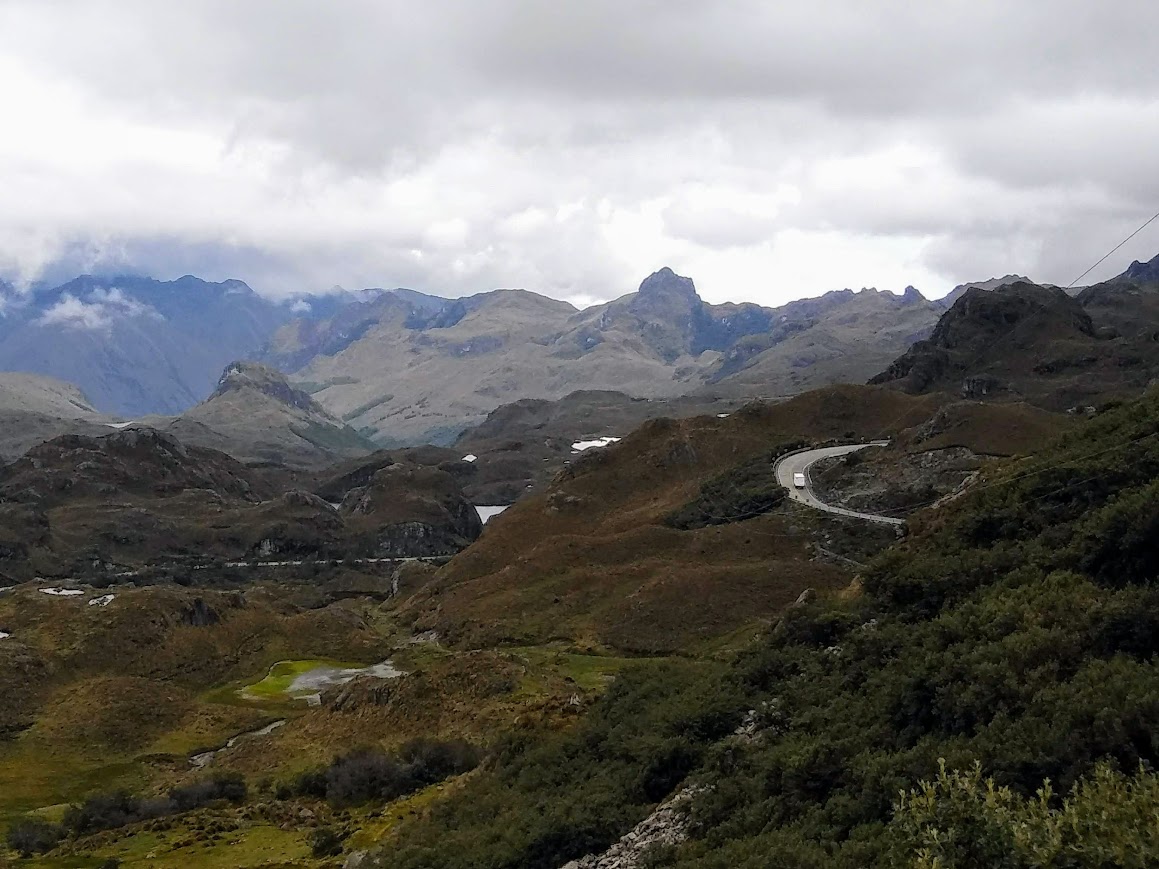
The highway between Cuenca and Guayaquil weaves its way through Cajas National Park.
“Both the prefect and I continue our fight for decentralization of administrative functions and programs,” said Mayor Cristian Zamora. “We believe we are better able to address the needs of our communities at the local level and want the authority and funding to do that.”
“We have serious needs that have not been met by recent governments that we hope can be addressed by the new Assembly and the six asambleistas of Azuay province,” said Cristóbal. “We are developing an agenda with the help of cantonal and parish councils as well as the people of the province to provide guidance for the Assembly.”
Constantly clearing and repairing the highway between Cuenca and Guayaquil is not a long-term solution. It is going to take a new highway.
“It has to be a new one, a toll road to replace the current highway,” said Ochoa-Mogrovejo. “I think it is going to happen. It has to happen.”
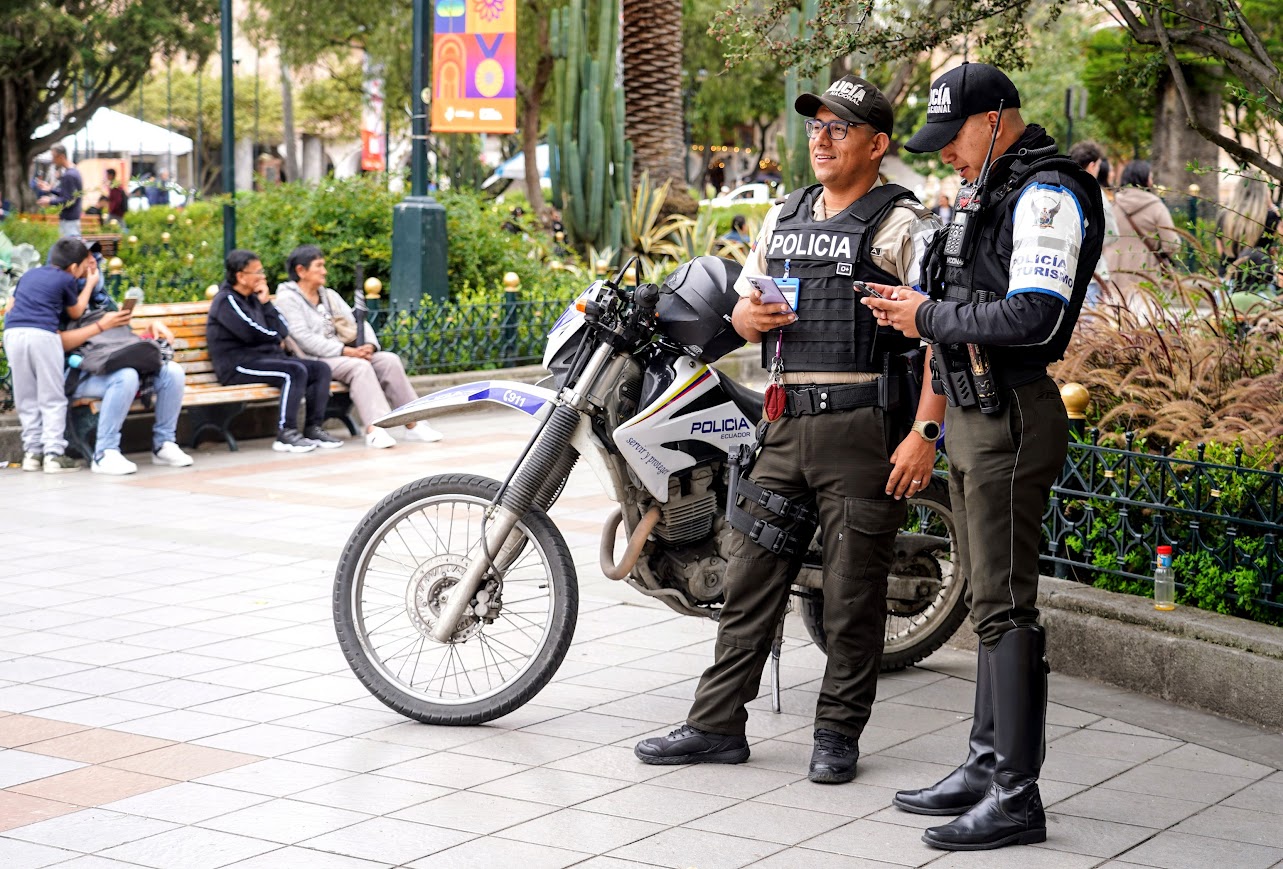
Local police have little power. They assist citizens and police public spaces such as Parque Calderón.
In November, the national government signed a $1.8 million contract with Korea Expressway Corporation for a pre-feasibility study for a new route and cost of the new road to Guayaquil.
As a government-affiliated organization under the Ministry of Land, Infrastructure, and Transport, Korea Expressway Corporation is responsible for planning, construction, operation, and maintenance of expressways in South Korea.
The plan is for the toll road to be six lanes with several tunnels to connect Cuenca to Guayaquil in less than an hour and half. Currently, it takes just over three hours to get to Guayaquil.
Officials think it could be ten years before the toll road is a reality.
The second issue that Mayor Zamora feels the national government needs to address is security.
“We cannot address a crime when a felony is committed,” said Ochoa-Mogrovejo. “We need more national policemen.”
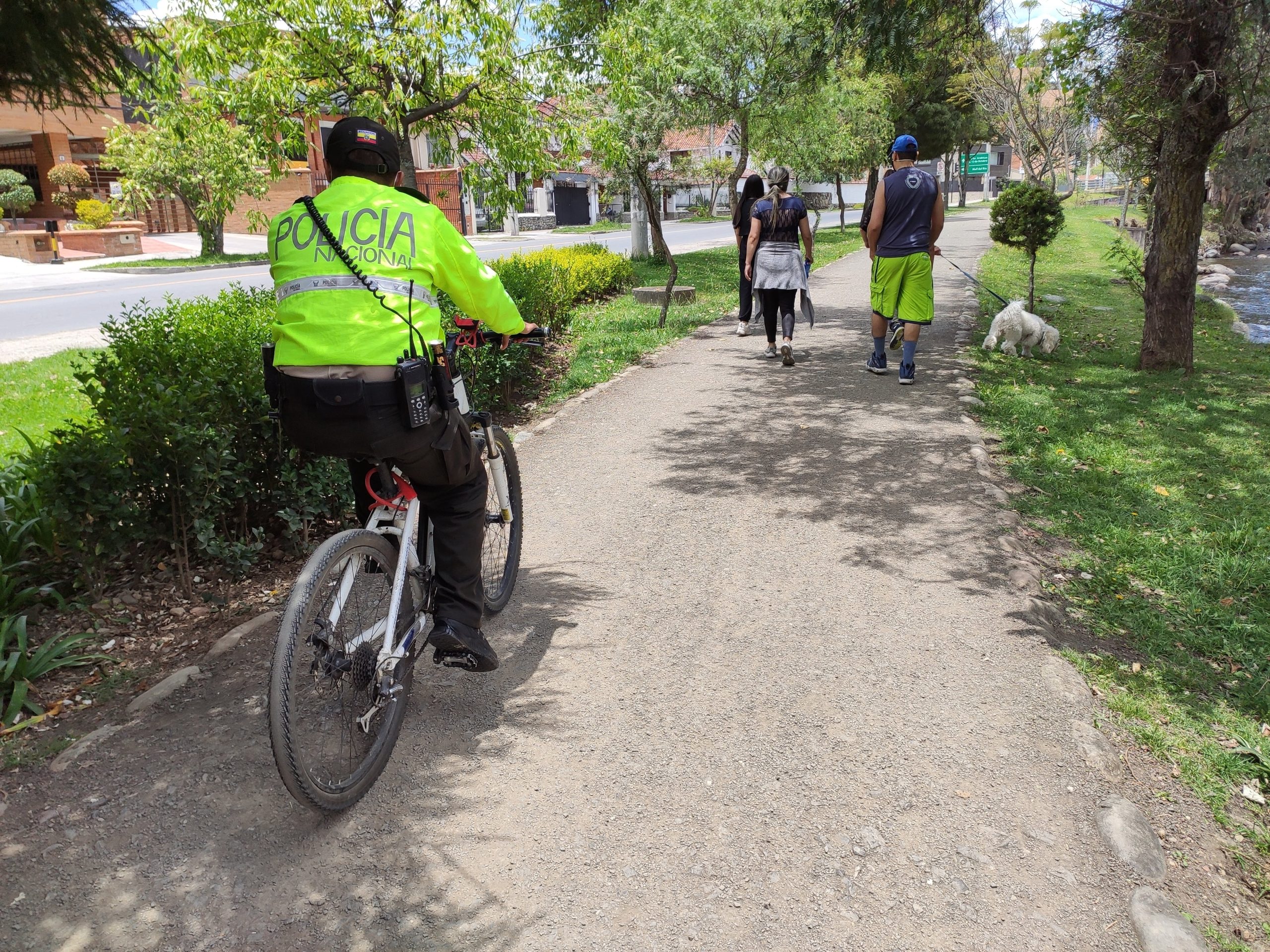
The national police on patrol on Parque Lineal Yanuncay.
Unlike the United States and Canada, local police in Ecuador do not have the legal authority nor are they armed like their counterparts in North America.
“Local police, also known as Citizens Guards, main function is the preemption of crimes,” said Ochoa-Mogrovejo. “They assist citizens and police public spaces such as Parque Calderón.”
With strict limitations on the local police and social media posts passing along the latest criminal incidents, one could conclude crime is something everyone should be concerned about.
“Cuenca is the safest city with a population of over 100,000 people in Ecuador,” said Ochoa-Mogrovejo. There are 16 cities in Ecuador with over 100,000 people.
“Only eight cantons in Ecuador are safer, but they are all a lot smaller than the Cuenca canton.” A canton is an administrative division, below a province. There are 222 cantons in the country. Cantons are further divided into parishes.
According to Numbeo, a crowdsourced platform that is not peer-reviewed, the crime rate in Cuenca is “moderate.”
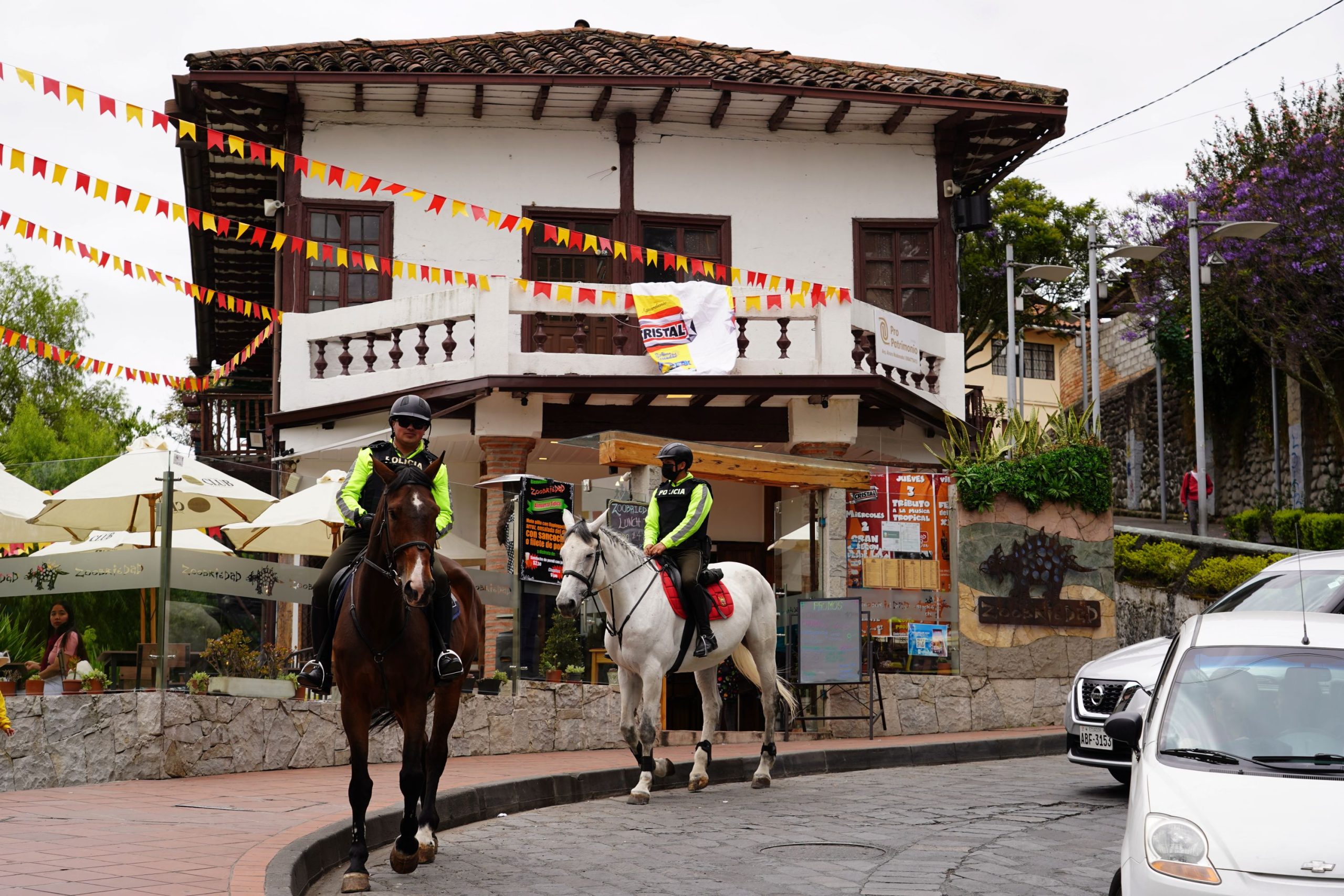
Cuenca has always been considered a relatively safe city. It is known as one of the two safest cities in South America with populations over 500,000.
Cuenca has always been considered a relatively safe city. It is known as one of the two safest cities in South America with a safety index of 54.4, according to Best Diplomats.
Most expats feel safe in Cuenca. Many say they feel a lot safer in Cuenca than they ever did in the United States.
“Cuenca is safer than many cities in the United States,” said Ochoa-Mogrovejo. “We have less crime than U.S. cities such as Detroit, Memphis, and St. Louis.”
Despite the low crime rate, social media posts earlier this month warned people about the latest incidents that involved two armed robberies of pedestrians. The people who posted the incidents did not attribute the information to any authoritative sources.
“I don’t think social media is exaggerating the crimes,” said Ochoa-Mogrovejo. “The mayor said we have to do something to change the perception because Cuencanos are insecure despite the low crime rate.”
Ochoa-Mogrovejo added that social media provides a distorted vision of reality. Over the last decade, social media channels have become a go-to resource for the public to follow local news, including crime reports, according to Pew Research, a nonpartisan American think tank.
A study of social media by a University of Cuenca professor confirms the effects of social media and people’s perceptions.
“When people were asked if crime was a problem in Cuenca, many people answered yes,” said Ochoa-Mogrovejo. “But when they were asked if crime had affected them, over 70 percent said it had not.”
The bottom line to minimize crime according to Ochoa-Mogrovejo is to be street smart. That includes staying off your cellphone when you’re on the street, being aware of people near you or following closely, and taking only well-traveled, well-lit routes when walking.
“Every city in the world has crime. You have to be street smart,” Ochoa-Mogrovejo. “When I went to Athens, Greece for a conference, we asked if it was safe to go out on foot. Our hosts said it was but just don’t go out at certain hours.”
After being robbed by a gang of three at 11:00 at night while walking alone, an American expat in Cuenca blamed himself, not the city, for being so foolish.
His message was that if one uses common sense, most likely it will be an enjoyable and crime-free life in Cuenca.
__________________
Photos by Stephen Vargha
Stephen Vargha’s second edition of his book about Cuenca, “Una Nueva Vida – A New Life” is available at Amazon in digital and hardback formats. His award-winning blog, “Becoming Cuenca,” supplements his book with the latest information and hundreds of professional photos by him.



Hogar Esperanza News

Fund Grace News

The Cuenca Dispatch

Week of September 20
Ecuador turns to industrial power cuts to protect Mazar and keep homes from going dark.

Ecuador raises its 2026 growth forecast, but El Niño could spoil the outlook next year.
Cuenca retirees challenge medical and therapy changes at IESS senior center.
Fabianos Pizzeria News
