
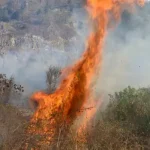
















Government now claims pipeline rupture was an act of sabotage, not the result of a landslide
Energy Minister Inés Manzano claimed Thursday that the rupture of the Trans-Ecuadorian pipeline in Esmeraldas Province was caused by an act of sabotage, not by a landslide as first reported. “This oil spill was not an accident and was not caused by a landslide,” she said. “The break in the line happened in an open area unaffected by the landslide. We now understand that this was done deliberately.”
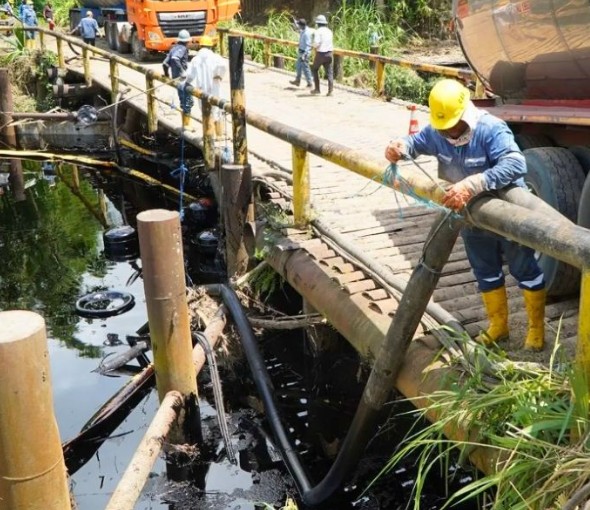
Workers pump oil from a containment area Thursday in Esmeraldas Province.
In addition, Manzano said there are risks of attacks by saboteurs in other parts of the country, such as Papallacta, which supplies drinking water to Quito.
Manzano based her sabotage claim on a police intelligence report. “Their inspection of the site confirmed that this was not an act of nature, but one perpetrated by enemies of the government,” she said. “Our concern now is of other attacks on the country’s infrastructure and resources.”
The minister provided no other details to back the new claim, saying an investigation is underway.
In the press conference, Manzano also said an accident by a Petroecuador employee “aggravated” damage from the oil spill when a containment dam was opened improperly on the Viche River.
Petroecuador and Environmental Ministry announced Thursday that so far, the equivalent of about 14,000 barrels of been contained or removed from rivers near the oil spill. A Petroecuador official said he was unable to estimate the total number of barrels released in the spill. “We do not yet have a firm figure for the oil lost but will provide one soon,” he said.
According to several sources, oil flowed from the broken pipeline for five to seven hours before it was stopped.
Several local officials in Esmeraldas Province are criticizing the government’s response to the oil spill, claiming it is “slow and insufficient.” Esmeraldas Mayor Vicko Villacís claims the extent of the damage has been “vastly underestimated,” challenging the Risk Management office’s estimate that 3,000 people have been directly affected.
“The real number is more like 500,000,” says Villacís, who traded accusations with Manzano on social media Thursday. “They are only counting the families whose drinking water is contaminated immediately downstream from the accident, but their number is far, far below the actual number. They are not considering the farmers who cannot irrigate their fields and the thousands of fishermen who cannot fish.”
During the exchange, Manzano called Villacís “incompetent” and Villacís accused Manzano of playing “election damage control” in support of President Daniel Noboa.



Hogar Esperanza News

Fabianos Pizzeria News

The Cuenca Dispatch

Week of September 20
Ecuador turns to industrial power cuts to protect Mazar and keep homes from going dark.

Ecuador raises its 2026 growth forecast, but El Niño could spoil the outlook next year.

Cuenca retirees challenge medical and therapy changes at IESS senior center.
Fund Grace News
