






Gringo tribes studied by expert
There is a particular kind of energetic expat who hits the ground running in Cuenca on Monday, buys him or herself an alpaca wool hoodie on Tuesday, and by Wednesday morning is ready to reorganize the bus system, modernize the electrical grid, improve customer service, regulate fireworks, retrain taxi drivers, and explain to the municipality why Avenida de las Américas ought to operate more like the New Jersey Turnpike, and import dog shrinks from Harvard.
Most of us have met him, or have occasionally been him. He is easily identified in the wild by the phrase, “Back home, what we do is…” This is usually followed by a plan involving apps, zoning regulations, propane conversion, bike lanes, customer service seminars, QR codes, and meetings with people who have not requested his assistance.
 A recent Cuenca High Life column described just such a gentleman, newly arrived and apparently eager to meet Presidente Daniel Noboa in order to explain the deficiencies of Cuenca’s bus system. He wished to discuss diesel fumes, route planning, driver training, tram integration, and the possible conversion of the buses to propane gas or battery power.
The image comes across as undeniably comic and one imagines the presidential guard at Carondelet Palace saluting solemnly while a retired gentleman from New Hampshire unfolds a transit map, takes a ballpoint pen from behind his ear, and explains why Route 100 — the bus to Baños — requires better integration with the Tranvía and rerouting on the return loop.
Yet the story also reveals something more interesting than the simple folly of gringos. It is easy to laugh at the man who wants to fix the buses, but it is worth asking from an anthropological view, why retired foreigners want to fix anything at all.
Many expatriates in Cuenca are former managers, engineers, professors, civil servants, business owners, nurses, soldiers, administrators, and professional school board members. For forty years they solved problems, attended meetings, written procedures and reports, supervised people, and were personally consulted before anybody changed the filter papers on the coffee drip machine.
Retirement, though not unexpected, arrives suddenly and the day comes when nobody needs their opinion on procurement policy.
This is not always easy to take. A man whose entire life revolved around supervising three hundred employees may feel rather useless when the most important decision of the morning is whether the avocados in Supermaxi on Monday will be ready to eat by Thursday. The impulse to reorganize the bus system may be absurd, but beneath it lies the anxiety of a person whose usefulness has lost its official title.
That does not make the behavior attractive, but it makes it recognizable.
The retired anthropology professor who wrote the original piece was right about one thing. There are expatriates who arrive in Ecuador and rapidly diagnose the country as if it were a badly managed condominium association. They complain about buses, dogs, graffiti, potholes, fireworks, car alarms, traffic, banks, plumbers, restaurants, and the mysterious failure of Ecuadorians to arrange daily life according to the preferences of retirees from Muncie, Indiana.
Some have been here eleven days. Some do not speak Spanish and believe that “local government” is what happens when el Presidente personally answers emails about trash collection billing.
Such people exist, I suppose, and they are not an ornament to foreign settlement. Still, the matter becomes more complicated once the laughter fades. The foolishness is not always in noticing a problem, but in assuming that nobody else noticed it before.
Cuenca’s buses do produce fumes and some of the routes are confusing. Some drivers appear to regard acceleration and braking as forms of percussion. The Tranvía and the red bus system could probably be better integrated, but none of these observations requires a doctorate, a gringo forum, or a confidential meeting in person with the president.
But the buses are not diesel because Ecuador never heard of electricity. They are diesel because diesel buses are cheaper, easier to maintain, and already supported by an existing system of mechanics, parts, depots, fuel supplies, and drivers who know what they are dealing with. Electric buses sound simple, quiet, clean, and efficient when discussed over almuerzo, rather like replacing all the barking dogs with Labradors trained by dog psychologists from Portland, Oregon. Then one asks how much it cost and who pays and you wake up with a start.
Ecuadorians are not unaware of modernity. They own phones, use apps, build shopping malls, operate private clinics, run banks, install fiber-optic internet, and ride a tram through the middle of Cuenca. The country is not waiting in a Panama hat for a retired North American to explain the concept of batteries.
The real problem is not foreign advice. Countries borrow from one another constantly. Cuenca’s tram system itself is not the product of a committee of Cañari elders sitting beside the Tomebamba with a notebook and a length of bamboo. Modern cities are built from imported ideas, foreign loans, political bargains, local compromises, and several layers of inconvenience. The island of Jamaica has some electric buses imported from China, and so does the city of Guayaquil, for that matter.
The problem is tone. There is a difference between saying, “I wonder why this works this way,” and saying, “Let me tell you people how this should be done.” The first sentence opens a conversation, but second acts as a damper.
This is where the original column was strongest. It identified a real expatriate weakness: the temptation to confuse observation with authority. Living in Ecuador does not make one an expert on Ecuador any more than eating lunch in a Chinese restaurant makes one a scholar of the Ming dynasty.
But the professor’s piece had its own small irony. For a man who claims to avoid loud expatriates, he seemed to be remarkably well informed about gringo gatherings, opinions, online forums, grievances, personalities, and recurring conversational habits as if he had already infiltrated their cabals. There is a certain irony in the fact that even in retirement the professor’s instincts for what I believe anthropologists call participant observation (aka spying) continue to govern his daily routine more than one might expect from someone who finds the company disagreeable.
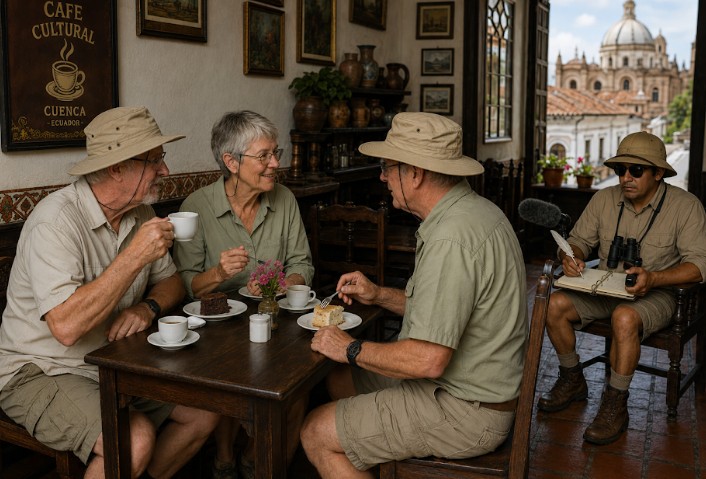
Anthropologists starting with Margaret Mead in Polynesia have traditionally immersed themselves in the tribe they are studying. In Cuenca, the tribe being studied often consists of retired Americans in cargo shorts, bush hats, and bifocals with eyeglass cords discussing parking, dentistry, health insurance, and the cost of imported peanut butter. One does not acquire such detailed knowledge of the target population purely by accident.
This is not a criticism. It is almost a compliment. The expatriate world in Cuenca is a legitimate field of study, with rituals, taboos, status markers, sacred texts, origin myths, and recurring disputes about where to buy proper cheese. There are elders who remember when Ordoñez Lasso was cheaper, prophets who announce that the city is finished, converts who insist they have found paradise, and apostates who have moved away to Portugal.
There are also ordinary people trying to make a tolerable life in a foreign country without embarrassing themselves more than necessary.
Most expatriates are not trying to colonize Ecuador. They are trying to understand the pharmacy system, pay the elusive garbage bill on time, find the right bus to Baños, avoid being overcharged by a plumber or key-cutter, renew a visa or cedula, and decide whether or not to shoot the dog next door.
Sometimes they complain because they are arrogant. Sometimes they complain because they are lonely. Sometimes they complain because they have lived long enough to know that things can be better, while not yet having lived here long enough to understand why they are not.
This is where charity becomes useful, though not too much of it. A little charity prevents us from becoming smug. Too much charity excuses behavior that should simply be discouraged.
The newly arrived foreigner should not demand an audience with the president about bus routes. He should buy an Emov card, ride the buses for six months, learn enough Spanish to ask where they go, and only then begin forming opinions. Even then, he might first discuss them with someone who actually knows what a canton is.
On the other hand, the enlightened observer should also be careful. It is very easy to become the kind of person who sneers at expatriates sneering at Ecuadorians, which is not a moral improvement so much as a more advanced version of the same hobby.
In Cuenca, everyone eventually observes everyone else. The locals observe the foreigners. The foreigners observe the locals. The long-term foreigners observe the new arrivals. The professors observe the loud-mouths. The columnists observe the professors. The commenters observe the columnists. Then everybody meets BTL and calls it an online community.
Perhaps that is the real civic system. The buses run on smoky diesel, at dawn the hounds begin to howl, the Tranvía glides past with its European dignity, Avenida de las Américas remains stubbornly unlike the New Jersey Turnpike, and somewhere near a pharmacy, a hardware store, or the checkout line in Supermaxi or Coral, a newly-arrived man is still explaining how everything could be improved if only somebody would just listen.
Of course he is wrong, but maybe he is not 100% wrong.