










High culture: How psychoactive substances helped spur Andean civilization
By Andrew Lawler
The subterranean corridor was lit only by eerie light that filtered down narrow ventilation shafts and reflected from polished stone. Priests huffed on decorated conch shell trumpets, sending deep blasts echoing against the cut stone walls of the narrow gallery. Using a bone tube, an attendant blew a powerful psychoactive snuff up the nose of a pilgrim, launching the recipient on a brief but explosive internal journey.
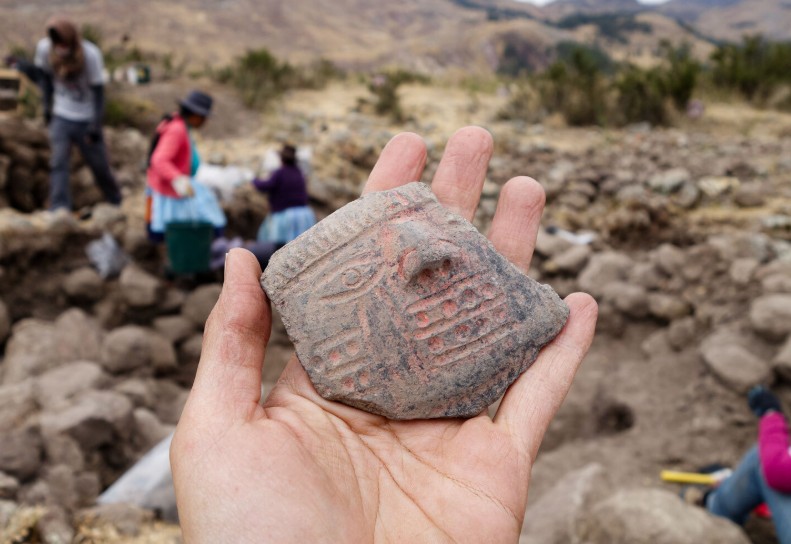
At the Peruvian ritual site Atalla, part-human and part-animal ceramics may show visions experienced under the influence of psychoactives such as San Pedro cactus. (Michelle Young)
Archaeologists have long believed this 3000-year-old temple complex in a high and remote valley in the central Peruvian Andes was a center of drug rituals such as the scenario above. Carved friezes depict psychoactive plants and stone heads illustrate humans transforming into serpents, raptors, and jaguars. Trumpets made from Ecuadorean conch shells have been found near a circular plaza designed to amplify the sound of water rushing through an underground channel. Beneath the collection of stone buildings, excavators found an intricate network of galleries with the remains of dozens of polished graphite mirrors, as well as a 4.5-meter-tall granite stela of a fanged deity.
Such finds strongly suggested the practice of mind-altering rituals, but in 2016 a team led by Stanford University’s John Rick began to unearth what he calls “the smoking gun.” They uncovered a new gallery and spent two painstaking seasons excavating its floor. “It was crazy, we started to find all this material, including 21 bone tubes,” recalls Oscar Espinoza, a Ph.D. student at Tulane University. He led analyses of the tubes, which yielded traces of tobacco and something considerably more potent: seeds from the vilca tree, which contain bufotenine; dimethyltryptamine (DMT); and 5-MEO-DMT, a combination that produces short-lived but extremely intense visions.
The Chavín de Huántar discovery, published in May 2025, spotlights the power of new technical advances, some derived from pharmaceutical research, that make it possible to detect chemical and biological traces of drugs and other substances in artifacts thousands of years old. “People have been saying for decades that they”—ancient Andeans—“were using psychoactives,” says Dan Contreras, a University of Florida archaeologist who has worked extensively in Peru and was a co-author on the 2025 study. “Now we are getting direct confirmation.”
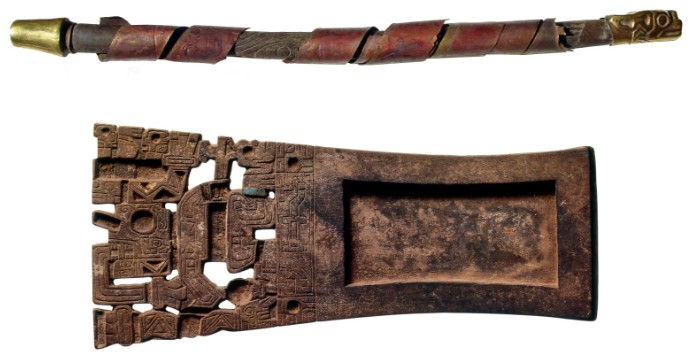
Snuff trays and tubes, like these found at San Pedro de Atacama in Chile, were used to ingest crushed seeds of the psychoactive vilca plant.
The work also benefits from recent research into the use of hallucinogens in treating mental illness, which has promoted broader acceptance of these substances. “There was long a feeling that drugs made you sick and addicted,” says José Capriles, an archaeologist at Pennsylvania State University (Penn State) who excavates in Bolivia. “Today, there is a new openness,” he adds, which is freeing grant money and attracting graduate students.
Drug-based rituals, it is now becoming clear, played a central role in the emergence of Andean civilization. Rick believes Chavín’s ritual leaders invited elites from other regions to take part in elaborate ceremonies centered on ingesting powerful substances amid a dramatic sound and light show. In so doing, “they harnessed the process of mental alteration to establish powerful levels of authority.”
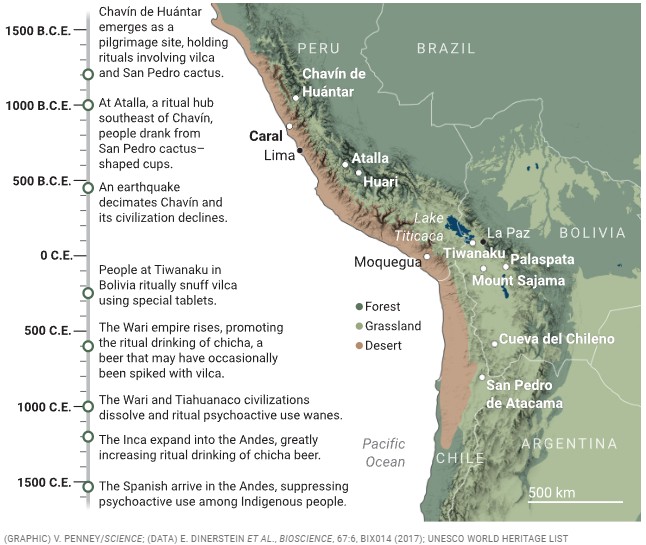
Chavín’s success spawned imitators throughout the region. In subsequent centuries, the Tiahuanaco and Wari peoples built on these traditions to cement political, social, and religious power as their territories expanded to encompass vast swaths of western South America. Widespread ritual drug use fell into decline only when the Inca rose after 1200 C.E.; Spanish conquerors suppressed remaining practices after their 1532 invasion. Although psychoactives remained in use for medicinal and small-scale religious purposes—many can still be found for sale in open-air markets—their powerful and pervasive influence on Andean society was relegated to the shadows.
When humans first arrived in South America at least 15,000 years ago, they found an ecologically diverse continent peculiarly rich in psychoactive plants. Botanists estimate more than 100 species here significantly alter human consciousness—more than two-thirds of the global total. South America was a vast open-air pharmacopeia.

A frieze found at Chavín de Huántar in Peru depicts a person holding a branch of psychoactive San Pedro cactus. (Constantino Torres)
Coca, the basis for the popular stimulant cocaine, flourishes in tropical forests flanking the Andes Mountains. The mescaline-rich San Pedro cactus thrives along the barren Pacific coast, while the vilca tree grows on the dry and rocky foothills of the western slopes. To the east, a vine and shrub that grow deep in the Amazon River Basin can be combined into a dark red brew called ayahuasca, capable of creating intense visual and psychological experiences.
Scattered evidence suggests early societies along the Peruvian coast experimented with psychoactives as early as the third millennium B.C.E. More solid evidence is found at Chavín, which emerged 150 kilometers to the north by 1200 B.C.E. The temple complex remained in continuous use until decline set in after an earthquake around 550 B.C.E. Notably, it lacks defenses, palaces, or signs of an organized military. Chavín was not the center of a political state, but a pilgrimage site that for centuries drew visitors from afar.
“This system was not based on coercion,” Rick says. He envisions a series of nested secret societies overseen by shaman-priests who welcomed devotees from across the central Andes. An outer circle would have participated in public rituals in the large open-air square plaza in front of the main temple, whereas an elite entered a more intimate circular plaza ringed with friezes that include images of the mescaline-producing cactus. An even smaller circle might have ingested vilca in the underground galleries. Pottery found in some of these galleries comes from distinct regions around northern Peru, suggesting specific spaces were set aside for the exclusive use of visiting elites.
Not all researchers agree with Rick’s sweeping interpretation. Verónica Lema, an archaeologist at Argentina’s Museum of Anthropology who participated in the Chavín lab work, warns there is not yet enough evidence to understand what was taking place at Chavín, where, and for what purpose.
But the temple center does appear to have inspired people throughout the region, who built copycat versions. “Chavín seems like the mother culture,” said Justin Jennings, an archaeologist at the Royal Ontario Museum. “Something like 20 sites reflect its influence.” Rick believes these centers competed, tweaking their formulas and rituals to draw pilgrims. “This was a time of huge levels of creativity and competition,” he said. “If you didn’t innovate with the latest psychoactives, you were left behind.”
 A 2025 study by anthropologist Cathy Costin of California State University, Northridge of ritual vessels from this era strengthens this view. Plentiful images of psychoactive plants on the vessels, found along Peru’s north coast, suggested they were used by shaman-leaders who could “conjure and harness the spirit world,” she says. That, in turn, “likely paved the way for the later development of power based on coercion and economic muscle.”
Costin based her conclusions on ancient images, whereas Michelle Young, an archaeologist at the American Museum of Natural History, partnered with chemists at Vanderbilt University to look for molecular traces of the drugs themselves. She uncovered artifacts excavated in the religious precinct of Atalla, a major hub between 1000 and 500 B.C.E. that lies 450 kilometers southeast of Chavín. The site’s residents built a massive, stepped platform using enormous cut stones, and made ceramics featuring part-human and part-animal figures strongly reminiscent of Chavín’s.
Among the discoveries were shards from cactus-shaped cups in the religious precinct. “This is pretty direct evidence that San Pedro was used within the temple, but we wanted chemical confirmation of mescaline,” Young says. At a Vanderbilt lab specializing in medical applications of advanced mass spectrometry, a technique that separates molecules by mass, chemistry graduate student Karly Serrano developed a new technique to analyze the cups’ contents without harming the vessel pieces. Liquid added to the shards absorbed residues, which could then be extracted and analyzed. “We are bringing the best tools in advancing medicine into archaeology,” says lab chief John McLean.
“We were not able to detect mescaline,” Serrano says, but she did identify 15 different sorts of lipids, fatty organic molecules. Among them were triglycerides, the most common kind of fat in the human body. Though these may point to contamination during the excavation, the lipids more likely come from degraded mescaline. To test that possibility—and to help gain insight into how that chemical signature breaks down over time—Young will provide Serrano with sherds from nonritual vessels for comparison.

An ancient vessel found at a coastal Peruvian site shows a figure transforming into an animal-human form while pouring a substance that may have triggered the change.
In July 2024, Capriles led a team that excavated a rock shelter near eastern Bolivia’s 6500-meter-high Mount Sajama. Beneath thick layers of dirt, burnt straw, and old llama manure, the archaeologists uncovered bits of textiles, decorated pottery, and other luxury goods. They also found a clue to drug-based state building in the Andes in the wake of the growth of regional powers such as the Moche and Nasca in the early centuries of this millennium, hundreds of years after Chavín’s demise. Among the finds was a wooden snuff tablet, a small tray used by vilca users to snort the psychoactive powder.
Capriles’s colleague Mirtha Gomez Saavedra, now at Penn State, dated the artifact to between 250 and 550 C.E. This is an era when the city of Tiwanaku on the shores of Lake Titicaca in today’s Bolivia rose to prominence. Its imagery, temples, and drug paraphernalia suggest a religious tradition centered on ritual use of vilca powder. After 200 C.E., the Tiahuanacans, as they are known, extended their influence south and west, and within 3 centuries their culture reached into northern Chile and Argentina and to Peru’s Pacific shores.
Given few signs of military conquest, Capriles and other archaeologists believe that ritual drug use and its religious underpinnings were key to spreading the Tiahuanacan way of life until the culture’s dissolution around 1000 C.E.
The tablet testifies to the drug trade that supported that culture. It was made from tropical palm wood and carved in a simple style common to the Amazon Basin, more than 500 arduous kilometers to the east, suggesting this lonely rock shelter was a node on a llama caravan route that moved prestige goods—including psychoactive plants from the rainforest or the eastern slopes of the Andes. “There were networks that began in the green ocean—the Amazon—and extended to the Pacific,” Capriles says. Local peoples who interacted with the traders, he adds, may have adopted use of the drugs—and the rituals that attended them.
More evidence for the trade came from a recent analysis of another find. In 2018, while working at the site of Cueva del Chileno, not far from Mount Sajama, Capriles’s team excavated a remarkably well-preserved leather bundle packed with snuff tablets, snuff tubes, spatulas made of llama bone, and a pouch of three fox snouts sewn together. The bundle, unique in Andean archaeology, dated firmly to the Tiahuanaco era.
Melanie Miller, now at the University of California San Francisco, scraped material from inside the pouch, and then used a combination of liquid chromatography and mass spectrometry to reveal five powerful psychoactive compounds, including cocaine. Among them were DMT and bufotenine, key ingredients of ayahuasca—the first evidence that the plants associated with the potent Amazonian brew were trafficked into the ancient Andean highlands, and also the first sign of ancient South Americans combining different medicinal ingredients.
This summer, Capriles began work at a newly discovered Tiahuanacan palace at Palaspata, in the highlands south of Bolivia’s capital of La Paz. One of his goals is to pinpoint sites of ritual activity for closer examination, though political unrest in Bolivia forced him to shorten his season.
In the meantime, the sheer abundance of drug paraphernalia in collections scattered across the Andes testifies to the extent of psychoactive use during the Tiahuanaco period, while offering tantalizing possibilities for residue analysis. In 2003, Kirk Costion, an archaeologist at Mesa Community College, was excavating near Moquegua, a valley settlement nestled in the mountains of south-central Peru. He befriended an expat Canadian, who one day guided him to a local church, and then to a small room inside packed with complete ancient pottery vessels.
“Sticking out of the pots were wooden spoons and at least half a dozen snuff tablets,” Costion says. A local priest had paid local boys to comb cemeteries and other ancient sites in the area for artifacts, but the collection was neglected after his death. Although the objects were later conserved and transferred to the local museum, they have yet to be carefully studied.
To the south, in the Chilean village of San Pedro de Atacama, another Catholic priest assembled remains from the area’s 11,000 years of human history, though in a more systematic way. Among the roughly 400,000 objects are hundreds of snuffing tablets, snorting tubes, spatulas, and a few pouches.
Recently, Lema also identified bird-bone tubes that were used as enema syringes, which allowed users to absorb vilca into the body even more efficiently than through the nostrils. These artifacts have “millimeter-precise dosing openings that can be adjusted by inserting or removing a stopper with a different dosing measurement,” she says. Most come from graves dating to the Tiahuanacan era.
“You find [drug paraphernalia] in roughly one in three graves,” says Constantino Torres, a retired ethnobotanist from Florida International University. “Since [the objects] were not buried with women, that means there was a really high rate of use among men, around 50%,” he adds, noting their style is also different from that popular in distant Tiwanaku. “This was not influence that came from an invading army. My speculation is that this was the spread of an ideology that lacked central control.”
That picture does not convince Lema, however. San Pedro de Atacama, she says, is “far from the central area, and no elite class developed,” making it difficult to tie Tiahuanaco-style religion and rituals with this remote site.
What is widely considered South America’s first empire emerged from the city of Huari in the Ayacucho Valley of the south-central Andes around 600 C.E., just after Tiahuanaco culture began its spread. Unlike the Tiahuanacans, the Wari mixed military might and diplomacy to expand their realm, often building fortified hilltop compounds. The nature of Wari society is still hotly debated, although most scholars see it as a rigid hierarchy dominated by a few elite families but lacking firm central control. And it, too, may have harnessed the power of psychoactives.
Snuff tablets are virtually unknown at Wari sites, even at those cheek-to-jowl with Tiahuanaco settlements in frontier areas such as Moquegua. Instead, Wari elite seemed to prefer grand feasts to consolidate their power over lower orders as well as neighboring elites. “The shared experience of eating and drinking forges affinity,” said Donna Nash, an Arizona State University archaeologist excavating at Cerro Mejía, a mountaintop Wari settlement near Moquegua. These feasts included beer fermented from the fruits of the molle tree common to the region.
Psychoactives, however, may have intensified the experience. At least some Wari brewers appear to have spiked batches of beer with vilca. Depictions of vilca seed pods on Wari feasting vessels show “beyond a reasonable doubt” that the drug was a key part of their rituals, according to Pat Knobloch, an independent scholar who has closely studied Wari iconography. The recent discovery of 13 vilca seeds among the remnants of feasts is additional evidence that they infused the substance into the alcoholic beverage. “This is not a slam dunk, but it is pretty good evidence,” Jennings adds.
When mixed with molle beer, the ground-up seed creates an experience that is far less intense but much longer lasting than when snorted. Molle contains a hydrocarbon that, when combined with a fermented beverage, further inhibits the drug’s psychoactive properties. “I might have a vilca beer with you, [even if] I’m not going to snort that stuff,” Jennings says.
He argues that this molle-vilca brew served a vital function in Wari expansion until its collapse around 1000 C.E. Studies in modern subjects have shown a similar drug, ayahuasca, creates increased empathy and openness that can last for months. Jennings suggests feastgoers experienced a similar “afterglow” that would have bonded them with the feast givers.
That, in turn, would have generated enthusiasm for Wari expansion and their labor-heavy irrigation projects in the highland deserts, though the Wari also conducted traditional military campaigns to gain territory.
To make a more solid case, Jennings hopes to obtain the chemical signature of the drug in a Wari beer cup, though he acknowledges “finding evidence of vilca reduced to powder and then mixed with a liquid is going to be hard.”
That might be necessary to convince some skeptical colleagues. “I will happily start thinking about vilca added to chicha once we have residue analysis from a cup or pitcher,” Nash says. Lema cautions against extrapolating the effects of psychedelics in modern Western societies onto the ancient Andean past. And Capriles notes the beliefs of the participants may be more important than a drug’s specific effects. The power of Catholic communion, for example, centers more in one’s personal understanding of the ritual than in the intoxicating nature of the wine.
Archaeological finds related to ritual psychoactive use appear to decline after 1000 C.E., with the dissolution of the Wari and Tiahuanaco realms. Two centuries later, the small ethnic group of the Inca began their push to dominate the Andes, and maize-brewed chicha beer eclipsed the old psychoactives. As the Inca Empire expanded, chicha drinking became a central ritual in vast plazas, and the brew was a common method of labor payment.
“What was important to the Inca was creating political alliances, rather than spreading a religious cult,” Capriles says. The Inca Empire eventually stretched from Ecuador to Chile. That sheer scale, according to archaeologists, precluded the widespread use of powerful drugs for social control. “Psychoactives are a problem for state-level societies,” Stanford’s Rick says. “They make people more creative, and less easy to regiment.” The substances remained known and in use, although later Spanish conquerors attempted to snuff out a practice they viewed as demonic.
Researchers expect more revelations from the newfound capacity to test for ancient psychoactives. For example, the analyses might one day be able to decipher the phylogenetic differences among varieties of coca. Linking those varieties to specific artifacts could shed light on long-distance trade, and on the cultural influences that spread the powerful mind-altering substance along with other valued goods.
But researchers emphasize that ancient chemical signatures won’t be enough to determine how psychoactive substances reshaped ancient politics and beliefs. “It is essential to increase the number of excavations and analyses,” Lema says, “but it is equally important to improve our ability to listen to both the ancient and present Indigenous Andean worlds.”
Projects are underway, for example, to collect psychoactive residues from the wares of Indigenous Amazonians, building data sets for detecting ancient psychoactive remains while gaining knowledge about contemporary practices and beliefs. The physical, emotional, and spiritual effects produced by these powerful substances in people today are also useful data points, Torres argues. “I grew up in hippie days, and participated in taking these things back then,” he says. “They influenced the way I see the world, and I assume this was even more so in the past.” He argues that “the human body remains the more reliable tool for investigating their impact,” noting a long history of psychoactive researchers experimenting with the substances they study.
Back at Chavín, Rick and his team are continuing to excavate, hoping to uncover more clues to its ancient rituals. Among their newer neighbors are two retreat centers catering to Peruvians and foreigners yearning to experience the power of psychoactives within the shadow of an ancient temple once devoted to their use.
These modern pilgrims can be a nuisance; Matt Sayre, an archaeologist at High Point University who works at Chavín, says they have, on occasion, bribed the park’s guards to gain access to the site at night to wander among the plazas and galleries.
But their motivations have a long history. “These plants are powerful tools of knowledge, allowing access to different dimensions,” says Ingrid Diaz, who owns a local vegetarian restaurant and operates one of the retreat centers with her American husband. In an unintended consequence of archaeology, bolstered by scientific advances, those eager to participate in psychoactive rituals are once again making the sacred trek to Chavín.
________________
Andrew Lawler is based in Asheville, North Carolina. His most recent book is The Secret Token: Myth, Obsession, and the Search for the Lost Colony of Roanoke.
This story was researched and reported with the support of the Ferriss-UC Berkeley Psychedelic Journalism Fellowship.



Hogar Esperanza News
The Cuenca Dispatch

Week of September 06

U.S. sinkings of Ecuadorian fishing vessels trigger court scrutiny after 28 crew members are released.

Cuenca targets a November launch for its first new international link to Chiclayo.

Exports hit a quarterly record, but Ecuador’s import bill is rising even faster.
Fund Grace News

Fabianos Pizzeria News