













How can Cuenca face floods and drought at the same time?
Tom walked into Carlos’s bakery carrying a large umbrella in one hand and a blue water container in the other.
Carlos stopped arranging bread behind the counter.
He looked at the umbrella.
Then at the water container.
Then at Tom.
“I don’t want to ask.”
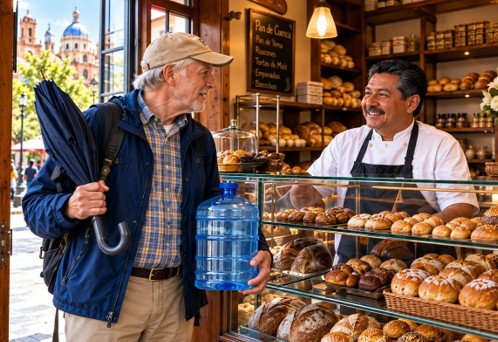
Tom arrives at Carlos’s bakery carrying an umbrella and water container after reading the El Niño warnings. Carlos explains why Cuenca can face floods and drought at the same time.
“Good,” Tom said. “Because apparently Cuenca can have floods and drought at the same time, and I’ve decided to prepare for both.”
Carlos smiled.
“So you’ve been reading the news.”
“They’re warning about El Niño and flooding.”
“Yes.”
“But they’re also warning about drought.”
“Yes.”
Tom put the water container on the floor.
“You’re not helping.”
Carlos laughed.
“In Cuenca? It might rain too much over there and not enough over here.”
Tom looked at him.
“At the same time?”
“Welcome to the Andes.”
One name does not mean one kind of weather
El Niño can produce very different conditions within the same country and, in Cuenca’s case, within the same canton.
That was the part Tom had missed.
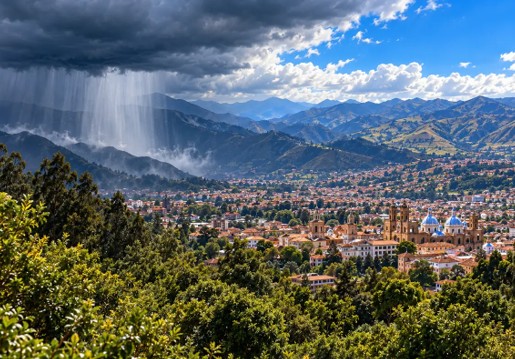
Cuenca canton stretches across dramatically different elevations and terrain, allowing the same broad climate event to produce very different local conditions.
Like many of us, he had learned the shorthand.
El Niño means rain.
Flooded streets. Swollen rivers. Landslides. Brown water rushing through neighborhoods.
That certainly can happen.
But Cuenca officials are preparing for something that sounds contradictory.
Mayor Marisol Peñaloza said lower-elevation areas such as Chaucha and Molleturo need to prepare for flooding rains. At the same time, she warned that much of the canton, including urban and suburban Cuenca, could experience severe drought. CuencaHighLife
Floods there.
Drought here.
Same canton.
Same El Niño.
Geography changes the story
Cuenca is not one flat piece of land experiencing one uniform climate.
The canton stretches across dramatic changes in elevation and terrain. Chaucha and Molleturo lie on Cuenca’s western side in areas strongly influenced by coastal weather. The city itself sits high in the Andes.
That matters.
Mountains change how air and moisture move. One area can receive intense rain while another receives much less.
The result can sound absurd if we expect weather to respect the lines on a map.
A family in one rural parish can be worried about a river overflowing while someone elsewhere worries that there isn’t enough water.
A road can be threatened by a landslide while another area faces dry vegetation and fire danger.
The forecast may say “El Niño.”
What actually happens depends partly on where you are standing.
Tom had made a perfectly reasonable mistake
“So when they say Cuenca is preparing for El Niño,” Tom said, “they’re preparing for two opposite things?”
“More than two,” Carlos said.
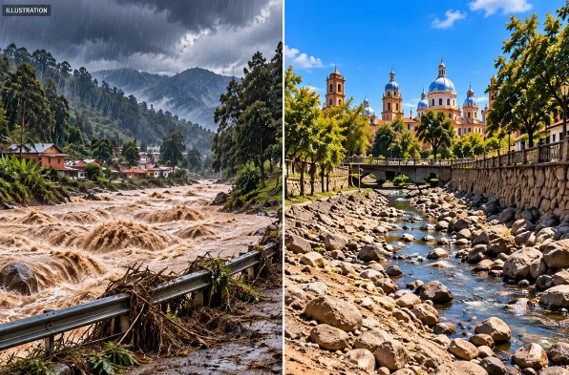
Cuenca can experience both extremes: dangerously high river flows during heavy rains and the Tomebamba reduced to exposed rocks during prolonged dry periods.
He began counting on his fingers.
“Flooding. Landslides. Drought. Fires. Agriculture.”
Tom added one.
“Water.”
Carlos nodded.
“And water.”
That last one matters to anyone who has lived here long enough to watch the Tomebamba shrink during a prolonged dry period.
Water isn’t simply something flowing through the city while we walk beside it.
It is part of the system that makes everyday life here possible.
Cuenca isn’t waiting to find out
The preparations are already underway.
Cuenca’s Cantonal Emergency Operations Committee was activated this week and will remain in permanent session during the red alert.
Officials identified 31 locations that could serve as temporary shelters. Municipal public works and agencies including EMAC, EMOV and ETAPA were told to maintain machinery, fuel and materials around the clock. ETAPA was instructed to monitor river flows and early-warning thresholds. Authorities also ordered preparation for fire risk. Diario El Mercurio
Then came the practice.
On Tuesday, emergency organizations across Azuay conducted a large-scale simulation involving El Niño and an earthquake.
The El Niño scenario wasn’t theoretical drizzle.
In Chaucha and Molleturo, the exercise assumed intense rainfall, overflowing rivers, evacuated families, damaged homes and injured residents. Gobierno Provincial del Azuay
Firefighters, police, emergency personnel and other agencies participated so officials could see how well they could coordinate if the simulation becomes reality. Diario El Mercurio
The point wasn’t to predict exactly what will happen.
It was to prepare for several things that could.
It sounds like a contradiction: prepare for flooding and prepare for drought.
Tom decided the safest approach was to prepare for both.
Swipe through the carousel to see why an umbrella and a water container may not be as ridiculous a combination in Cuenca as they first appear. https://www.instagram.com/p/Ddtsd4XkYBl/?img_index=1
Average weather tells us surprisingly little
People considering a move to Cuenca frequently encounter a comforting description.
“Eternal spring.”
It isn’t entirely wrong.
Cuenca’s climate is one of the reasons many of us enjoy living here.
But averages hide the part that begins to matter once somewhere becomes home.
An average temperature tells you little about what happens during a prolonged dry period.
Average rainfall doesn’t tell you whether that rain falls where the city’s water system needs it.
A beautiful river doesn’t tell you what its flow will look like after weeks without enough rain.
And heavy rainfall somewhere in the canton doesn’t mean your neighborhood is getting enough.
This is one of those things you begin to understand differently after you stop visiting a place and start depending on it.
If you’re considering a move, I explore that question further in my Next Cradle article, “Before You Retire Somewhere, Ask What an Ordinary Bad Week Looks Like.” It looks at how a retirement scouting trip can help you test the everyday life you might actually lead.
When you live here, the questions change
Tom picked up his water container.
“So should I be worried about floods or drought?”
Carlos shrugged.
“Yes.”
Tom laughed.
“That is a very Ecuadorian answer.”
“No,” Carlos said. “That is a mountain answer.”
And perhaps that is the useful lesson.
When we’re visiting somewhere, we ask:
What’s the weather like?
When we live there, the questions become different.
Where does our water come from?
What happens when there isn’t enough?
What happens when there’s too much?
Which roads become vulnerable?
How prepared is the community when the averages stop being average?
Those questions rarely appear in a “10 Best Places to Retire” chart.
But they tell us considerably more about what it means to live somewhere.
Tom headed toward the bakery door.
He still had the umbrella under one arm and the water container in the other.
“So I conserve water…”
“Yes.”
“…and carry an umbrella?”
Carlos smiled.
“Now you’re learning.”



Hogar Esperanza News

Fund Grace News

The Cuenca Dispatch

Week of September 20
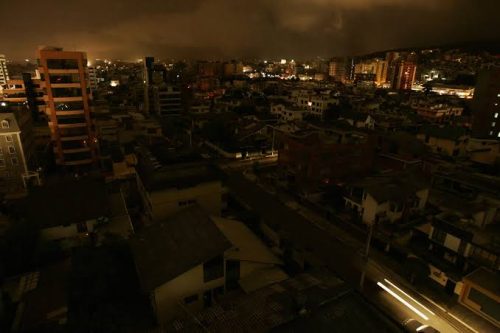
Ecuador turns to industrial power cuts to protect Mazar and keep homes from going dark.
Ecuador raises its 2026 growth forecast, but El Niño could spoil the outlook next year.
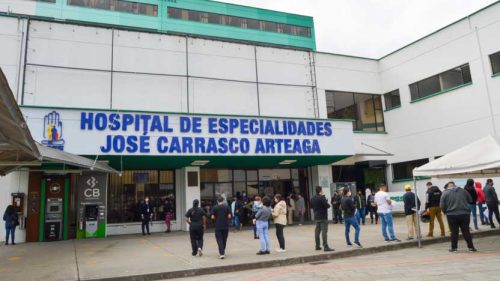
Cuenca retirees challenge medical and therapy changes at IESS senior center.
Fabianos Pizzeria News