











How the ‘war on drugs’ was lost and why getting high is cheaper than ever
By Matt Richtel and Irena Hwang
In the early 1970s, the U.S. government launched what became known as the “war on drugs.” The goal was to reduce substance abuse. The strategy: Crimp the demand for heroin, cocaine and other illicit substances by disrupting the supply and making drug use expensive.
 A key way “we measured success was getting the price up,” said Robert DuPont, who served as the White House drug czar from 1973 to 1977. “It meant we got the job done.”
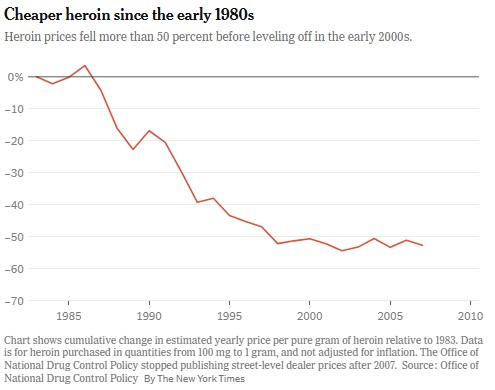
For a few years, prices did rise. But then they started dropping — and kept dropping, and dropping. Over the last two decades, the cost of getting high on opioids has fallen more than 90 percent, and the prices of other illicit drug experiences have dropped precipitously, too.
By contrast, the cost of many consumer items has risen steadily. In 1981, $10 would easily buy eight McDonald’s Big Mac hamburgers; last year, it wasn’t even enough to buy two. The result is a stark economic reality: It has become harder to buy dinner out, compared to most other purchases, but much easier to get high.
The obvious conclusion: The war on drugs has been lost.
Prices Drop, Deaths Rise
In 1972, 6,700 people died of overdose in the United States. In 2024, the figure was 80,000. Many factors contribute to the death rate, which soared beyond the rate of population increase, including the widespread use and accessibility of ultra-potent drugs that are cheap by historical standards.
 “When the price drops, people use more,” said Jonathan Caulkins, a Carnegie Mellon professor who researches drug prices and policy. “When they use more, they die more.”
One main reason for the price drop has been a transformation in how and where drugs are made. Until a decade ago, drugs were largely grown on vast farms that were costly to operate and relatively easy for law enforcement to identify. Today, many are synthesized from cheap chemicals in labs across the globe. Fentanyl is the most infamous, but the United Nations has identified more than 1,500 novel psychoactive substances — opiates such as fentanyl but also stimulants, hallucinogens, cannabinoids and sedatives.
“The supply is diverse, gone away from agriculture, and synthetic drugs are all over the world,” Dr. DuPont said. “Because drugs are so cheap to make, they can price them very low.”
Low-Cost Opioid High
The prices of street drugs were falling even before synthetic drugs emerged.
From the early 1980s to 2007, the price per pure milligram of heroin fell more than 50 percent, according to data from the Office of National Drug Control Policy.
Around the same time that prices leveled off, prescription painkillers and other synthetic opioids began to surge in popularity. These drugs, less expensive to make than heroin, further decreased the cost of getting high.
In 2025, $2 could buy a pill containing two milligrams of fentanyl, according to law enforcement sources. Those two milligrams of fentanyl are the equivalent of 60 milligrams of heroin, according to Caulkins, which in 1983 cost $46. That represents a 96 percent drop in the price of an opioid high from the early 1980s to 2025, even without adjusting for inflation.
Cannabis, Too
Cannabis prices have followed a similar trajectory. Between the late 1980s and early 2010s, the price per 10 milligrams of tetrahydrocannabinol, or THC — the psychoactive ingredient in cannabis — fell nearly 60 percent, according to federal data.
As with opioids, the falling price of a cannabis high partly reflects the increasing potency of the drug. Cannabis plants have steadily been bred to yield much greater levels of THC; with each passing year the same gram of marijuana has contained more highs — and more intense highs — than before. (According to federal data, the THC content of cannabis seized on the street in 1987 was about 3 percent. Recent data from Oregon and California showed that the THC content of products sold legally in state-regulated markets in 2025 was about 25 percent or more.)
In 2025, the price per 10 milligrams of THC ranged from about 10 to 20 cents in Oregon and California. That represents a price decline of more than 96 percent from 1987, when the Office of National Drug Control Policy began collecting consistent data on cannabis price and potency.
________________
Credit: The New York Times