














‘I get by fine without Spanish.’ Then Tom missed the joke
Everyone in Carlos’s bakery was laughing.
The woman beside Tom leaned against the counter. The man in the hat shook his head. Carlos was still smiling as he handed over the bread.
Tom smiled too. It seemed the appropriate thing to do.
Outside, Robert caught up with him.
“What was so funny?”
Tom shrugged. “No idea.”

Tom got exactly what he came for. He just didn’t know why everyone was laughing.
“You were laughing.”
“Everybody was laughing.”
Robert waited.
Tom lifted the paper bag. “Doesn’t matter. I got what I came for.”
Then came the sentence that, as far as Tom was concerned, settled the question.
“I get by fine without Spanish.”
See Tom’s bakery visits unfold in our 10-slide Instagram carousel, “I Get By Fine Without Spanish.” Then Tom Missed the Joke.
Tom, a Canadian from Vancouver now in his late sixties, had evidence on his side. He knew where to buy bread, how to get home and whom to call when something needed fixing. He could arrange appointments, send messages and show a taxi driver an address on his phone.
When words failed him, a translation app usually supplied enough to finish the job. Sometimes a friend helped. Sometimes the person across the counter spoke English.
He had worked out how to make his life in Cuenca function. That took some resourcefulness, and he was understandably pleased with the result.
The bread was right. The change was right. Nobody had been rude or unhelpful.
Still, Robert’s question stayed with him longer than he expected.
What had he come for?
If the purpose of entering the bakery was to buy bread, Tom’s morning had been a complete success.
But the people standing beside him had received something else with their purchases: a few minutes of conversation, a familiar bit of teasing, a reason to laugh together before returning to whatever the day required.
Tom had been standing close enough to touch the counter. He had missed nearly all of it.
It was a small thing. He could easily have forgotten it by lunch. Most of us have smiled through a conversation we couldn’t quite follow, even in our own language.
What bothered him was that he couldn’t have asked a follow-up question. He didn’t know where the joke had begun, who it concerned or whether Carlos’s answer had made it funnier.
He knew the price of the bread. He knew very little about the conversation happening around it.
Carlos had been the newcomer too
On his next visit, the bakery was quieter. Tom waited until Carlos had finished serving another customer, then asked about the laughter.
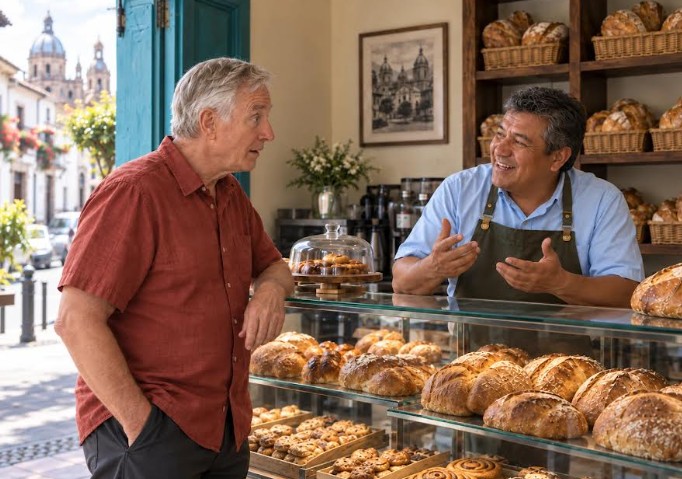
Carlos knew exactly what it was like to understand the transaction but miss the conversation.
Carlos explained, moving between Spanish and English, pausing to find a word. By the time he finished, the joke had lost some of its momentum. Tom suspected most jokes would struggle after several days and a translation.
Something else caught his attention.
“How’d you learn English?”
Carlos smiled. “Ohio.”
Tom stared at him. “You lived in Ohio?”
“Four years.”
Tom had bought bread from this man often enough to have a usual order. Somehow, four years in Ohio had never come up.
Carlos told him about arriving with limited English. He could buy food. He learned how to get to work. He figured out the ordinary things that had to be figured out.
Then he would sit with Americans and someone would say something. The table would break into laughter.
“And you laughed?” Tom asked.
Carlos smiled at him.
Tom nodded. He knew that smile.
It was strange to discover that the man behind the counter had once been on his side of the same experience. Carlos understood the satisfaction of managing in another country. He also remembered the conversations he couldn’t enter.
Tom had thought of Carlos as the person who knew what was going on. He hadn’t considered where Carlos might have learned how it felt to miss it.
The life we learn to arrange
There is comfort in finding reliable ways to do things in a new city. A familiar shop, a helpful contact and a phone full of useful numbers can make an unfamiliar place feel manageable.
Those arrangements are worth having. They can also become so efficient that we stop noticing what they leave out.
Ask a friend to translate a message and you get the answer you need. Visit the same businesses because someone there speaks English and the errands go smoothly. Talk through the day with people who share your language and there is plenty to discuss.
Over time, those choices can determine whose explanations we hear, whose concerns we recognize and which conversations we expect to be part of.
The question is easy to overlook because the system works. Nothing has to go wrong for us to become curious about what else might be available.
Tom’s bakery visit gave that curiosity a face. He wanted to know what had made Carlos and the customers laugh. Then he discovered he wanted to know about Ohio.
Neither subject had been necessary to complete his purchase.
How much Spanish is enough?
“How good does my Spanish have to be?” Tom asked.
“For what?”
“For living here.”
Carlos gestured toward the doorway. “You’re already living here.”
Tom waited.
“What do you want to do here?”
That was harder to answer.
For buying his usual bread, Tom already had enough. For asking Carlos about his years abroad, he needed more words, more patience or some combination of the two. For following the teasing between regular customers, he needed practice listening to people who weren’t slowing everything down for his benefit.
There would be other conversations too: a neighbor explaining a change on the street, a shopkeeper talking about family, someone offering an opinion Tom hadn’t heard among his friends.
Speaking Spanish wouldn’t automatically turn those encounters into friendships. A person can speak fluently and remain incurious. Someone with uncertain grammar can remember names, ask questions and keep showing up.
But each additional bit of understanding gives curiosity somewhere to go. A greeting can become a question. An answer can lead to another question instead of a grateful nod and a quick departure.
Tom didn’t need to decide how fluent he would eventually become before asking Carlos to repeat a sentence.
Enough to catch the joke
A few days later, another customer said something while Carlos was putting bread into a bag.
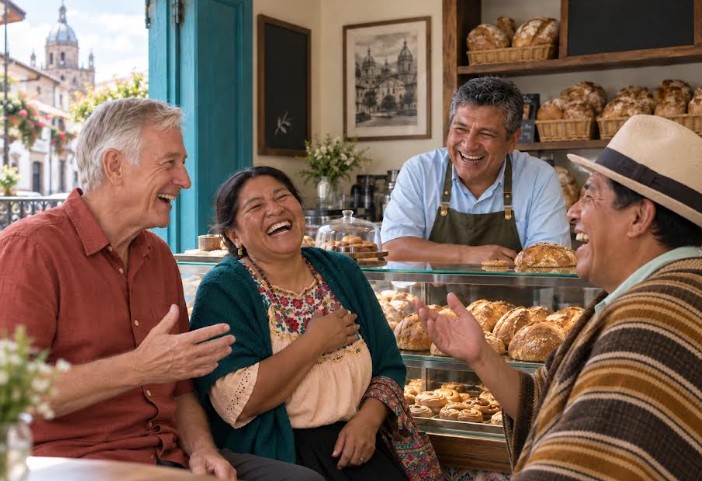
Nothing dramatic happened. This time Tom simply understood enough to be in on the joke.
This time Tom caught a few familiar words. He missed others, but he followed enough of the exchange to understand Carlos’s reply.
The customers laughed. Tom laughed too.
Carlos looked at him.
“You understand?”
Tom held out his hand and tipped it from side to side.
“Enough.”
Carlos shook his head. “Dangerous.”
Everybody laughed again. This time Tom knew why.
Later, Robert asked whether he was finally taking Spanish lessons.
“Let’s not get carried away.”
“But you’re learning?”
“Carlos taught me three words.”
“Useful words?”
Tom considered this.
“Not remotely.”
He seemed rather pleased about that.
He could still get by fine without much Spanish. His original claim had survived the week.
But now he had a reason to linger after paying. He knew something about Carlos that he hadn’t known before. And the next time someone started a story, he wanted to hear where it went.
Learning a little more also meant accepting the awkwardness of asking, repeating and getting things wrong. For someone accustomed to being capable, that could take as much effort as remembering the words.
He never needed Spanish to buy the bread. He wanted enough Spanish to hear more of the room.
Learning another language also asks us to do something many experienced adults haven’t done in years: become beginners again. In the Next Cradle companion, “That’s Not Really My Thing”: Why Becoming a Beginner Again Matters After 50, I explore what can happen when being comfortable with what we know makes it harder to try something new.
How much of the place you live do you want to understand?