










Is Colombia’s violent history repeating itself? Miguel Uribe’s murder inflames Colombia’s political divisions
By Claire McQue
With the eyes of Colombia upon him, a blonde-haired four-year-old called Alejandro Uribe darted towards the altar in Bogotá’s cathedral and planted a white rose on the coffin before him. Inside lay the body of his dead father, Miguel Uribe.
The presidential hopeful and senator of the Democratic Centre, Colombia’s largest right-wing party, died on August 11th from gunshot wounds sustained ten weeks earlier, as he campaigned in Bogotá. As I reported at the time, the attack was Colombia’s worst act of political violence in 35 years.
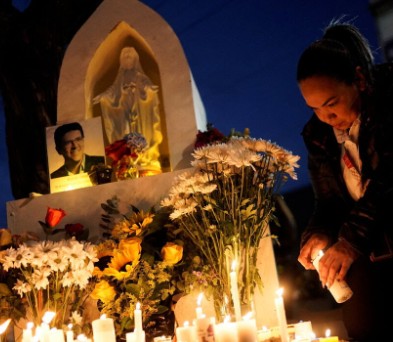
A woman lights a candle at a memorial for Miguel Uribe in Bogota.
The slain senator was given a state funeral on Wednesday. The mood in Bogotá, where I live, was grim. Colombians are grieving his loss. But they also fear a return to the violence at the height of Colombia’s armed conflict.
This scarred Mr Uribe’s own life. In the early 1990s Pablo Escobar’s henchmen kidnapped and later killed his mother, Diana Turbay, a journalist and the daughter of a former Colombian president. Now little Alejandro must endure the loss of a parent, just as his father did.
No one from Colombia’s left-wing government attended Uribe’s funeral, claiming they were not welcome. This political fallout signals where Colombian politics is headed ahead of next year’s presidential election.
Rancour is drowning out calls for reconciliation. At the ceremony on Wednesday, former president Álvaro Uribe (no relation) blamed the “vengeance” promoted by Gustavo Petro, Colombia’s president, for the senator’s murder. (Mr Petro had recently called the deceased Uribe “the grandson of a president who ordered the torture of 10,000 Colombians”.)
Yet Álvaro Uribe is equally militant. He and his supporters deride the peace deal of 2016, which ended six decades of war with the FARC, a guerrilla group. They accuse Juan Manuel Santos, the accord’s architect, of making pacts with violent criminals to grant their impunity. Mr Uribe also caused outrage by downplaying the state-backed slaughter of at least 5,700 former communist revolutionaries in the 1980s and 1990s, many of whom laid down arms to join the Patriotic Union party.
I asked Mr Santos, Colombia’s president from 2010 to 2018, what he thought. “The agreement was negotiated to avoid what happened to Miguel,” he told me over coffee. For instance, the deal stipulates security guarantees for the opposition. Yet two-thirds of the accord has not been fully implemented, despite it being fundamental to Colombia’s shedding of its violent past.
Álvaro Uribe’s undermining of the accord is therefore irresponsible. He is the lifelong leader of the Colombian right, but his legacy has been tarnished by his conviction on July 31st for bribing witnesses and attempting to pervert justice. Now under house arrest — from his 1,500-hectare ranch — Mr Uribe decries political persecution. His camp is trying to exploit the assassination to stoke fears of further violence, in the hope of pushing voters towards a right-wing candidate with an iron-fisted approach to security. It is a strategy that seems designed to erase the centre.
Mr Santos lamented this political polarisation. Both Messrs Uribe and Petro prefer confrontation, he said, rather than “following George Washington’s advice of building bridges and making democracy work”.
_________________
Credit: The Economist