












Is the Constitutional Court challenge to Noboa’s anti-crime laws the prelude of an institutional crisis?
By Ken Marist
Monday’s order by the Constitutional Court suspending key provisions of three anti-crime laws could set the stage for a government crisis. The laws, National Solidarity, Intelligence and Public Integrity, all aimed at combatting organized crime, were proposed by President Daniel Noboa and passed by the National Assembly in June and July.
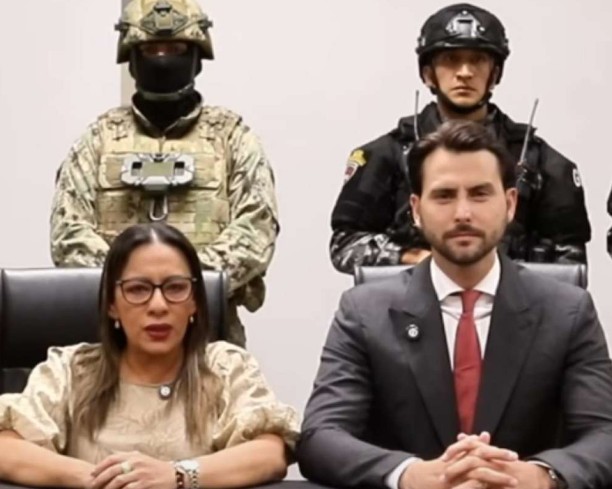
In a show of force, Government Minister Zaida Rovira and National Assembly President Niels Olsen were backed up by men in uniform when they criticized Monday’s Constitutional Court ruling.
In what appeared to be a preemptory strike, some Noboa supporters last week attacked the court’s alleged bias for supporting civil rights over tough government measures to attack crime.
“Yesterday’s decision was anticipated based on the court’s strict adherence in the past to constitutional language supporting the rights of individuals,” says attorney and university professor Xavier Goya. “This obviously is in conflict with the government’s plan to reduce some rights in the interests of targeting criminals,” says attorney and university professor Xavier Goya.
He adds: “The problem is that the job of the court is to defend the constitution. That’s why it is called the Constitutional Court.”
So far, more that 20 lawsuits have been filed against the three laws and government officials worry that litigation could continue for months.
Although Noboa’s office said it “respects the independence of democratic functions,” the president’s partisans have gone on the attack following the court’s decision. Government Minister Zaida Rovira claimed the temporary suspension of more than 20 articles in the three laws will “harm the National Police and the Armed Forces” in their fight against illegality. “The citizens are demanding that justice be done and that security be reestablished in the country, but the court does not hear their cry,” she said, demanding that the justices explain their decision.
National Assembly President Niels Olsen echoed Rovira’s claim. “The Assembly approved three laws that the people of the country demanded,” he said. “We fulfilled the mandate, but the court apparently did not consider this.”
At least three members of Noboa’s Democratic Action Party are advocating restructuring the entire court system with the possible elimination of the Constitutional Court.
Opponents of the three laws are applauding the court’s action. Criminal lawyer Pablo Encalada called the ruling “forceful, timely and necessary.” He says Noboa has “mounted an onslaught” against constitutionality. “The government is reducing the rights of citizens, insisting it is necessary to dismantle crime organizations operating in the country,” Encalada said. “The Constitutional Court is the last stronghold against this abuse.”
Encalada adds that the government’s campaign against crime is a “total and dismal failure,” and another approach is needed. “Curtailing the rights of citizens has not worked in the last 18 months so why would it work now? The rate of violence on the coast is soaring and the number of illegal gold mines has doubled since Noboa declared war on gangs.”
Constitutional scholar Marco Navas says the conflict between the executive, legislature and the judiciary is nothing new. “It has happened again and again ever since democratic governments adopted the idea of separation of powers,” he says. “I sincerely hope we will not have an institutional crisis in Ecuador like we have seen in other countries. I hope mature leadership and cool heads will prevail when the court makes its final rulings.”
Navas believes it is “inevitable” that some articles of the three laws will be judged unconstitutional in the end. “I am not sure if the court will make this determination based on its own review or if it will be determined based on legal challenges from third parties.”
Like others, Navas is concerned that lawsuits against the three laws could delay a final decision for months. “If judgements are slow to arrive, the tension between the executive and the court could grow to an explosive level. If the court issues a series of provisional rulings, all pending further review, we will likely face an institutional crisis.”