















It rained so why isn’t the electricity problem over?
Tom and Elaine watch the rain in Cuenca. But while their lights stay on, Ecuador is ordering factories to disconnect from the electricity grid. What does that tell us about the country’s power supply?
Rain was beating against the windows hard enough that Tom had abandoned any thought of going outside.

Tom and Elaine watch the rain in Cuenca. A wet afternoon offers reassurance, but does it mean the electricity problem is over?
He stood with his coffee, watching water run down the glass.
“Well,” he announced, “at least this should end all the talk about electricity shortages.”
Elaine looked up from her book.
“Why?”
“Because it’s raining.”
She waited.
Tom knew that look.
“What?”
“How much rain?”
“Enough that I’m not going outside.”
“That wasn’t the question.”
Tom returned to his chair.
His reasoning seemed perfectly sound. Ecuador’s electricity problems get worse when there isn’t enough water. Now there was water everywhere.
Problem solved.
Except that on Friday, October 9, Ecuador’s government announced additional electricity disconnections for industrial customers.
Apparently, the rain hadn’t received the announcement.
The Rain Came. So Why Is Mazar Still Losing Water?
The rain really did help.
On October 5, Ecuavisa reported that Mazar had recovered about two meters, reaching 2,132 meters above sea level at 5 p.m. Rainfall helped, and the plant had also been paused over the weekend to conserve water. Ecuavisa, October 5
That sounded encouraging.
But the improvement did not last.
La Hora subsequently reported a level of 2,129.07 meters at 4 p.m. on October 8. Those dated readings tell a clearer story than a single reassuring afternoon: the reservoir had risen, then fallen again. La Hora, October 8
Tom frowned when Elaine explained this.
“So the rain didn’t work?”
“The rain worked fine.”
“Then what’s the problem?”
“We’re using the water.”
This is the distinction that gets lost when we look out the window and assume Ecuador’s electricity troubles must be ending.
Rain falling is not the same as water remaining in a reservoir.
And a reservoir rising for two days does not mean it has recovered from weeks of declining water levels.
Think of Mazar as a Bathtub
Exposed reservoir banks illustrate the gap between welcome rainfall and the sustained inflows needed to rebuild water reserves.
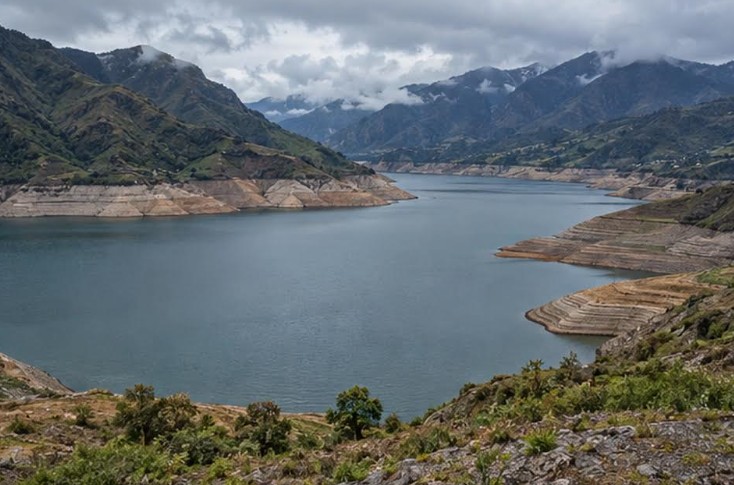
Exposed reservoir banks illustrate the gap between welcome rainfall and the sustained inflows needed to rebuild water reserves.
Elaine tried another approach.
“Think of Mazar as a bathtub.”
“I was afraid you were going to explain electricity to me.”
“I’m explaining plumbing.”
Water flows into the tub. But water also flows out.
In Mazar’s case, that outgoing water turns turbines and generates electricity.
The reservoir is part of the Paute hydroelectric system, which also includes the Molino and Sopladora plants. Together, the three facilities have an installed generating capacity of approximately 1,757 megawatts, the figure CELEC gives for the Paute Integral complex. CELEC, September 10
That’s an impressive amount of generating capacity.
But installed capacity describes what the equipment was designed to produce. It doesn’t guarantee how much electricity the plants can deliver on a particular afternoon.
That depends on usable water, operating conditions, and the demand the system must meet.
When Ecuador needs more electricity, it may have to release more stored water.
Save the water for later, and less electricity may be available today.
Use it today, and less remains for tomorrow.
“Can’t we do both?” Tom asked.
“That,” Elaine said, “is the problem.”
It Also Has to Rain in the Right Place
A wet afternoon in Cuenca doesn’t tell us how much rain is falling across the watersheds that supply Ecuador’s major hydroelectric plants.
Different rivers respond to different weather conditions.
And not all hydroelectric plants work the same way.
Mazar stores water for later use. Coca Codo Sinclair, Ecuador’s largest hydroelectric plant, depends much more directly on the river’s flow. CELEC describes it as a run-of-river development, although it also has a smaller regulating reservoir. CELEC technical description
Too little water can reduce its generation.
But heavy rain can create another problem.
On September 14, Coca Codo Sinclair temporarily stopped operating because of high sediment concentrations in the river, according to El Comercio, citing CELEC. Reducing or stopping generation protects equipment when the river carries too much material.
Generation resumed after sediment concentrations fell. El Comercio, updated September 15
Tom stared at Elaine.
“So we need rain.”
“Yes.”
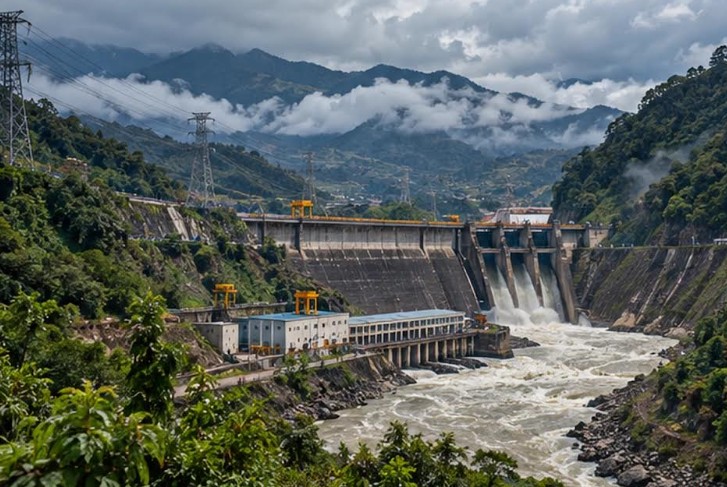
Hydroelectric generation links stored water to electricity supply, with transmission lines carrying power beyond the dam.
“But not too little.”
“Correct.”
“And apparently not the wrong kind of too much.”
“Now you’re getting it.”
The point isn’t that rain is bad.
It’s that generating electricity from rivers requires more than simply having wet weather somewhere in Ecuador.
Hydroelectric generation links stored water to electricity supply, with transmission lines carrying power beyond the dam.
When the Backup Plan Needs a Backup Plan
Tom thought he had found the answer.
“Fine. When there’s not enough hydroelectricity, we use the other power plants.”
“That’s the idea,” Elaine said.
“So what’s stopping us?”
On October 9, a report by Expreso supplied an uncomfortable answer.
Expreso reported that the government had announced temporary disconnections for industries classified as Alto Voltaje 1 and certain industrial customers using medium-voltage electricity.
The ministry cited difficult water conditions at major hydroelectric plants.
But, according to the ministry statement described by Expreso, it also identified something else: problems delivering fuel to floating thermal power plants because of conditions at sea. Expreso, October 9
These generating barges are supposed to help provide electricity when hydropower is insufficient.
Yet a thermal power plant cannot produce electricity without fuel.
The reported explanation points to two vulnerabilities operating at the same time.
Ecuador was struggling to preserve water for hydroelectric generation while also experiencing difficulties supplying fuel to part of its backup generation system.
Tom considered this.
“So the backup power plants need fuel.”
“Yes.”
“And the fuel has to arrive.”
“Yes.”
“And if it doesn’t?”
“We have another problem.”
Tom put down his coffee.
“I preferred it when we were just waiting for rain.”
The October 9 announcement also came during a national holiday weekend, when the government reported increased demand among certain industrial customers.
Officials said the temporary restrictions were intended to protect the electricity system and prioritize supply to households.
Expreso noted that the statement did not specify the affected companies, interruption times, or full scope of the restrictions.
The rain had returned.
But Ecuador still needed dependable backup generation, reliable fuel deliveries, and enough electricity to meet demand.
Your Lights Are On. What About the Factory?
The industrial restrictions didn’t begin on October 9.
On October 8, La Hora reported a separate announcement: disconnections for the Alto Voltaje 1 and Medio Voltaje Industrial segments would increase to three days a week beginning Monday, October 12. The stated aims were to preserve water reserves and protect residential supply. La Hora, October 8
The October 9 announcement introduced additional temporary restrictions during the holiday weekend.
The measures affect specified industrial customers, not every business in Ecuador.
That distinction matters.
But so does another one.
Keeping electricity flowing to homes doesn’t necessarily mean the system can supply everyone who needs it.
Elaine explained the situation to Tom.
“Suppose the government doesn’t have enough electricity for all the usual demand. It can reduce consumption by requiring some large industries to disconnect.”
“So our lights stay on?”
“That’s the goal.”
“But the factories lose electricity?”
“Some of them do.”
Tom thought about it.
“What happens to their workers?”
“That depends on the business. Some can generate their own electricity. Others may have to change production schedules or reduce operations.”
“And their customers?”
“They may feel the effects too.”
Tom looked toward the kitchen.
“Even a bakery?”
“Possibly. A bakery might have electricity while a supplier has trouble producing or delivering something it needs.”
That didn’t mean every bakery had been ordered to disconnect.
It meant electricity problems could reach a business through its suppliers, even when its own lights remained on.
The exporters’ federation, Fedexpor, warned that interruptions threatened export production, port operations, and logistics, according to Expreso’s October 9 report.
The government, meanwhile, says protecting household electricity supply is its priority.
Both concerns are real.
Nobody wants another period of widespread residential blackouts.
But keeping homes supplied by restricting industrial demand carries costs of its own.
“So if my lights stay on,” Tom said, “that doesn’t mean the electricity problem is over.”
“No.”
“It just means my lights are on.”
“Exactly.”
“I was hoping the light switch was a more reliable source of information.”
And We Can’t Simply Buy Electricity from Colombia
Ecuador has another potential source of support: electricity imports.
The country is connected to Colombia’s electricity grid, and cross-border transfers can help when domestic supply is insufficient.
But that arrangement has limits.
In an October 7 fact-check, Ecuador Chequea reported, citing the Colombian system operator XM, that scheduled commercial electricity exports to Ecuador had been at zero since September 7. This did not mean every physical flow across the connection had stopped. Ecuador Chequea, October 7
Colombia’s temporary rules prioritize its own electricity demand and allow exports only under specified conditions. They restrict exports rather than impose an unconditional ban. CREG Resolution 101 127 of 2026
The countries remained physically connected, but that didn’t mean Colombia had surplus electricity available for Ecuador to purchase whenever it needed some.
“Can’t we just buy more?” Tom asked.
“Only if someone has it to sell.”
“So the neighbors might need their electricity too?”
“Imagine that.”
A connection to another country’s grid is useful.
It is not the same as having a guaranteed reserve.
And when neighboring countries face similar weather pressures, the problem can become regional rather than national.
So Are the Blackouts Coming Back?
This is probably what most people in Cuenca want to know.
The industrial measures described in the October 8 and 9 reports do not establish a residential blackout schedule for Cuenca.
The government’s stated objective is to avoid widespread household interruptions by managing industrial demand and preserving electricity reserves.
That is an important distinction.
But an objective isn’t a guarantee.
Whether Ecuador can maintain supply depends on several things happening together: enough usable water, operating hydroelectric plants, dependable thermal generation, available fuel, manageable demand, and imports when they can be obtained.
The industrial restrictions provide another indication of how much pressure the system is under.
If large customers must repeatedly reduce their electricity consumption to maintain supply elsewhere, the underlying vulnerability has not disappeared.
That doesn’t mean residential blackouts are inevitable.
It means a few rainy afternoons cannot settle the question.
What We See Outside the Window Isn’t the Whole System
A couple of weeks ago, I wrote about another apparent contradiction.
How can Cuenca face floods and drought at the same time?
The answer was that water conditions differ from place to place. A flooded street doesn’t mean every river basin has enough water.
Now we’re encountering another version of the same mistake.
It rains in Cuenca.
Therefore Ecuador has enough water.
A reservoir rises.
Therefore the electricity shortage is over.
Our lights stay on.
Therefore everyone has the electricity they need.
None of those conclusions necessarily follows.
Ecuador’s electricity supply depends on rivers, reservoirs, generating plants, fuel deliveries, transmission connections, and the needs of millions of households and businesses.
The October 9 report made that especially clear.
Even when the country has alternative generating equipment, that equipment needs reliable fuel. Even when households have electricity, industries may be required to reduce their consumption.
The system is much bigger than the weather outside our window.
Tom looked outside again.
The rain hadn’t stopped.
“So all this rain doesn’t mean we’re safe?”
Elaine considered that.
“It means it’s raining.”
Tom picked up his coffee.
“I liked my explanation better.”
The rain matters. Ecuador needs it.
But rainfall alone cannot ensure that electricity demand is met, that backup plants have fuel, or that rivers provide dependable flows.
Reservoirs can rise.
They can fall again.
And a light that stays on in one apartment tells us very little about the strain elsewhere.
The real question isn’t whether it rained today.
It’s whether Ecuador has built an electricity system that can keep working when tomorrow it doesn’t.
When a crisis passes, the weaknesses it exposed can remain. That’s the question we explore in Next Cradle’s companion article, “The Crisis Is Over. But Did Anything Really Change?”
It Rained. Why Isn’t Ecuador’s Electricity Problem Over?
The Story in 10 slides
Sources and further reading
Reporting used for the October 11, 2026 article. Reservoir figures refer to the dated readings described in the text.
— Ecuavisa, October 5, 2026: El embalse de Mazar se recuperó levemente tras las lluvias. Weekend conservation and the October 5 reservoir reading.
— La Hora, October 8, 2026: Crisis eléctrica: Cortes de luz para grandes y medianas industrias suben a tres días. October 8 reservoir reading and restrictions announced for October 12.
— Expreso, October 9, 2026: Gobierno de Ecuador dispone desconexiones temporales a industrias. Additional restrictions, the ministry’s reported explanation, and Fedexpor’s response.
— CELEC, September 10, 2026: Maintenance announcement for Central Molino. Paute Integral’s installed capacity.
— CELEC: Central Hidroeléctrica Coca Codo Sinclair: technical description. Plant design and regulating reservoir.
— El Comercio, updated September 15, 2026: Coca Codo vuelve a operar, tras suspensión temporal. Sediment-related interruption and resumption, citing CELEC.
— Ecuador Chequea, October 7, 2026: Colombia sí suspendió oficialmente suministro de energía eléctrica hacia Ecuador. Scheduled commercial exports and remaining physical connection.
— Colombia’s CREG: Resolution 101 127 of 2026. Temporary conditions governing electricity exports.