

















José Lettin’ It Roll: An expat couple’s friendship with an informal toilet paper merchant
By Steven Rigney
There is a bus stop at a busy intersection near the Feria Libre in Cuenca where my wife, Susan, and I would often frequent. It is also where we would shop for our toilet paper. “Cuatro papeles, por un dolar,” Jose loudly chanted as he meandered through the stopped traffic. We were newly arrived in 2014, but the scene of vendors at intersections was familiar to us from our short time exploring the city.
From an economic standpoint, it was rather expensive for the four small rolls. One could get much better value from a supermercado. But from a life standpoint, the extra money it cost us four or five times a month when we would see him was nominal. It was a small price to pay for our contribution to the local economy in general and to José in particular.
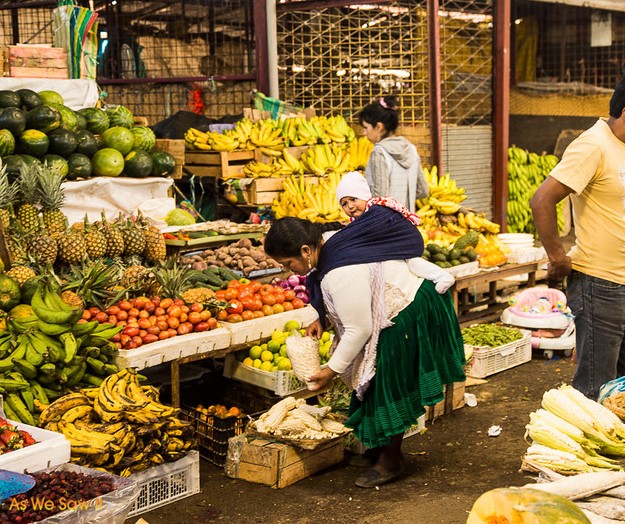
Cuenca’s Feria Libre market, officially El Arenal, is the city’s largest market and the stomping ground to hundreds of formal and informal vendors — like José.
He bought his inventory from a store around the corner for 75 cents a 4-pack and sold them for a dollar. His 25-cent profit was capitalism at its finest. As I observed his sales while I waited for the bus, I could see he probably made the prevailing minimum wage. His working conditions were harsh though, compared to the standards of most Ecuadorians. He was on his feet for hours on the hard blacktop in the rain or hot sun, all the while breathing the fumes of cars and buses. But he did okay; he was his own boss, kept his own schedule and it seemed to suit his needs.
José’s needs were not much. He was rough and unkempt, missing many of his decayed teeth and lived the hard life of a street person. I discovered later on that he was 35 years old; the same age as our oldest son. He was an alcoholic.
He was also about the friendliest and most cheerful person one could meet.
José greeted us immediately upon seeing us for the first time. He wasn’t looking for a handout or even trying to sell us his wares. He was just being friendly with his ready, gapped-tooth smile and playful banter. That he couldn’t speak or understand a word of English did not deter him a lick. He talked up a storm, completely oblivious that we couldn’t speak or much understand him. With my limited Spanish, I caught the gist of his mostly one-sided conversation. He was curious about who we were, where we were from, where we lived, where we were going and everything about us.
It was a relationship that would grow over the months even without formal language compatibility. That was a barrier to friendship that José was heedless of.
We started buying our toilet paper from him whenever we saw him working; even when we had sufficient supply at home. Often when in the Feria Libre neighborhood, I would see him about when he wasn’t selling his wares. I didn’t know where he lived, but it appeared that he must stay in a cheap hovel nearby. Near the bus stop he would have friendly chats with the guard in front of a bank, shopkeepers, eatery owners and passersby. It was clearly his neighborhood.
When looking for a tool on the chaotic street behind the Feria Libre, I ran into José. He offered to come and help me even though he couldn’t understand what I was looking for. He just wanted to hang out with me.
I found the tool and upon returning towards home in the front of the Feria Libre, I came across a gringo friend and stopped to chat. José hung back very respectfully, allowing me my gringo space. Continuing on our way, he resumed his steady chatter.
Another time, getting off a bus, I saw José in conversation with the equally non-English speaking bank guard. They saw me and motioned me over. I was alone, and as usual José wanted to know where I’d been and why Susan wasn’t with me. I said she was at home, which gave Jose the opportunity to kid me. He was animated as he told me, “There’s a whorehouse right up the street behind Supermaxi!” With a twinkle in his eye, he encouraged me, “They’re real pretty and it only costs $10. You could go and tu esposa would never know.” He continued mirthfully, “We won’t tell, go ahead.”
Oh, they had fun with that one!
While on my shopping rounds at the Feria Libre one morning, I encountered José again on the back street. After our friendly greeting, he was excited to take me inside and introduce me to his ex-wife. She had a booth selling potatoes and seemed to be a rather solid person. A small boy of seven was also there, nicely dressed up for school. They all seemed to have a friendly, easy relationship. José beamed as he proudly introduced his gringo friend to his son. He was also very proud of that boy.
José had an entrepreneurial spirit in him. Once, upon seeing me, he couldn’t contain himself as he told me he had just rented a “local.” That was what he called a small storefront by the bus stop. He was busy loading up his new store with a quantity of toilet paper and some other small items that he was planning to sell. Unfortunately, he didn’t realize that he couldn’t sell the same amount to foot traffic as he could by delivering directly to car windows. His little store lasted a month.
I was out looking for some take-out food one dark evening by his intersection. He saw me and worriedly came up to me. He wondered why I was out here on the street at that time. “This is not a good place for you to be at night,” he cautioned. “Es muy peligroso!” I was comfortable in that environment, and I found my food, but I did value his concern.
Whenever José saw us, he never failed to stop whatever he was doing and come and talk to us, gregarious and cheery as always. Except once.
Coming home through a side alley from shopping one morning, I saw him with three of his fellow street companions. They appeared as if they had been on an all-night binge. They were in verbal confrontation and José was not having any of their guff. He barely acknowledged me as I passed.
José was our friend and he was proud that Susan and I were his gringo friends. I felt confident that if for some reason, we were caught up in some anti-gringo social strife, he would be right there to step in and defend us.
As I mentioned, he would always ask where we were going on the bus or where we had been. When I would tell him, I got the distinct impression that he didn’t know much about these common places around town, like El Centro, El Vergel or the Terminal Terrestre. They seemed foreign to him. It appeared as if he had spent his entire life within a few blocks of the Feria Libre and we were his vicarious link to that outside world he longed to know about.
We lost track of José when the intersection got torn up and the buses were rerouted to make way for the Tranvia. I still go by that intersection and frequent the Feria Libre, but he’s not there. Maybe he’s in jail or maybe dead. I don’t know but I wish him well.
José was not a hero or admirable, much less a good example. He was merely one expression of humanity, doing the best he could with what he was given and not meaning to hurt anyone. He was doing what Max Ehrmann’s Desiderata extols us to do: making his way through the noisy confusion of life, being cheerful and striving to be happy. Just livin’ his life, easy come, easy go.
_________________
Steven and Susan Rigney come from Washington State, USA and have lived in Cuenca part time since 2012. When not writing, Steven enjoys hiking and mountain biking around the hills surrounding Cuenca.