










‘Killing field’ of 76 children sacrificed by pre-Inca civilization unearthed at burial site in Peru
By Sierra Bouchér
A 700-year-old burial mound containing the remains of 76 sacrificed children and two adults — all of whom had their chests cut open — has been found in Peru.

A sacrificial site of 76 children and two women is the latest find at Pampa la Cruz, an archaeological site in Peru. (Image credit: Gabriel Prieto, Huanchaco Archaeological Program)
The burial mound is the latest of multiple sacrificial sites found at Pampa La Cruz, near the coastal city of Trujillo in northwestern Peru. All of the sites are connected to the Chimú, a large civilization that thrived in the region from the 12th to 15th centuries. The Chimú predated the Inca and are known for their artwork and textiles.
The children were buried naked, with their clothes near them. Their chests had been cut open from the collarbone down to the sternum, and their ribs had been forced open, potentially to gain access to their heart, previous research on other burial mounds at Pampa la Cruz suggested; these included a discovery in 2022 of 76 child sacrifice victims.
Within the mound, which measures 197 by 66 feet (60 by 20 meters), researchers also found silver and copper squares that may have been sewn to the children’s clothing, as well as ear ornaments and Spondylus shells.
The Spondylus shells were “more valuable than gold for these people,” said Gabriel Prieto, an assistant professor of anthropology at the University of Florida who directs the excavations at Pampa La Cruz. They could only be found farther north — at that time, in the territory of the Lambayeque, a civilization of skilled metalworkers.
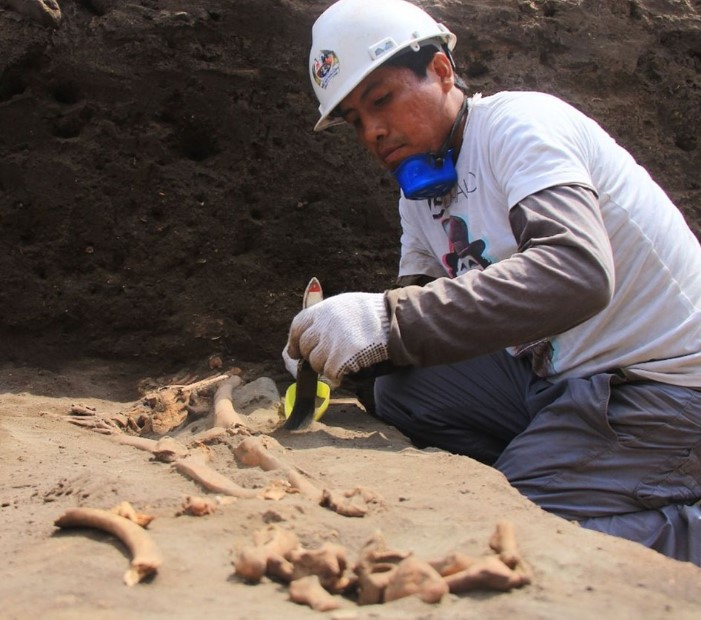
An excavation worker at the Pampa La Cruz cleans human bones.
The presence of the shells was only the first hint of this burial mound’s connection to the Lambayeque. Based on further analysis of the other 76 victims found in 2022 at the same site, the researchers determined that all of the victims had cranial modifications, in which the malleable skull of an infant was elongated using boards or head wraps. This practice was done by the Chimú, but to a less-extreme degree of modification, Prieto told Live Science. The higher intensity of cranial modifications suggests the victims may have been Lambayeque in origin.
The combination of cranial modification and shells led the researchers to investigate the origins of the victims further. The team examined isotopes, or variations of elements, in the individuals’ remains. Isotopes in the water and diets of these children ended up in their remains, providing clues of where the sacrifice victims grew up. Based on a new isotopic analysis of the victims found in 2022, the researchers found that the diets of these people matched with the Lambayeque region.
The children and their families may have been conquered by the Chimú and brought to the site at Pampa la Cruz to build irrigation systems, Prieto suggested. The Chimú were expanding their agriculture into areas that didn’t naturally grow crops well, and they needed complex irrigation systems to grow food in the Pampa la Cruz area, according to Prieto. Once these irrigation channels were completed, the children were likely sacrificed to strengthen the land.
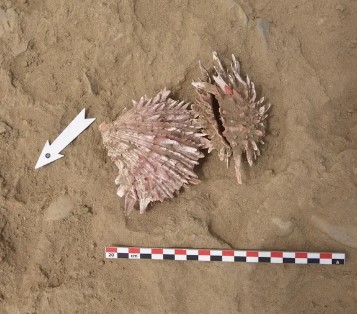
Spondylus shells were valuable to the Chimú. (Image credit: Gabriel Prieto, Huanchaco Archaeological Program)
“The children’s burial in this mound was possibly an offering to energize the fields,” Prieto said. “In Andean cosmology, the dead people become ancestors, and the ancestors legitimize the land rights, and justify and support the systems that keep the land producing.”
The fact that these children were likely not of Chimú heritage would have added an extra layer of value to strengthen the lands, Prieto said.
This is the first excavation at this site with evidence of sacrifices of nonlocals. However, “these are not just local towns that are sacrificing their children,” John Verano, a biological anthropologist at Tulane University and part of the excavation team, told Live Science. “It seems to be controlled by the central government” of the Chimú.
The researchers will investigate this theory by expanding their excavations into Chan Chan, the capital of the Chimú civilization. The research in Pampa la Cruz will also continue. “It’s opening many, many windows to learn about the Chimú that goes beyond the mere idea of their ritual sacrifice,” Prieto said.
_________________
Credit: Live Science