















By Carlos Vega
Money laundering in Ecuador has evolved beyond being simply a security threat — it’s now a parallel economy that moves billions of dollars outside of state oversight. According to economist and actuary Juan Sebastián Naranjo, the scale of this illicit economy could exceed 6% of Ecuador’s Gross Domestic Product (GDP), amounting to over $6 billion annually.
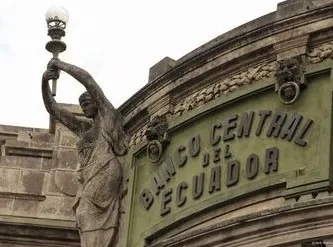
Although Ecuador’s economy is stagnant, the amount of money passing through the financial system is growing rapidly.
“A mismatch has been detected between the income declared to the Internal Revenue Service (SRI) and actual banking activity. It’s estimated that 50% to 60% of this so-called ‘hot money’ is undeclared and thus likely of illicit origin,” Naranjo says. This does not account for funds that never enter the banking system—cash transactions that evade institutional detection altogether.
Economist Hidalgo-Romero highlights the growing disconnect between Ecuador’s financial system and its stagnant real economy. “While the economy remains flat, the financial system keeps expanding — something that cannot be explained by legitimate factors alone. This is a clear indicator that illicit money is circulating within the system,” he warns.
He adds: “It is also an indication of the government’s reluctance to confront money laundering.”
One of the most alarming signs is Ecuador’s high use of physical cash: 17% of GDP circulates in banknotes and coins, far exceeding the 10% typical of countries with stronger financial traceability. “This heavy reliance on cash makes tracing illicit funds almost impossible,” Hidalgo-Romero says.
He also notes that sectors such as construction, car sales, and mining routinely operate with large volumes of unmonitored cash. “This is what we call microlaundering — thousands of small, seemingly legal transactions that, combined, amount to millions in laundered money.”
Microlaundering: a silent cancer
Unlike the dramatic depictions in films, money laundering in Ecuador often takes a subtler form: microlaundering. This involves thousands of minor transactions made through intermediaries or front companies — car purchases, house construction paid in cash, or multiple $3,000 and $4,000 deposits.

Experts say real estate is a popular vehicle for money laundering.
“A single $4,000 transaction doesn’t raise eyebrows. But 40 of them totals $160,000, and still no red flags are triggered,” says Hidalgo-Romero. By fragmenting transactions, launderers circumvent the controls in place within the banking system — making it a growing and systematic problem.
Where Are the Weakest Points in Ecuador’s Anti-Money Laundering Framework?
The most vulnerable sectors include construction, car dealerships, informal commerce, and illegal mining. However, the problem runs deeper: institutional controls have been outpaced by evolving laundering tactics.
-
The Superintendence of Companies struggles to keep up with shell companies invoicing millions with no real backing.
-
The Financial and Economic Analysis Unit (UAFE) lacks both trained analysts and modern digital tools.
-
Over 500 credit and savings cooperatives operate under different regulatory standards than banks, despite managing large amounts of money.
More than 60% of Ecuador’s economically active population works in the informal sector, a condition ripe for exploitation by organized crime. Fragile microenterprises, operating without oversight, offer ideal cover for laundering activities.
“It’s a structural issue,” Hidalgo-Romero says. “In the absence of formal employment, many are tempted — or forced — into criminal networks. There’s often no alternative.”
Gold and Drugs: The Perfect Pair for Laundering
The 2024 case of the company Goldenminerals illustrates how gold has become a new instrument for laundering illicit profits. Operating without its own mining concession, it partnered with Cerro Azul in Azuay to extract gold through poorly regulated contracts. Investigations show that legally registered companies without environmental permits were used to simulate gold exports.

Illegal gold mining is becoming more profitable than drug exports.
Currently, over $1.3 billion in Ecuadorian gold exports originate from illegal mining. These transactions not only evade tax oversight but also channel criminal funds directly into the national financial system.
Does Ecuador Have the Tools to Combat Money Laundering?
“It’s not that banks aren’t doing their job,” says Hidalgo-Romero. “They comply with existing regulations, but those regulations are outdated.” He recommends strengthening oversight bodies like the Superintendence of Companies and the UAFE by investing in specialized personnel — though he acknowledges that this is both expensive and difficult given Ecuador’s low public sector wages.
Naranjo offers another approach: integrating the databases of the financial system, SRI, property registry, and commercial registry, and applying artificial intelligence. “With political will, we could develop robust predictive models in just 15 months,” he asserts.
Money laundering is constantly adapting — shifting from cash to cryptocurrencies, from fictitious exports to illegal mining — while Ecuador’s institutions remain slow, underfunded, and outdated. “Justice is sluggish, controls are obsolete, and mafias are embedded within the state,” Naranjo says. “Without reliable data, expert staff, and sustained political resolve, authorities will always be two steps behind.”
What Can Be Done?
-
Create a national registry of ultimate beneficiaries of companies and concessions.
-
Promote digital payment systems to reduce dependence on cash.
-
Integrate and cross-reference government databases to flag anomalies in real time.
-
Invest in strengthening UAFE and oversight agencies with skilled personnel.
-
Develop a coordinated national strategy with specific goals and a defined budget.
The United States: Part of the Problem?
Julia Yansura, Director of Environmental Crime and Illicit Finance at the FACT Coalition, offers a critical perspective: “The U.S. plays a role in enabling laundering. Recent systemic changes have weakened U.S. anti-money laundering safeguards, making it easier for dirty money to enter unnoticed.”
Gold from illegal mining in countries like Ecuador — now more profitable than drug trafficking — is laundered through fictitious trade companies and exported. That revenue is then funneled into U.S. and European financial systems, especially in real estate markets. “Gold is ideal for laundering — it’s high in value, portable, and superficially legal,” Yansura adds.
Justice and Enforcement Remain Weak
The UAFE produces around 830 reports per year highlighting suspicious financial activity, which are submitted to the Attorney General’s Office. However, few of these result in penalties, asset seizures, or convictions.
“The Ecuadorian justice system is overwhelmed and infiltrated by organized crime,” says Roberto Adriano, economist and former banking advisor. “There’s no effective mechanism to identify shell companies or final beneficiaries. The system lacks personnel and resources.” Out of 69 money laundering investigations launched annually, only six result in convictions, he says. Asset confiscation remains minimal — barely 1% of the suspected laundered funds.
Gaps in Banking Surveillance
In Ecuador, anti-laundering controls in banks still rely heavily on manual processes. Internal auditors must review account activity and request documentation for transactions that appear suspicious. However, the process depends heavily on the diligence of commercial advisors and the authenticity of submitted documents.
“If someone submits a forged contract, it’s nearly impossible for an auditor to detect it without legal or technological expertise,” warns Camila Rodríguez, a money laundering prevention specialist. “Manual reviews and good intentions are not enough to fight organized crime.”
International experts emphasize Ecuador’s lack of real-time automated monitoring tools, weak Know Your Customer (KYC) standards, and the lack of integration among agencies like the UAFE, SRI, and notarial systems.
Without these resources—and without continuous training for financial staff — the country’s anti-money laundering defenses remain highly vulnerable to increasingly sophisticated criminal networks.