















Movie set in the Galapagos tells the true story of how a tropical utopia turned into a living hell
By Caryn James
“Modern Adam and Eve in Pacific Eden”. “Mad Empress in the Garden of Eden”. “The Insatiable Baroness Who Created a Private Paradise”. These actual headlines and many more like them blared across newspapers and magazines in Europe and the US in the mid-1930s. Yet that “Private Paradise”, occupied by a handful of people on an otherwise uninhabited Galapagos island, became a site of deceit, manipulation and, ultimately, mysterious disappearances.

The self-invented Baroness Eloise Wehrborn de Wagner-Bosquet on Floreana with one of her two lovers, Robert Phillipson (Credit: Doheny Library Collection at USC)
Ron Howard’s entertaining new film, Eden, dramatises this outlandish but true story, with its colourful characters including a misanthropic doctor-philosopher, an earnest down-to-earth married couple, and a flamboyant poseur who called herself a Baroness. And you can see the just-as-colourful real people on screen in an eye-opening 2012 documentary, The Galapagos Affair: Satan Came to Eden, from film-makers Dayna Goldfine and Dan Geller.
Eden begins with the words “Inspired by the accounts of those who survived.” Obviously, some of them didn’t. Howard tells the BBC that, beyond the mystery plot, he saw the real-life people as an intriguing microcosm of human nature. “These people gave us this kind of fun, fascinating study,” he says. “Within it there is suspense and betrayal and violence. There’s tragedy, but there is also humour and there’s nobility. And it all happened in Darwin’s Galapagos.” Indeed, the setting is thematically apt – although Charles Darwin’s theory of survival of the fittest, based on his 19th-Century studies in the Galapagos, might seem mild next to the wilful human mischief of this group.
In life and in the film, the first of them to arrive on the island of Floreana was Friedrich Ritter (Jude Law), who moved there from Germany with his lover and acolyte Dore Strauch (Vanessa Kirby) in 1929. Grandiosely planning to write a philosophical work that would offer a new future for all humanity, he figured they’d just leave the world behind. He had his eccentricities. He had all his teeth extracted because, Dore later explained in her memoir, he had “a system of eating which required an intensive mastication of each mouthful”, which had “worn his teeth to stubs”.

Eden features an all-star cast including Jude Law and Vanessa Kirby as the first settlers Friedrich Ritter and Dore Strauch (Credit: Vertical)
The couple’s isolation was shattered a few years later when the Wittmer family arrived: Heinz (Daniel Brühl), his pregnant wife Margret (a de-glammed Sydney Sweeney), and their adolescent son. Heinz had read about Ritter’s experiment in the German press – news made its way via Friedrich and Dore’s letters home, and Friedrich’s writing – and was an admirer. He also hoped that his unwell son’s health would improve in the island climate.
How tensions spiralled
Friedrich and Dore saw the new neighbours as invaders. And the hostility ramped up all around with the addition of the Austrian self-invented Baroness Eloise Wehrborn de Wagner-Bosquet (Ana de Armas) and her two lovers, one man more in favour than the other, both of them in thrall to her. Her past was a swirl of rumours, including that she had once been a dancer in Constantinople, and her plan was to build a luxury hotel for tourists on Floreana. You can guess what the isolationist Ritter thought of that. How she imagined she would bring electricity and indoor plumbing, much less luxury, to the rugged island is a whole other question.
In Howard’s film the Baroness arrives on shore in a long silk robe, carried on the shoulders of her two men as if she were a goddess. And although the film recreates the characters and setting with great authenticity, Howard says, “In fact, in places we tone these characters down a little bit. If Ana de Armas played the Baroness as fully and theatrically as the woman seemed to present herself, we were concerned that we would just be crossing some line.”
Goldfine tells the BBC: “If we were to draw a literary analogy, the Wittmers were like the Swiss Family Robinson, and Dr Ritter was like Robinson Crusoe, and the Baroness was just – there’s no one like her.”
She was truly a piece of work. As she does on screen in Eden, she actually did pitch her camp very close to the Wittmers and bathe in their one source of drinking water. She pilfered supplies of food from both families. She and her men would have small but loud parties within earshot of the Wittmers. Before long, she was scheming, pitting the Ritters and the Wittmers against each other. And that was not a pot that needed stirring. “The Ritters and the Wittmers hated each other,” Goldfine says. No wonder. The free-spirited Dore scorned Margret as a hausfrau, even though she herself was controlled by Friedrich in an increasingly toxic relationship. As Margret’s due date approached, Dr Ritter flat-out refused her request to help with the birth. Howard’s film has Sweeney giving birth alone in the cave where the Wittmers really did live before building a house, howling as she is threatened by feral dogs.
Look at the actual people in The Galapagos Affair and you can see that Law vaguely resembles the lean, intense Ritter, and also see that de Armas’s Baroness was given quite a Hollywood glow-up. The documentary is full of archival footage, much of it shot over many visits to Floreana by Allan Hancock, a California mogul who regularly sponsored a ship full of scientists who came to explore. A film made by a member of Hancock’s crew includes the Baroness and this rather unkind commentary: “She is not beautiful but attractive enough to have lured two European men to share her exile.”
Hancock himself made a short film he co-wrote with the Baroness, a silly little silent called The Empress of Floreana, which is included in the documentary. The Baroness plays a close-to-herself character called The Piratess, and one of her real-life lovers, Robert Phillipson, plays Her Swain, but she soon rejects him and seduces a newlywed husband who has been stranded on the beach (played by Emery Johnson, the film’s director and a member of Hancock’s expedition). “The Baroness took it very seriously by all accounts and thought this was maybe an audition for a bigger, better idea.”
Goldfine and Geller based their documentary on a wealth of letters and articles from the time, as well as Dore’s memoir, Satan Came to Eden (1936), and Margret’s, Floreana: A Woman’s Pilgrimage to the Galapagos (1959), with Cate Blanchett speaking Dore’s words and Diane Kruger Margret’s. It’s no surprise that those books contain conflicting accounts of some crucial events, including a deathbed scene that one woman recalls as gloriously peaceful and the other says included the line, “I curse you with my dying breath.”
An enduring mystery
No one knows what really happened to the people who vanished from Floreana. However, while Howard acknowledges, “It’s a mystery. There are some things that no one will ever know,” he and Eden’s screenwriter, Noah Pink, devised a definite end for the film. “When you’re making a movie based on real events, it still has to deliver as a movie. I think it has to take some sort of narrative position,” Howard says. No spoilers for exactly what happens, but the film’s trailer gives some hints. Someone pulls a gun, someone else pulls a knife, and the Baroness says: “Trust me, by this time next year one of us will be gone.”
Based on their research, “We felt like [our ending] was a very likely scenario and entertaining and intense. There are probably more boring outcomes we could have selected, but given the multiple choice we decided to go ahead and let the audience have a visceral experience,” Howard says, adding: “It’s pretty easy to surmise what happened”. But that’s a minority opinion. Most accounts call the events some version of “an unsolvable mystery”, and Goldfine and Geller say that no new evidence has surfaced since they made their documentary.
________________
Credit: BBC



Hogar Esperanza News

Fund Grace News

The Cuenca Dispatch

Week of September 20
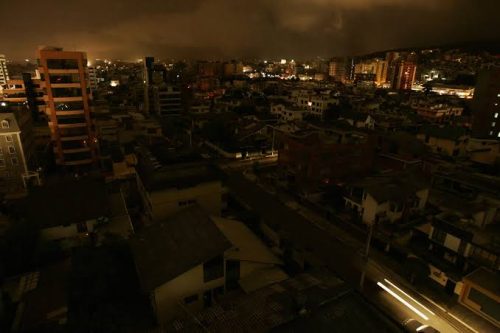
Ecuador turns to industrial power cuts to protect Mazar and keep homes from going dark.

Ecuador raises its 2026 growth forecast, but El Niño could spoil the outlook next year.

Cuenca retirees challenge medical and therapy changes at IESS senior center.
Fabianos Pizzeria News