












North America needs a marriage guidance counsellor
The trade war between the United States and Canada has reached the stage at which mediation may no longer be sufficient. What they really need is a marriage guidance counsellor. 
The two countries have been together for more than two centuries. They share the world’s longest undefended border, speak approximately the same language, watch many of the same television programs and have spent years exchanging cars, oil, lumber, tourists and actors. Canada gave the United States William Shatner, Celine Dion and Pamela Anderson, while the United States gave Canada Walmart, McDonald’s and Fox News. There have naturally been tensions, but every long marriage has its difficulties.
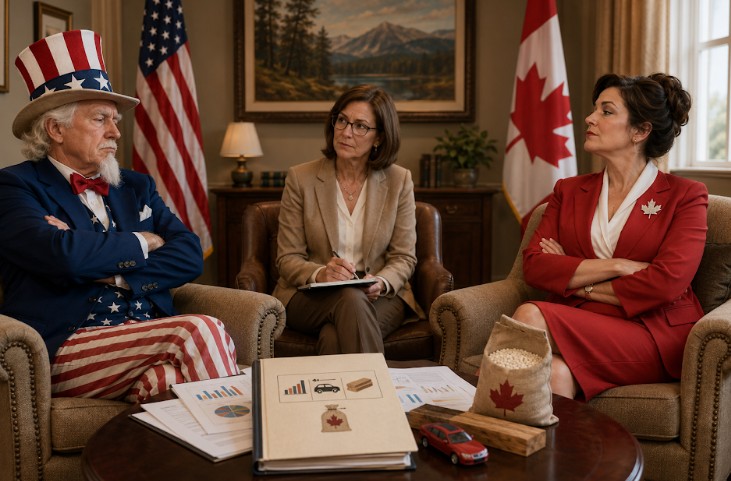 Now the United States has imposed tariffs of 50 percent on selected Canadian goods following the collapse of trade negotiations. Canada has responded with tariffs of its own on about US$20 billion worth of American products, including steel, aluminum, furniture, clothing, cheese, appliances, seafood and cosmetics. In other words, the couple are no longer merely arguing about money. They are throwing the furniture, clothing and the kitchen sink at one another. Washington says Canada has been behaving unfairly toward American farmers and manufacturers, while Ottawa says Washington is trying to damage Canadian industries and bully Canada into accepting an unacceptable agreement.
At this point the counsellor would probably lean forward, put down her notebook and say, “Donald, when Mark protects the Canadian dairy industry, how does that make you feel?” Donald would say that Canada has been taking advantage of him for years. Mark would say that this is simply not true. Donald would then mention Canadian tariffs on dairy products, Mark would bring up American tariffs on steel, aluminum and automobiles, and the counsellor would ask them to stop interrupting each other and remind them that the purpose of the session is not to decide who started it.
(Unfortunately, deciding who started it is the principal purpose of most international diplomacy.)
The disagreement is especially peculiar because the United States and Canada are not merely neighbors who occasionally borrow a lawn mower. Their economies have been intertwined over many decades. A vehicle assembled in Ontario may contain American parts, cross the border several times during production and ultimately be sold in Michigan. Placing a tariff on it is a bit like charging your wife an entrance fee every time she walks from the kitchen into the living room. It may produce some income, but it is unlikely to improve the marriage. The two countries traded about US$872 billion in goods and services last year, or approximately US$2.4 billion every day. Couples who share that much money usually require separate bedrooms.
They already have a prenuptial agreement called the United States-Mexico-Canada Agreement, which was negotiated during President Trump’s first term and replaced the previous agreement known as NAFTA.
Apparently, like many husbands, the United States has discovered that the agreement it enthusiastically signed several years ago is not quite what it remembers agreeing to.
Canada is particularly vulnerable because the United States is by far its largest export market, but the United States also depends heavily on Canadian oil, metals, lumber, electricity and automotive components. This gives Washington more leverage, but it does not mean Washington can hurt Canada without inflicting at least some damage on itself. If you set fire to your neighbor’s condo, your own curtains may also begin to smolder.
Then there is potash, which may be one of the most important things most people have never knowingly discussed. Potash is a group of potassium-bearing minerals used mainly to make fertilizer. It does not have the glamour of oil, the political appeal of steel or the excitement of automobiles, but without it crop yields fall and food becomes more expensive. Canada is the world’s largest exporter of potash, and roughly 80% of US potash imports come from Canada, principally from the enormous deposits beneath Saskatchewan. (Russia and Belarus are among the other major suppliers, which does not leave the United States with an especially attractive list of alternative shopping destinations.)
Potash is therefore the economic equivalent of the reliable spouse who quietly buys groceries, pays the electricity bill and remembers to feed the dog while everyone else is arguing. It has been specifically exempted from the latest round of 50 percent US tariffs, presumably because even the most enthusiastic trade warrior eventually has to eat. Tax Canadian potash heavily and the additional cost is passed on to American farmers, who then charge more for wheat, corn, soybeans, meat and almost everything else produced from them. A tariff intended to punish Canada could end up raising the price of potatoes in Idaho and make french fries at McDonalds a gourmet item.
This is one reason potash rarely receives much attention during speeches about national strength. It is difficult to sound self-sufficient while explaining that your crops depend upon several million tonnes of Canadian fertilizer, or raising the issue of mutually assured destruction.
This North American domestic dispute raises a delicate question here in Cuenca, where substantial communities of both American and Canadian retirees have until now lived together peacefully. They are united by their inability to understand why Ecuadorians put green mayonnaise on everything and why government offices always require one more photocopy than anyone has brought with them. Will the trade war spread to Cuenca? Could Canadian retirees begin imposing tariffs on drinks bought by Americans at happy hour, with Americans retaliating by placing a surcharge on maple syrup? Could the Canadian contingent refuse to attend Thanksgiving dinner unless the cranberry sauce is clearly labeled in both English and French?
There may have to be rules of neutrality. American and Canadian retirees could be seated at separate tables in restaurants, while mixed-nationality pickleball matches might require United Nations observers.
Fortunately, the danger of actual violence is slight since Canadians are famously polite, while most American retirees in Cuenca did not move 3,000 miles south in order to take up arms against Canada. There might nevertheless be passive resistance. Canadians could stop apologizing when an American bumps into them, while Americans could begin calling Canadian bacon “ham.” Both measures would represent a serious escalation.
Ecuadorians may find the entire dispute difficult to understand because, from Cuenca, the United States and Canada appear almost indistinguishable. Both countries are cold, wealthy, enormous and very far away. Their citizens arrive wearing hiking shoes, complain about the altitude and are astonished that a taxi ride costs less than a cup of coffee back home. The Canadians generally have small maple leaves stitched onto their backpacks to make certain they are not mistaken for Americans. If the trade war continues, these may have to be enlarged.
The strange truth is that the United States and Canada probably need each other more than either presently wishes to admit. Their industries, transport networks, farms and energy systems are deeply interconnected. Tariffs may punish the other side, but they also raise costs for domestic businesses and consumers. This is the economic equivalent of a husband refusing to repair the family car because his wife uses it more often than he does. A conventional mediator might examine tariffs, quotas, dairy protections and automobile regulations, but a marriage guidance counsellor would ask a more fundamental question: Do you two actually want to remain together?
Canada might indignantly declare that it is an independent country and perfectly capable of finding other customers. The United States might say that Canada is lucky to have easy access to the huge American market. Then there would be an uncomfortable silence before one of them pointed out that moving house would be terribly expensive and neither can change the neighbors. They may not particularly like one another at the moment, but they share a 5,500-mile border, several Great Lakes, oil pipelines, an automobile industry and a large part of the North American food supply, so divorce is not really on the cards, regardless of who holds them.
The counsellor should prescribe a cooling-off period, followed by a quiet dinner in a neutral location, which we can call a summit. Cuenca would be ideal. We have plenty of Americans and Canadians who could explain that life becomes easier once you stop trying to recreate your home country abroad. We also have inexpensive restaurants and hotels, agreeable weather and very little domestic production of either steel or maple syrup, so we can always switch the subject to bananas.
The only difficulty would be deciding who picks up the tab for dinner. That could start a new war.