


















Paperbacks are checking out
The other day, while waiting in line at Supermaxi, I found myself nose to nose with a wire rack of paperbacks whose optimism exceeded their typography. Cumbres Borrascosas by Emily Bronte leaned against a Bill Bryson travelogue translated into Spanish, something cheerfully titled Aventuras y desventuras del Chico Centella, while Homer’s Odisea kept company with a glossy-covered volume promising recipes for enlightenment via Sopa de Pollo para el Alma, which possibly should have been displayed alongside the Maggi caldo de pollo.
There is something democratic about encountering works of great literature exhibited between the cartons of eggs and the nylon stockings. One does not have to enter a cathedral of culture, whispering reverently beneath vaulted ceilings, to find Emily Brontë or a modern humorist. One simply reaches out, alongside the mints and the discount shampoo, and for the price of a modest almuerzo or two acquires a tragedy, the Divine Comedy, or the collected works of Sherlock Holmes.
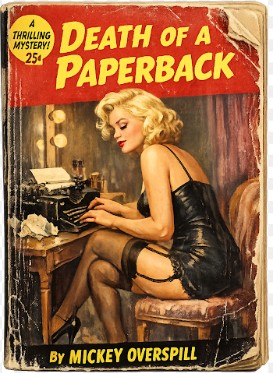 It was ever thus, or at least thus since 1935, when Allen Lane launched Penguin Books in Britain after failing to find anything decent to read at a train station. Lane’s genius was not merely the paperback itself but the branding. Penguins arrived dressed in color-coded uniforms: orange for fiction, green for crime, blue for biography. They were inexpensive, portable, and sold not only in bookshops but in places where ordinary people actually went: newsstands, tobacco shops, railway kiosks, bus stations, and airports. Literature, which had long worn the stiff collar of hardback respectability, loosened its tie and became part of the daily commute.
For a generation raised on transistor radios and public libraries, paperbacks were both passport and possession. They could be slipped into a coat pocket, abandoned on a bus, traded with a friend. They did not demand commitment. They invited curiosity.
Even pop music noticed. The Beatles, always alert to the small absurdities of modern life, gave us that affectionate anthem to literary ambition:
Paperback writer, paperback writer.
Dear Sir or Madam will you read my book,
It took me years to write, so will you take a look.
In two brisk minutes, McCartney captured the eternal plea of the unpublished: please read, please notice, please validate my existence through retail distribution.
Yet across the United States, I recently read in the New York Times, the humble mass-market paperback, the so-called “pocket book”, is shuffling toward extinction. Once squat, cheap, and ubiquitous, these little volumes were stacked on spinner racks in supermarkets, pharmacies, airports. Industry figures show a dramatic decline over the past two decades. ReaderLink, the largest distributor to non-bookstore outlets, has announced it will no longer carry them. Airport retailers have been phasing them out. When existing stock is gone, it will not be replenished.
The reasons are practical and are probably obvious to most people. The format’s greatest strength, portability, has been annexed by the smartphone and the e-reader. Why carry one novel when a device the same size stores a thousand? Production costs for mass-market editions are no longer dramatically cheaper than for larger trade paperbacks, yet the retail price difference remains significant. Libraries, once wary of flimsy glued spines and falling pages, prefer sturdier, more long-lasting formats. Consumers, who once treated books as disposable companions, now increasingly prize them as aesthetic objects: hardcovers with sprayed edges, foil stamping, curated display value for social media.
And so a technology that once democratized reading is being retired in the name of efficiency and taste.
Still, something is lost when books vanish from the everyday landscape. Many readers recall discovering stories not in bookstores but in grocery aisles, bus stations, corner pharmacies. The paperback’s magic lay in its casual accessibility. It asked nothing more than a dollar or two and a willingness to be transported. No algorithm recommended it. No battery sustained it. It simply existed, patiently, until someone picked it up.
Romance and crime novels, those perennial engines of publishing, continue to thrive, though often now in digital form or as handsome trade editions and of course students still seek cheap paperbacks of classics for coursework, copies they can underline without guilt. The appetite for stories has not diminished. Only the container is changing.
Back at Supermaxi, the rack remains, its titles slightly dog-eared, its presence faintly nostalgic. I wonder how long it will survive before yielding to phone chargers or artisanal chocolate. Progress, after all, is relentless, and retail space is finite.
Meanwhile, somewhere in cultural memory, a keening Liverpudlian voice continues its pitch:
It could make a million for you overnight.
A claim as improbable, endearing, and enduring as the paperback itself.