

















Pirates of the Caribbean sail through the fog of war
By Jonathan Mason
If there really is a war on drugs in the Caribbean, no one seems quite sure who declared it. The U.S. Navy has been busy blasting suspected smuggling boats out of the water, yet one captured sailor has been returned to Colombia and another, according to regional reports, is to be handed over to Ecuador.
If these men are truly “narcoterrorists,” as Washington now calls pirates and smugglers, why send them home? Wouldn’t the U.S. want to keep them for questioning, for intelligence, or at least to parade them down Fifth Avenue in shackles on Thanksgiving Day.
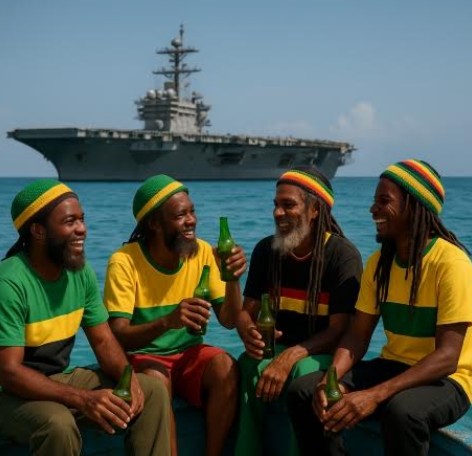 Instead, they are delivered to court systems that cannot use the evidence, because it is all classified military intelligence. It is a curious form of justice where the intelligence is secret, the cargo has sunk, and the defendants might just be fishermen with a side hustle.
In Ecuador, prosecutors are left with survivors but no proof. The drugs washed away, the boat either blown to smithereens or stashed in Davy Jones’ Locker, and the Americans will not share radar data or satellite images, saying it is all “operationally sensitive.”
So hometown judges in South America might get a few quill-written witness statements on tar-stained parchment, a machine-translated memo, and not much else. Small wonder that many of these cases tend to fade away into oblivion before they reach a verdict.
The Americans, for their part, tell two different stories. Sometimes it is a war, complete with “narcoterrorists” and precision strikes. But at other times it is law enforcement, with Coast Guard cutters politely escorting prisoners to port. When it suits them to bomb, it is war. When it suits them to extradite, it is crime control. Everyone pretends both versions are true at the same time.
Meanwhile, scaring off smugglers with pyrotechnics has its limits. The more boats they sink, the greater the risk of hitting the wrong one. It takes only a single mistake, a bona fide fishing crew mistaken for smugglers or a cruise missile whizzing somewhere near a cruise ship like Icon of the Seas to turn an under cover of night operation into an international panic.
The Caribbean may be vast, but one really large tragedy at sea could have Titanic implications.
Smugglers, of course, adapt faster than navies. They build new submersibles, recruit new “fishermen,” and plot new routes through the Lesser Antilles. Some may even send decoy vessels to test radar coverage. The tech keeps improving on both sides, yet the game remains the same. When enforcement gets clever, criminals evolve by natural selection.
The problem is not only the boats but the fuzzy lines drawn by the law. If it is truly a war, captured crew should be prisoners of war and treated as such. If it is law enforcement, they should be arrested, charged, given horrible food, and tried with proper evidence in a proper court. Right now, they seem to fall into a gray zone where no one quite knows what rules apply. That ambiguity helps everyone avoid responsibility, except the boat people who get sandwiched between a coral reef and a very hard place.
Ecuador and Colombia face the hardest task. They are now being asked to prosecute people based on information that cannot be shown in court. They are expected to demonstrate sovereignty while cooperating with a superpower that often acts without saying please. Each country has its own laws, but they don’t recognize “classified intelligence” as admissible in court.
The result is a very uneasy partnership. The U.S. claims the moral high ground, the local governments claim their sovereignty, and the drug trade continues to do whatever it is that it does. Every few days another headline appears: another interception, another sinking, dismembered remains, and maybe another handful of survivors in handcuffs.
What is really needed is a proper regional treaty, not another press release. A summit among the northern tier of South America, Central America, and the Caribbean could lay down real rules. It could decide who boards, who arrests, who prosecutes, and how evidence is shared. A Caribbean Maritime Security Compact would help prevent potential accidents, reduce political confusion, and give smaller nations in the region a genuine voice in their own waters.
Without it, the region remains stuck in a half-war that no one quite owns. The U.S. Navy can sink or blow boats out of the water, but cannot build court cases that way. Local prosecutors could build court cases but cannot access the proof.
Until the region finds a way to cooperate, the Caribbean will remain full of ghost ships, some crewed by fishermen, some by smugglers (or narcoterrorists as we must now call them), all sailing blindly through the same thick fog of unknowing. No one can really win in this war, but that doesn’t stop anyone from seeking guts and glory by taking aim at los piratas del Caribe.