














Please put it in writing
I can manage a conversation in Spanish reasonably well. I can talk to a shop assistant, explain a minor domestic crisis to the woman who cleans my apartment, order food, ask directions and occasionally understand the answer. Face-to-face, I have gestures, facial expressions and the opportunity to say “¿Mande?” until either the meaning becomes clear or one of us gives up.
“Mande” is one of those useful Ecuadorian words that seldom appears in beginners’ Spanish lessons. Literally, it means something like “command me,” but in everyday conversation it is a polite way of saying, “Pardon?” or “What did you say?” It sounds considerably better than barking “¿Qué?” at somebody, and I have had plenty of practice using it.
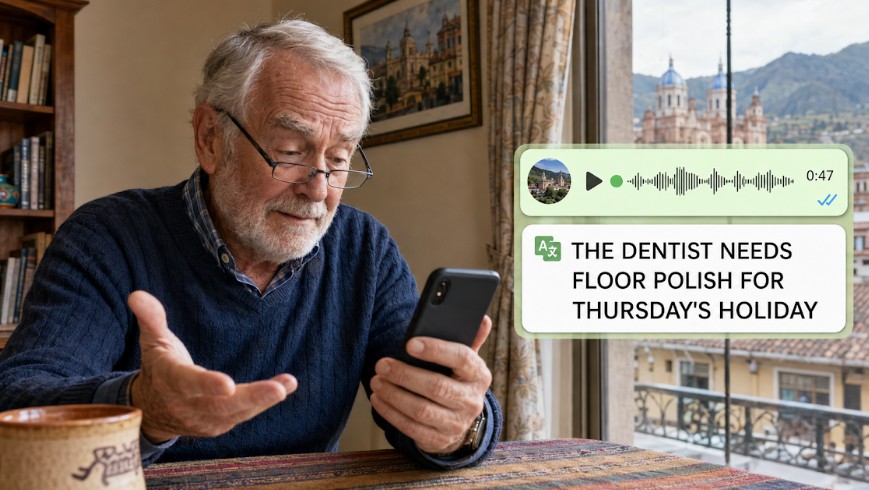 Then my phone emits a small chirp and life becomes more difficult, because someone has sent me a 47-second WhatsApp voice message.
Forty-seven seconds does not sound long. It is shorter than most TV commercials and not enough time to boil an egg. Yet a 47-second recording in rapid Ecuadorian Spanish can contain more uncertainty than the collected prophecies of Nostradamus.
The message begins with traffic noise and a dog barking. The speaker appears to be walking, short of breath, opening a door and addressing a child while simultaneously telling me that something may or may not happen on Thursday. There is a crucial word at 23 seconds which could mean detergent, documents or downstairs. I play it again, and then repeat a few more times and by the fourth hearing I have learned the rhythm of the message but not its meaning.
This is one of the peculiar frustrations of learning a language. A conversation conducted face-to-face is a joint undertaking. The person speaking can see whether you understand. If your expression suggests that you have just been asked to repair a helicopter, she can slow down, repeat herself or use different words. I can insert another “¿Mande?” at the appropriate moment.
A voice message offers none of this. The sender speaks at full speed, often without much preparation, and dispatches the result. All the work has been transferred to the recipient.
This is not solely a problem for foreigners. Native Spanish speakers also complain about long, rambling voice messages, just as English speakers do. The difference is that they are generally trying to discover the point. I am still trying to discover the verbs.
Voice messages are extremely convenient for the sender. Writing requires a moment’s thought. You must decide what you want to say, put it into some kind of order and perhaps read it before pressing Send. Recording requires only a thumb and a stream of consciousness.
“Hello, yes, I was just thinking, because María said, well, I don’t know whether she actually said it, but anyway, tomorrow, or perhaps Friday…”
The sender saves 30 seconds. The recipient may spend five minutes extracting the information that the appointment has moved to three o’clock.
This is one example of a wider technological tendency. Devices advertised as saving time often save the time of one person by consuming the time of another.
Self-checkout saves the supermarket from employing a cashier while requiring the customer to locate the barcode, identify the variety of tomato and wait for an employee to approve some entirely harmless purchase. Online forms save an organization from interviewing you while requiring you to enter information it already possesses. Automated telephone systems save companies from answering telephones while sending customers through a maze constructed by someone who has never needed help.
The WhatsApp voice message is the personal version of the same arrangement. The sender dictates and the recipient becomes the secretary.
WhatsApp has introduced voice-message transcription, which is a considerable improvement. I have installed it on my phone. In theory, I press a button and spoken Spanish appears as written Spanish.
In practice, the result sometimes resembles testimony taken by a court reporter during an earthquake.
Names are particularly vulnerable. So are Ecuadorian place names, local expressions and sentences recorded on buses. A reference to an upcoming Public Holiday (feriado) may emerge in transcription as Fairy Liquid. Nevertheless, even an imperfect transcript gives me something to work with.
I can copy the text and ask artificial intelligence to translate it, although copying is not always convenient. My usual method is to take a screenshot and give the image to ChatGPT. It reads the transcription, translates it and will often explain what the sender probably meant when WhatsApp has produced nonsense.
This sounds like an absurdly elaborate procedure for understanding a message that might have read:
“Please buy floor polish.”
The technological chain is impressive. One piece of artificial intelligence converts the voice into questionable Spanish. Another reads a photograph of that Spanish, corrects it and converts it into English. A satellite may have been involved somewhere. Vast computing resources have been mobilized because someone did not type six words.
It is possible to do this on a computer as well. A WhatsApp voice message can be downloaded from WhatsApp Web or Desktop and given to an AI service capable of accepting audio files, with a request to transcribe and translate it. The availability of that option depends on which version and service you use. In many cases, the phone transcription followed by a screenshot remains the least troublesome method.
When sending messages, I reverse the process. My preferred method is to dictate in English using Gboard inside WhatsApp and have it translate my words into written Spanish. This is very fast and gives me the correct spelling, accents and punctuation without requiring me to peck at a weird Spanish keyboard.
It does, however, require enough knowledge of Spanish to proofread the result before pressing Send. Translation software is remarkably capable, but you should still check that you have not accidentally sent an invitation to a sleepover to your dentist when you only wanted an appointment after breakfast.
This use of technology seems altogether more considerate. I do the work at my end so that the recipient receives a clear written message at the other. If I am arranging an appointment for Tuesday at ten, the other person can glance at the message later and confirm the details. Nobody has to listen repeatedly to a recording in search of the important five seconds.
There is, of course, an even simpler solution. which is that you can ask people to put important information in writing.
This needs to be done tactfully. Voice messages are normal in Ecuador and throughout much of Latin America. The person sending one is not being inconsiderate. She may find speaking faster, easier and more natural, particularly on a phone. Announcing that you refuse to listen to recordings would be both rude and impractical.
There is also the obvious issue that people may simply lack the literacy skills to put something in writing, though they will rarely want to tell you this.
I sometimes reply: “Entiendo mejor cuando está escrito.” I understand better when it is written.
That usually works and often a complicated recording is followed by a short message containing the address, time, price, or item required. The fog clears and you realise that the proposed service costs $12 and not the apparent $200 that had initially floored you.
I do not object to all voice messages, because they carry tone and personality in ways that written words cannot. A greeting from a friend sounds warmer when spoken, and some stories are better told than typed and if a food delivery tipo says “estoy afuera” that is good enough for me. But instructions, addresses, dates, shopping lists and changes of plan belong in writing.
The difference is simple. A voice message says, “Here are all the words that occurred to me while sitting on the bus.” A written message says, “Here is what you need to know.”