












Power disconnections extended to 72 hours for large companies as hydro plant water levels drop
Only a day after the Energy Ministry extended 24-hour electric disconnections for large energy consumers to 48 hours, it extended them again to 72 hours. “The low water at Mazar and Coca Codo Sinclair leaves us no option but to take these additional measures,” Energy Minister Juan Carlos Blum said Friday morning.
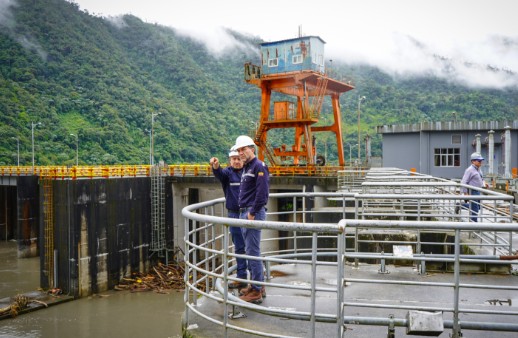
Energy Minister Juan Carlos Blum, right, visited the Coca Codo Sinclair hydroelectric plant Tuesday.
The ministry also announced Friday that 9,089 large and medium-sized companies will have their power disconnected for 48 consecutive hours next week.
Blum said he was optimistic that rainfall will increase the flow of the Rio Coca by the weekend, increasing power generation at the Coca Codo Sinclair hydro plant. “If this happens, we could increase production by 300 or 400 megawatts, alleviating pressure on Mazar,” he said. Rain was recorded Thursday and Friday at Coca Codo Sinclair and the Mazar complex but it was not enough to raise water levels.
According to the Energy Ministry, the continuous 48-hour blackouts will occur between Monday and Saturday next week, with businesses choosing the two days they will go without power. “The disconnections will be scheduled over the weekend so there will be no surprises for the customers affected,” the ministry said.
Following Friday’s announcements, business leaders questioned the fairness of the power cuts. “As the largest consumers of electricity, we accept the responsibility of helping the country through a difficult period,” said Xavier Andrade, Foreign Trade Director of the Guayaquil Chamber of Industries. “At the same time, we question a strategy that makes us the sacrificial lambs of this crisis. I suggest it is time that the burden be shared.”
Andrade also objected to the government plan to increase the price of electricity for corporate consumers. “Not only are we asked to disconnect from the grid for 72 hours a week, we now face a 185% price increase for kilowatt hours and will pay the highest rate in South America.”
Economic analyst and newsletter publisher Alberto Acosta Burneo also questioned the government’s strategy. “These actions attack the competitiveness and even the sustainability of Ecuadorian companies,” he says. “Is it fair that they bear the full impact of an energy crisis that may well have been avoided with better planning?”
In a Quito radio interview Friday, former newspaper columnist Oswaldo Ramos claimed that politics is a driving force behind power cuts to business and industrial customers. “We have elections in two months and the government has a very strong interest in shielding voters from blackouts,” he said. “After all, the ruling party is running candidates in prefecture and cantonal races and if we have a repeat of the 2024 blackouts you know who the voters will blame — the government.”