














Quito and Guayaquil experience blackouts as Coca Coda Sinclair hydro plant undergoes repairs
Electric service in large areas of Quito and Guayaquil was suspended Sunday and Monday, with blackouts lasting from a few minutes to more than two hours. The suspensions coincided with cleaning operations at the Coca Coda Sinclair hydroelectric plant, during which power generation stopped.
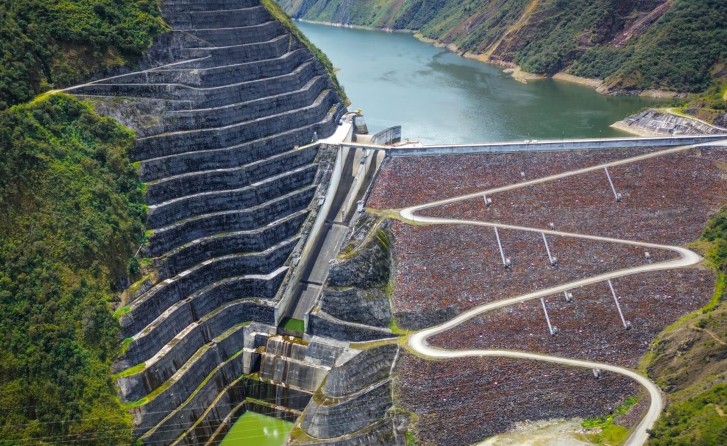
The water level at the Mazar reservoir has dropped 13 meters since mid-August.
Although officials from the Quito Electric Company reported that suspensions were required for local repairs, energy experts say they were the result of insufficient reserves. “These events are an early warning of what we face in the coming months,” said electrical engineer Alejandro Jaya. “The national power system operates without reserves and when we have a generation stoppage at major facilities like Coca Coda, we are forced to end service to some customers.
Jaya, a former director of the National Electricity Corporation (CNEL), said the deficit of 1.2 to 1.3 megawatts in the power system has not been reduced since the 2024 blackouts. “We knew we needed additional generation capacity, but the new projects that were announced have not moved forward,” he said. “Since the production of the entire system is 5.2 megawatts, the deficit is massive.”
He added that the claim by Quito Electric that the blackouts were part of routine maintenance was not true. “Customers are always notified in advance when maintenance is scheduled and there was no notice in either Quito or Guayaquil when the lights went out.”
Energy consultant Fernando Salinas expects the country’s power problems to get worse before they get better. “Without significant rain, we are two months, maybe less, away from generalized blackouts,” he said. “The level at Mazar is dropping and with the reduction of electricity transfers from Colombia there is trouble ahead.”
The water level at the Mazar reservoir, which powers three hydro plants in eastern Azuay Province, has dropped 13 meters in less than a month. On Tuesday morning, the level stood at 2,140.2 meters above sea level while it was at the maximum level of 2,153.5 meters on August 13.
At maximum capacity, the Mazar complex and Coca Coda Sinclar provide 70% of the country’s electricity, says Salinas. “The problem is they almost never work at this level and now, with the sedimentation problem at Coca Coda and low water at Mazar, they are lucky to generate 50%,” he said.
Salinas complains that CNEL and the Energy Ministry are “looking the other way” as the country faces a new energy crisis. “They are acting as if we are in a normal weather cycle and that the dry season will end on schedule,” he says. “But we have an El Niño coming in and this will extend the drought in the highlands by two or three months. We must consider the possibility of Mazar going out of service entirely.”
Jaya says he doesn’t have a “crystal ball,” but admits the outlook is troubling. “We are entering a difficult period with the electricity situation and it is important that the authorities at local and national levels be honest with the people.”



Hogar Esperanza News

Fabianos Pizzeria News

Property Manabi

The Cuenca Dispatch

Week of September 06

U.S. sinkings of Ecuadorian fishing vessels trigger court scrutiny after 28 crew members are released.

Cuenca targets a November launch for its first new international link to Chiclayo.

Exports hit a quarterly record, but Ecuador’s import bill is rising even faster.
Fund Grace News
