














Resurrecting the lost giants of the Galápagos may be the key to restoring the islands’ delicate ecosystem
By Hannah Nordhaus
In October 1820, the Nantucket whaling ship Essex laid anchor at a blue-green harbor on the Galápagos island of Floreana, more than 600 miles off the coast of Ecuador. The sailors rowed their whaleboats ashore and followed paths trampled by ancient reptiles, through broken basalt and tangled thickets of saltbush and cactus — “keeping a sharp look out,” wrote cabin boy Thomas Nickerson, “for the object of their search.”
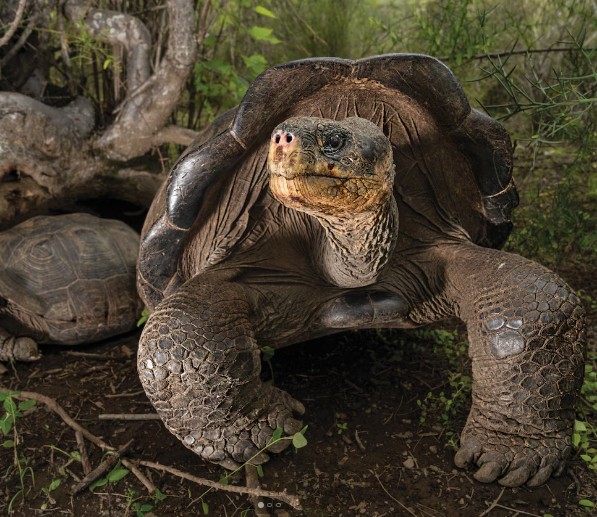
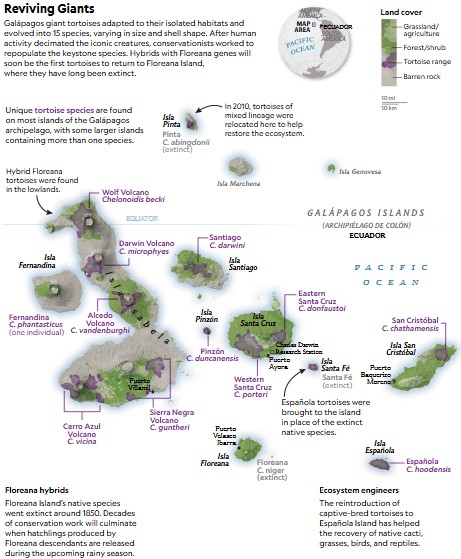
A few decades ago, scientists visiting Wolf Volcano encountered tortoises with long necks and curved shells, shown here. The animals appeared unlike those that were native to the area, a realization that sent the team on a quest to determine where they came from.
They were hunting for Galápagos giant tortoises. The animals varied from island to island — some had round, domed carapaces while others had shells that curved up at the front like Spanish riding saddles — but all could provide food for multiple sailors. When the whalers found a small “turpin,” they’d flip it over, tie canvas straps to each of the creature’s legs, then hoist the tortoise onto their backs like a knapsack. They’d tie the largest ones, some weighing more than 500 pounds, by their legs to long poles, hauling them two or three men per side across sharp and uneven lava rock and back to their ship.
There, they’d stack their captives upside down in the hold like nesting bowls. Tortoises could live up to a year without sustenance. “They neither eat nor drink, nor is the least pains taken with them,” wrote Owen Chase, the ship’s first mate. “They are strewed over the deck, thrown under foot, or packed away in the hold, as it suits convenience.” The Essex took more than 60 of Floreana’s tortoises, which had the curved shells known as saddlebacks and were, Nickerson wrote, “the most rich flavourd and delicious meat I have ever met with.” Then the ship set off for the Pacific whaling grounds, where, a month later, it was rammed by a whale, a disaster that provided the inspiration for Herman Melville’s Moby-Dick. The sailors salvaged as many tortoises from the foundering ship as they could fit on their small whaleboats, eating them — and eventually, each other — on their ill-fated voyage back to the South American mainland. The other tortoises sank with the ship or floated away.
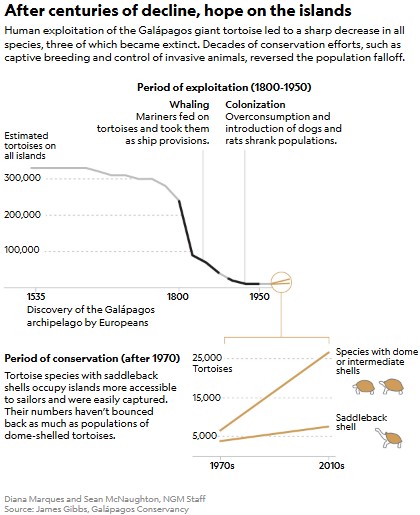
The Essex was far from alone in its plundering of Galápagos tortoises. When Charles Darwin arrived at Floreana in 1835 on the journey that would spark his theory of evolution, he heard of whaling vessels taking as many as 700 tortoises on one visit. “Their numbers have of course been greatly reduced in this island,” he wrote. Historians estimate that between 1774 and 1860, passing ships took some 100,000 of the nearly 300,000 tortoises that lived on the islands when the Spanish arrived in 1535, driving populations of all 15 Galápagos tortoise species into steep decline and three to extinction. The Floreana tortoise, last seen in the 1850s, was the first to disappear.
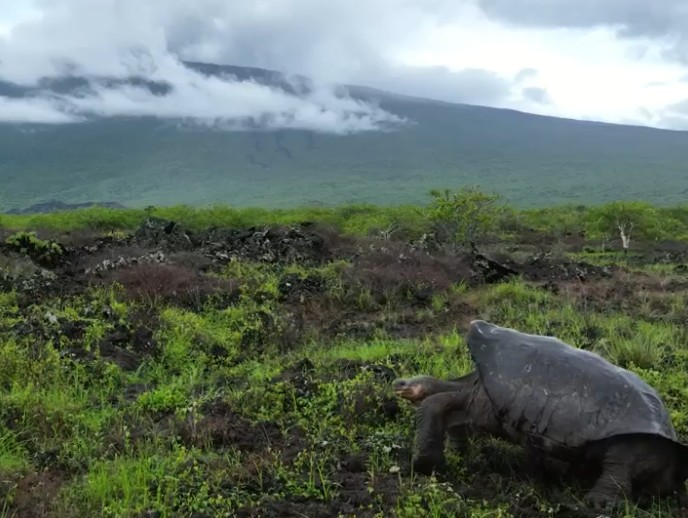
A hybrid Floreana tortoise walks in the foothills of Wolf Volcano on Isabela Island.
Almost two centuries later, though, the Floreana tortoise is set to become the first extinct Galápagos species to be returned to its ancestral home. The revival of these gigantic creatures arrives at a moment when the “resurrection” of dire wolves is making headlines and scientists are working to retrieve the genes of other long-gone creatures like woolly mammoths. But such prehistoric species would return to a world that has lived without them for millennia. The descendants of the Floreana tortoises, by contrast, will be reintroduced to the place where they once belonged, playing a critical role in an ecosystem that still desperately needs them. To accomplish that, a team of dedicated scientists has not only pushed the frontiers of genetic sequencing to identify a species that had been hidden from plain view, but also traveled to remote corners of the archipelago and sorted through bones and shells from dusty archives to right one of the great wrongs of Galápagos history.
This improbable scientific journey began in 2000. As a team of conservation scientists traipsed through the densely vegetated gullies at the base of the secluded Wolf Volcano on the northwest island of Isabela, they confirmed earlier observations that some of the tortoises there looked different. The animals had saddleback shells, a sign that they were a separate species from the more familiar domed ones on the volcano’s higher, wetter slopes. “There were pockets of tortoises that looked out of place,” remembers conservation biologist James Gibbs, a National Geographic Explorer and leader of the Galápagos Conservancy, which works to protect and restore the archipelago’s wild ecosystems.
To learn more, Gibbs and the team took blood samples “from every unusual-looking tortoise” they encountered, placing identification tags on as many as they could, and sent the specimens to their research partner Adalgisa “Gisella” Caccone, an evolutionary biologist at Yale University and a National Geographic Explorer. When she analyzed their DNA, she couldn’t identify their genetic sequences. They didn’t match those of any living tortoise species in her genetic database. Caccone was bewildered. “I called them ‘aliens,’ ” she says. “We didn’t know where they came from.”
 The researchers considered the possibility that some of those aliens could have floated ashore from whaling ships like the Essex. Banks Bay, on the volcano’s western flank, was the final Galápagos anchorage for many ships on their way to the whaling grounds, and sailors were known to sometimes throw their surplus overboard before setting sail. Some of those unwanted animals may have floated to shore and ascended the volcano’s ragged flank, living among the native tortoises and eventually breeding with them.
The whalers were responsible for the loss of so many tortoises — killing and eating most and carrying a number back home as trophies or pets. But perhaps, the scientists speculated, they had also inadvertently ensured the survival of the animals’ genes. Only after several advances in genetic sequencing technology would the group realize the sailors had provided important clues to revive a species.
Scientists have been working to save the giant tortoises of the Galápagos since the middle of the 20th century, when only a few thousand were left on the entire archipelago. The whalers were gone, but tortoises had continued to fall prey to the creatures they brought with them — rats, pigs, dogs, and ants that fed on eggs and hatchlings, and goats and donkeys that disrupted and devoured their food supply. Galápagos National Park officials knew they had to do something or risk losing entire species. Beginning in the 1960s, conservation teams used the limited tools then available to save them.
They started on Española Island, east of Floreana, where the population had been reduced to 14 individuals. Between 1964 and 1974, park officials moved all the tortoises from the island to the Charles Darwin Research Station at the park’s headquarters on Santa Cruz Island. With the help of a strapping male brought in from the San Diego Zoo that, according to records, had come from Española in the 1930s, they bred thousands of young. After a laborious campaign to eradicate goats from the island, they then reintroduced the hatchlings, and today more than 3,000 tortoises live there.
Park teams replicated that success on other islands as well. But despite those triumphs, there was one glaring disappointment: not finding a mate for the very last tortoise on Pinta Island, north of Floreana. Scientists had rescued the animal they named Lonesome George from his native island in the early 1970s, transporting him to a corral at the park’s research station in hopes of preventing a fourth species from going extinct. In the years that followed, they anxiously searched for a partner. They first scoured Pinta with no luck. Then they placed females of other species with saddleback shells that resembled those of the Pinta in George’s corral at the research center. When he showed no interest in breeding, they tried artificial insemination; the females did, finally, nest in George’s corral, but the eggs were all infertile. By the early 2000s, the conservation icon was close to 100 years old, and time was running out for the species.
 At the same time, developments in genome sequencing were allowing Caccone to expand her tool kit to identify the Wolf Volcano aliens. In 2006, she used a new method of DNA analysis to retest the samples. She made the astonishing discovery that the scientists had collected blood from a tortoise whose genes appeared to be 50 percent Pinta. Perhaps it wasn’t too late for Lonesome George, and they could find Pinta relatives on the island and save the species. Thrilled, she proposed that the park send another expedition to the volcano. “We said, We have to go back there. We need to find this animal. If there is one, there could be many more.”
Still trying to pinpoint the other strange Wolf Volcano genes, she also began to look more closely at the three species then believed to have gone extinct: the Santa Fe tortoise, the Fernandina tortoise, and the Floreana tortoise. Without the DNA of live animals to compare to the alien genes, the only cells available for sequencing were from old specimens carried across the ocean by whalers or scientific collectors. “We went around to museums to collect samples of bone and skin,” Caccone says. At the American Museum of Natural History, they found bones a New York naturalist had unearthed in 1928 from lava caverns on Floreana, deep chasms where some tortoises had tumbled and died; at Harvard University’s Museum of Comparative Zoology, they found bones and shells collected in 1834 and 1872. “They were very porous,” she says, “gray-looking,” crumbly, and desiccated.
Even so, she managed to scrape enough genetic material to obtain sequences of their DNA. And “Boom!” she says. The alien tortoises “were in the same clade”—ancestral grouping—“with Floreana.” The saddlebacks were hybrids of the native Wolf Volcano domed species mixed with the long-extinct Floreana saddleback species. The scientists’ speculations had been correct. The whalers’ castaway tortoises had survived and interbred.
In 2008, a large expedition returned to Wolf Volcano to collect more samples so the team could get a better idea of how many Floreana and Pinta tortoises were on the island and search for possible mates for George. Teams from the park and the Galápagos Conservancy set up camps around Wolf Volcano and collected blood samples from 1,667 tortoises, placing identification tags on each one. In her Yale lab, Caccone analyzed those samples against her expanded database and found 17 tortoises with Pinta genes—and 84 with Floreana ancestry.
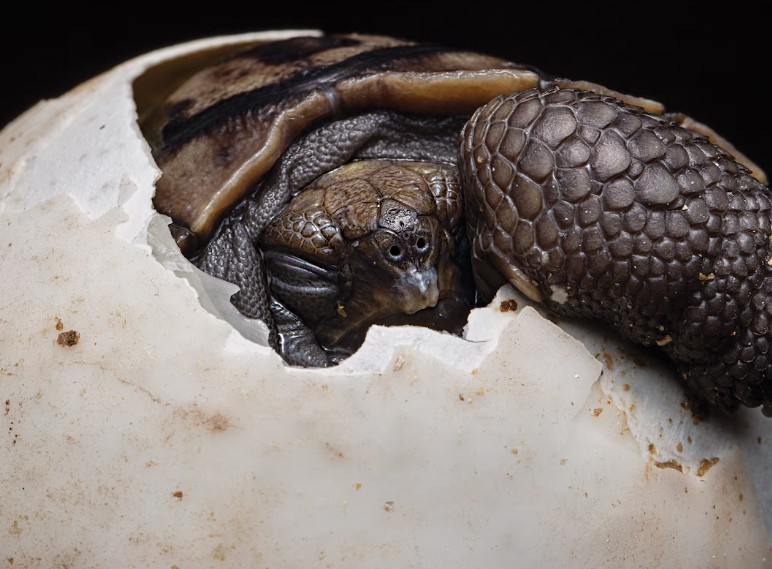
At the Santa Cruz breeding center, tortoises like this one are being bred for reintroduction on Floreana Island, where they went extinct years ago. Today about 300 of these so-called Floreana hybrids are ready to be released, after a long campaign to clear the island of non-native rats and feral cats.
Still hoping to find more Pintas, the park team embarked on the lengthy process of planning, permitting, and funding another expedition to the volcano with a helicopter and nets to allow them to retrieve those hybrids. But in June 2012, Lonesome George’s keeper found him dead in his corral. End of his line, end of his species. (Later, a necropsy would reveal George had an anatomical problem with his sperm duct and was probably incapable of reproducing.)
As scientists relinquished the idea of saving the Pinta species, they focused on the Floreana hybrids. “People had given up hope so long ago” for the species, explains Gibbs, that it took some time for the researchers to understand the opportunity that these numerous living relics presented. But when they did, they realized, “Wow, this is actually as significant” as finding Pinta tortoises on Wolf Volcano, says Gibbs. It was then that the conservation team began to consider a radical proposal: capturing and breeding the descendants of the species and repopulating Floreana, where the animals hadn’t lived for more than 150 years.
Returning tortoises to Floreana wasn’t important solely because scientists had found a lost species; it was also ecologically critical. Here in the Galápagos, Darwin had observed that species were exquisitely adapted to their habitat. Only recently have ecologists begun to realize how exquisitely adapted habitats are to the creatures that live there.
When the last tortoise disappeared from Floreana, the island’s species suffered. Important native plants began to die off, while populations of invasive pests, plants, and livestock exploded, eating or outcompeting native plants and animals. By the end of the 19th century, the island’s mockingbirds, racer snakes, rails, and hawks had disappeared. In the years that followed, finches, barn owls, lava gulls, and vermilion flycatchers went missing too.

On Santa Fe Island, where native tortoises are extinct, park rangers have released a similar species that they bred in captivity and then flew to the island via helicopter.
Park officials hope to mend the hole in the ecosystem the lost tortoises had left behind. “Without giant herbivores, the balance of an island ecosystem can collapse,” says Washington “Wacho” Tapia, a biologist who has worked in Galápagos conservation since the 1990s. Tortoises are “ecosystem engineers,” shaping vegetation as they move like bulldozers across the landscape. “They flatten the ground and open the land for small reptiles, ground-nesting seabirds, and native plants,” says Tapia, keeping weeds at bay, helping native cacti regenerate, spreading seeds with their dung, and creating ponds and wallows that also harbor other species.
Researchers knew that the animals had helped restore ecological balance on other islands. On Española, for example, scientists observed native grasses and cacti recovering, along with the lava lizards and albatross that had declined in the tortoises’ absence. Where the giant reptiles have returned, ecosystems have flourished. “This is a bit of a change of mind in restoration,” notes Arturo Izurieta Valery, who until recently was the park’s director. Today conservation teams bring back missing animals with a focus on “an extended ecosystem restoration.”
________________
Credit: National Geographic